

eLive Premium Auction 434
·
Lot 8043
eLive Premium Auction 434
·
Lot 8043
eLive Premium Auction 434
·
Lot 8043
17 Nov 2025
1:00 pm
GRIECHISCHE MÜNZEN
·
THRACIA
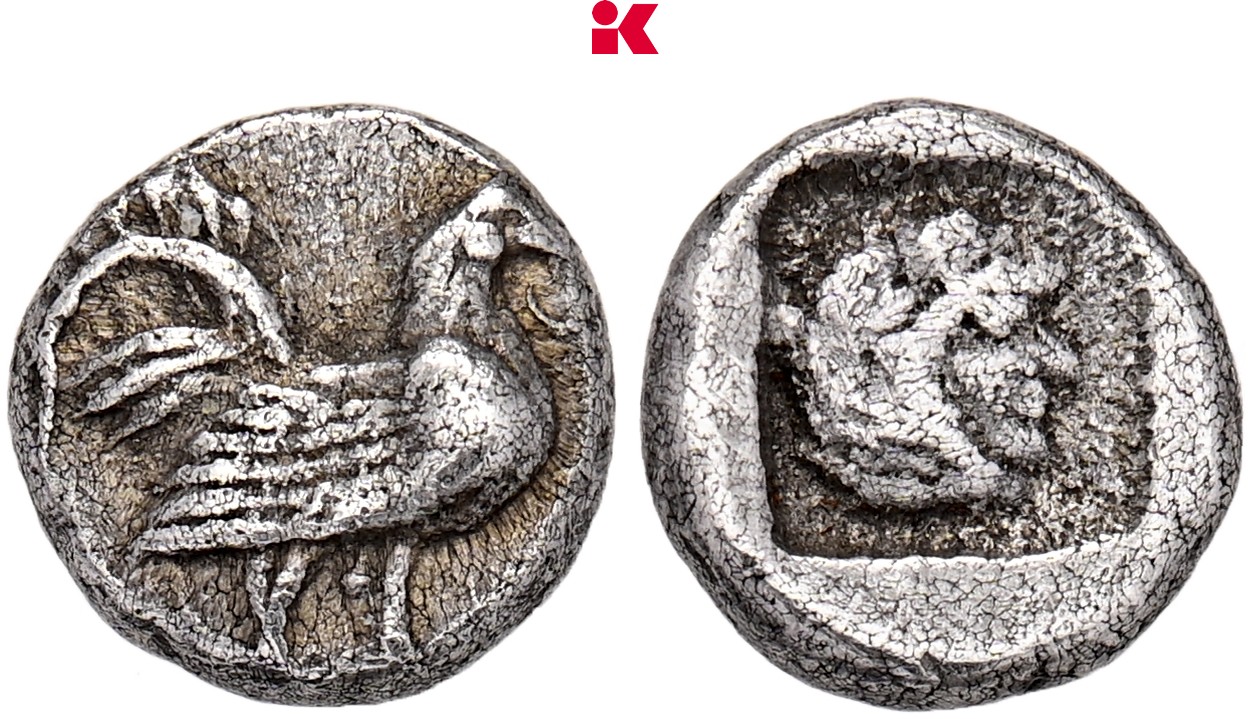
DIKAIA. AR-Trihemiobol, 492/475 v. Chr.;
Sold
17 Nov 2025
1:00 pm
GRIECHISCHE MÜNZEN
·
THRACIA
DIKAIA. AR-Trihemiobol, 492/475 v. Chr.;
Estimated price : €60
Hammer price
€155
My notes
Description
DIKAIA. Õ-Trihemiobol, 492/475 v. Chr.; 1,08 g Hahn steht r.//In Incusum: Herakleskopf im Löwenfell r. May, The Coinage of Dikaia-by-Abdera 37; Corpus Nummorum Online cn type 2034; Hoover 1453.
Min. korrodiert, sehr schön/fast sehr schön
Dikaia muss von der gleichnamigen, von Eretria gegründeten Siedlung am Thermäischen Golf unterschieden werden. So wundert es nicht, dass die thrakische Stadt in den Quellen mit dem Zusatz παρ́’ Ἄβδερα auftritt.
Die Aversdarstellung dieser Münze führte in der Vergangenheit zur fehlerhaften Zuweisung des Stücks nach Selymbria. Dort treten auf Drachmen (und Kleinsilbermünzen) des 5. Jahrhunderts v. Chr. ebenfalls Hähne auf den Vorderseiten auf, die dem hiesigen Stück nicht unähnlich sind. Eine Emission dikaischer Obole, auf denen dem Hahn die Legende ΔΙΚΑΙ (bspw. cn type 274) beigefügt ist, klärt den Irrtum jedoch auf. Gleichzeitig ist die These, die bspw. noch der BMC (Nr. 2 ff.) vertreten hatte, bei den Stücken mit Legende handle es sich um Münzen aus Dikaia, während jene Exemplare ohne Legende nach Selymbria zu verorten sind, abzulehnen. Münzen, die stilistisch derart verwandt sind, unterschiedlichen poleis zuzuordnen, ergäbe keinen Sinn. Siehe hierzu May, J. M. F., The Coinage of Dikaia-by-Abdera c. 540/35-476/5 B.C., NC 5, 1965, S. 1-25.
Die Reversdarstellung der Münze könnte einen Hinweis auf den Gründungsmythos der Stadt geben. Stephanos Byzantinos erwähnt einen Dikaios, den Sohn des Poseidon, als Gründer der Stadt Dikaia. Dikaios seinerseits ist mythologisch mit Herakles verbunden. In verschiedenen Versionen greifen Euripides, Apollodorus, Diodorus, Speusippos und Konon die Geschichte der beiden Brüder Dikaios und Syleus auf. Syleus sei dabei ein Unhold, der von Herakles bezwungen werden konnte. Im Anschluss, so Speusippos, habe der gerechte Bruder Dikaios vom Heros die Landschaft Phyllis zur Verwaltung erhalten. Siehe hierzu RE IV A,1 (1970) 1039-1040 s. v. Syleus (Gustav Türk).
Dikaia must be distinguished from the settlement of the same name that was founded by Eretria on the Thermaic Gulf. It is therefore not surprising that the Thracian city appears in historical sources with the addition παρ́’ Ἄβδερα. In the past, the obverse depiction of this coin led to it being incorrectly attributed to Selymbria. Drachms (and small silver coins) from there minted in the 5th century BC also feature roosters on their obverses, which are not dissimilar to the one depicted on this coin. However, an emission of obols from Dikaia bearing the legend ΔΙΚΑΙ (e.g. cn type 274) near the rooster clarify this error. We also oppose the theory proposed by BMC (No. 2 ff.) that coins bearing legends are from Dikaia and those without from Selymbria. It would be illogical to attribute coins that are so similar in terms of style to different poleis. Cf. May, J. M. F., The Coinage of Dikaia-by-Abdera c. 540/35-476/5 B.C., NC 5, 1965, pp. 1-25.
The reverse of the coin could refer to the city’s founding myth. Stephanos Byzantinos mentions a man called Dikaios, who was the son of Poseidon, as the founder of Dikaia. Dikaios, in turn, is mythologically linked to Heracles. Euripides, Apollodorus, Diodorus, Speusippos and Konon all recount different versions of the tale of the two brothers Dikaios and Syleus. They describe Syleus as a fiend who was defeated by Heracles. According to Speusippos, Dikaios subsequently received the territory of Phyllis from the hero for administration. Cf. RE IV A,1 (1970) 1039-1040 s.v. Syleus (Gustav Türk).
Min. korrodiert, sehr schön/fast sehr schön
Dikaia muss von der gleichnamigen, von Eretria gegründeten Siedlung am Thermäischen Golf unterschieden werden. So wundert es nicht, dass die thrakische Stadt in den Quellen mit dem Zusatz παρ́’ Ἄβδερα auftritt.
Die Aversdarstellung dieser Münze führte in der Vergangenheit zur fehlerhaften Zuweisung des Stücks nach Selymbria. Dort treten auf Drachmen (und Kleinsilbermünzen) des 5. Jahrhunderts v. Chr. ebenfalls Hähne auf den Vorderseiten auf, die dem hiesigen Stück nicht unähnlich sind. Eine Emission dikaischer Obole, auf denen dem Hahn die Legende ΔΙΚΑΙ (bspw. cn type 274) beigefügt ist, klärt den Irrtum jedoch auf. Gleichzeitig ist die These, die bspw. noch der BMC (Nr. 2 ff.) vertreten hatte, bei den Stücken mit Legende handle es sich um Münzen aus Dikaia, während jene Exemplare ohne Legende nach Selymbria zu verorten sind, abzulehnen. Münzen, die stilistisch derart verwandt sind, unterschiedlichen poleis zuzuordnen, ergäbe keinen Sinn. Siehe hierzu May, J. M. F., The Coinage of Dikaia-by-Abdera c. 540/35-476/5 B.C., NC 5, 1965, S. 1-25.
Die Reversdarstellung der Münze könnte einen Hinweis auf den Gründungsmythos der Stadt geben. Stephanos Byzantinos erwähnt einen Dikaios, den Sohn des Poseidon, als Gründer der Stadt Dikaia. Dikaios seinerseits ist mythologisch mit Herakles verbunden. In verschiedenen Versionen greifen Euripides, Apollodorus, Diodorus, Speusippos und Konon die Geschichte der beiden Brüder Dikaios und Syleus auf. Syleus sei dabei ein Unhold, der von Herakles bezwungen werden konnte. Im Anschluss, so Speusippos, habe der gerechte Bruder Dikaios vom Heros die Landschaft Phyllis zur Verwaltung erhalten. Siehe hierzu RE IV A,1 (1970) 1039-1040 s. v. Syleus (Gustav Türk).
Dikaia must be distinguished from the settlement of the same name that was founded by Eretria on the Thermaic Gulf. It is therefore not surprising that the Thracian city appears in historical sources with the addition παρ́’ Ἄβδερα. In the past, the obverse depiction of this coin led to it being incorrectly attributed to Selymbria. Drachms (and small silver coins) from there minted in the 5th century BC also feature roosters on their obverses, which are not dissimilar to the one depicted on this coin. However, an emission of obols from Dikaia bearing the legend ΔΙΚΑΙ (e.g. cn type 274) near the rooster clarify this error. We also oppose the theory proposed by BMC (No. 2 ff.) that coins bearing legends are from Dikaia and those without from Selymbria. It would be illogical to attribute coins that are so similar in terms of style to different poleis. Cf. May, J. M. F., The Coinage of Dikaia-by-Abdera c. 540/35-476/5 B.C., NC 5, 1965, pp. 1-25.
The reverse of the coin could refer to the city’s founding myth. Stephanos Byzantinos mentions a man called Dikaios, who was the son of Poseidon, as the founder of Dikaia. Dikaios, in turn, is mythologically linked to Heracles. Euripides, Apollodorus, Diodorus, Speusippos and Konon all recount different versions of the tale of the two brothers Dikaios and Syleus. They describe Syleus as a fiend who was defeated by Heracles. According to Speusippos, Dikaios subsequently received the territory of Phyllis from the hero for administration. Cf. RE IV A,1 (1970) 1039-1040 s.v. Syleus (Gustav Türk).
Show more'
Show less
Information for lot 8043 from eLive Premium Auction 434
| Nominal/Year | AR-Trihemiobol, 492/475 v. Chr.; |
|---|---|
| Weight | 1,08 g |
| Quotes | May, The Coinage of Dikaia-by-Abdera 37; Corpus Nummorum Online cn type 2034; Hoover 1453 |