

When the knighthood of the Province of Brandenburg travelled to Berlin on the occasion of the act of homage in 1840, they were offered a particularly special form of entertainment. In twelve tableaux vivants, the entire history of Prussia was presented before them. The reason this merits mention here: three of the twelve scenes were dedicated to Frederick II, while the other royal ancestors were allotted only a single scene each. After more than fifty years, the Hohenzollerns were thus once again invoking an era of military strength and cultural prestige. Frederick II became the model for their own political aspirations.
A Monument to "Old Fritz"
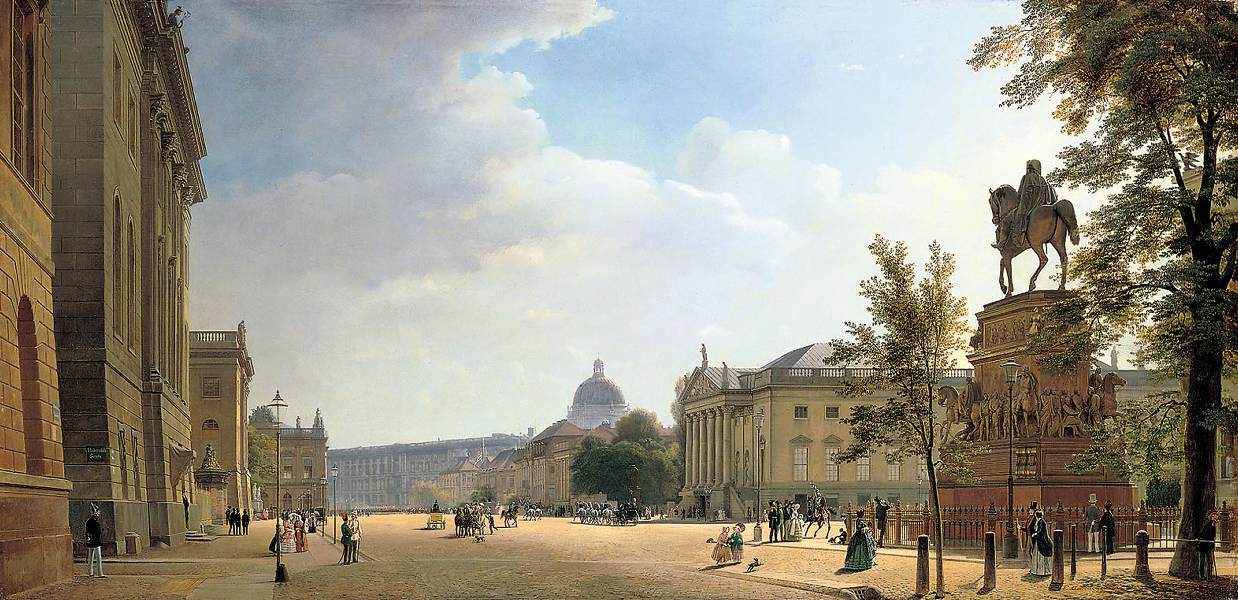
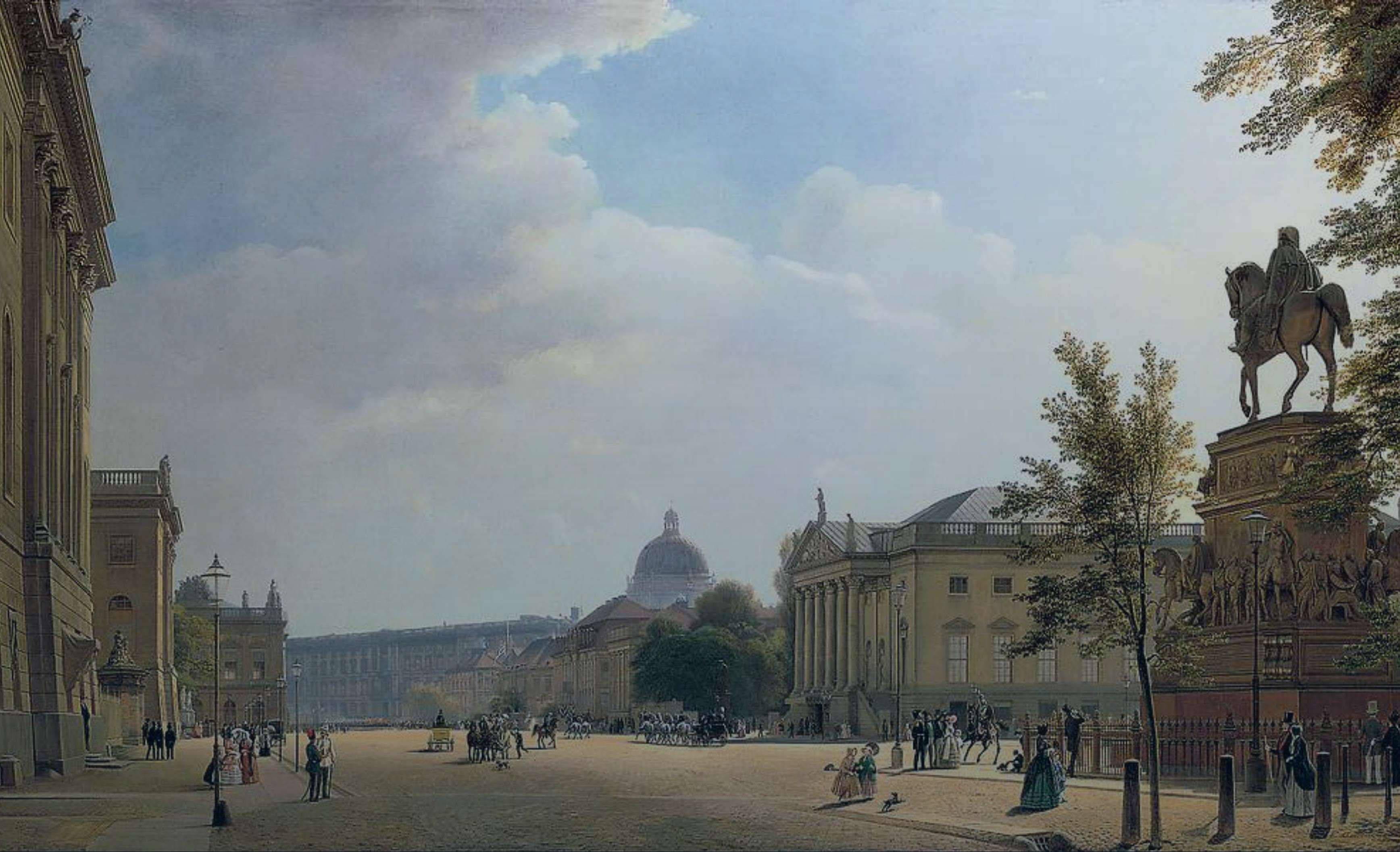
In this context, the long-delayed monument project for Frederick II held a special significance. It was not until 1836 that Frederick William III gave the final commission for the monument's realisation. The commission went to one of the most important sculptors of his time, Christian Daniel Rauch. He produced a design for an equestrian statue in a realistic manner, depicting Frederick in uniform on his favourite horse Condé. The cost of 200,000 thalers was borne by the state treasury. A public fundraising campaign was rejected. With a symbol of such central importance, the royal house wished to retain control.
Picture caption: Eduard Gaertner: The Street Unter den Linden, painting 1852.
The Foundation Stone
On 31 May 1840 — marking the centenary of Frederick II's accession to the throne on 31 May 1740 — Crown Prince Frederick William laid the foundation stone. His father the king, severely weakened by a persistent bout of influenza, was only able to attend the ceremony from the window of his study. Just one week later he died. No official medal was commissioned for this occasion. The medals sold in commemoration of the event were produced by the Berlin medal mint of the entrepreneur and mint master Gottfried Loos (Lot 165). The reverse shows an image closely resembling the later monument, since the model on which Rauch was working was already widely known.
The Casting in the Former Mint Building
The casting of the statue took place close to midnight on 11 July 1846, carried out by the bronze founder Friebel, who would go on to create many further bronze statues and bring the "Berliner Kunstgießerei" to great renown. On account of the statue's size, a new hall was specially erected for the casting. It stood on the grounds of the old mint at Münzstraße 10. The former mint building was also made use of. Since many further figures were required for the plinth, Fries did not complete the complex work of art until the end of 1849.
The Unveiling of the Statue at the Grand Frederick Festival on 31 May 1851
The aftermath of the 1848 revolution delayed the unveiling and completion of the statue. At last the day arrived: with a ceremony planned down to the smallest detail — the so-called "Frederick Festival" — the monument was inaugurated on 31 May 1851.
The military was the central target audience, while the press complained that the people of Berlin were denied access to the event. In order to establish a continuity with the campaigns of Frederick II, eighty surviving veterans of his army had been tracked down and invited as guests of honour.
At eleven o'clock — as a festival chronicle records — "His Royal Highness the Prince of Prussia comes galloping up, tall and stately as the god of war himself." This refers to William, who awaits his royal brother in the midst of the assembled army. The king made his entrance last, to the strains of Frederick the Great's march, followed by a distinguished gathering of guests from the princely houses allied with Prussia. Although no reigning sovereigns attended, many sent their crown princes. To the salute of the 30,000 soldiers present, Frederick William IV had the statue unveiled. The ceremony concluded with the chorale "Now Thank We All Our God."
The Medal
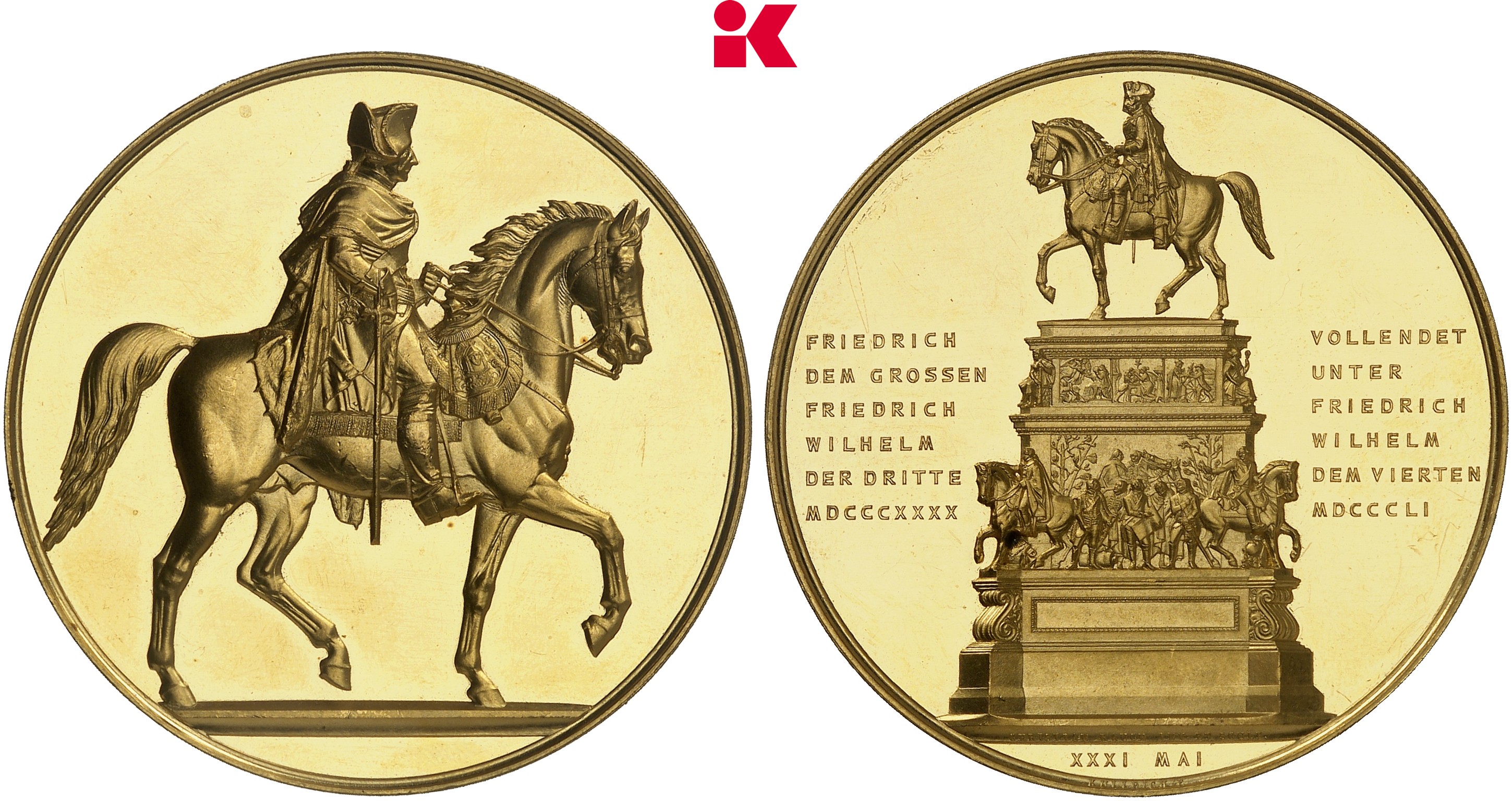
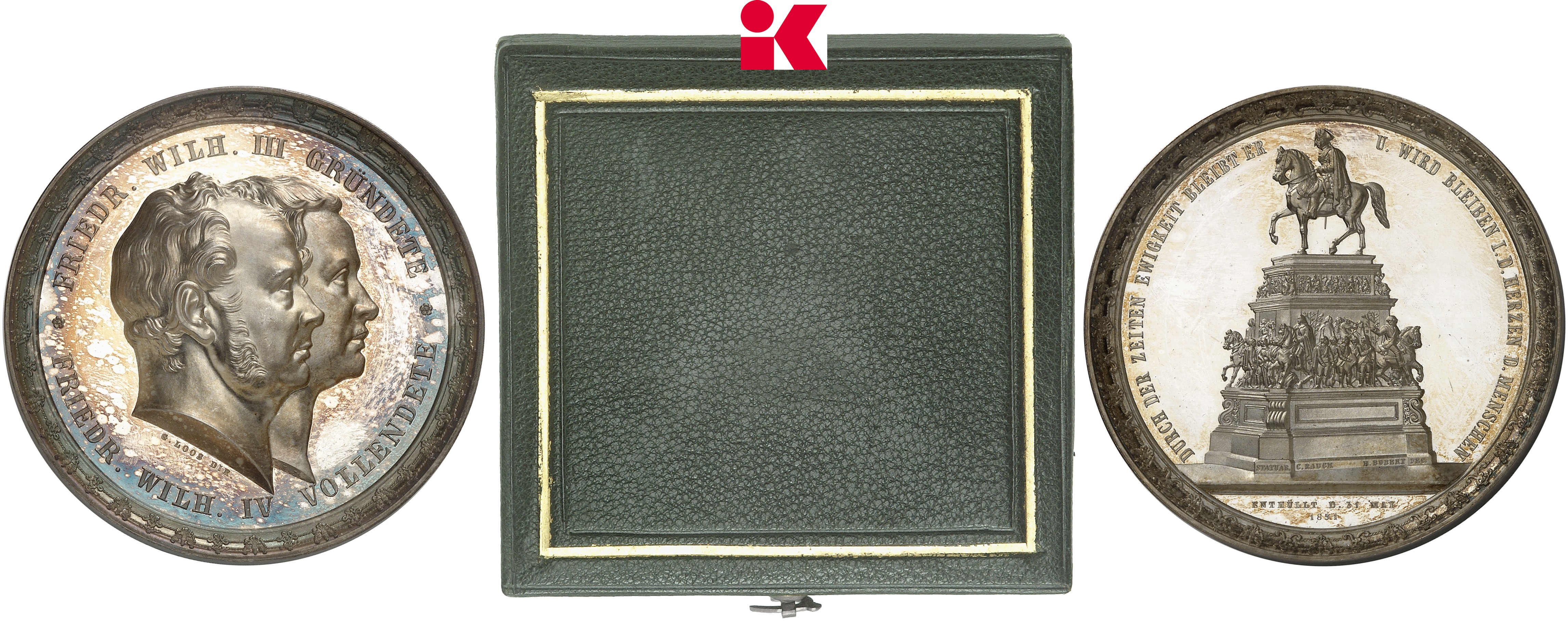
This time Frederick William IV had commissioned a medal for the occasion. The first to receive it was the sculptor himself, as a festival chronicle records: "The medal, examples of which in gold, silver, and bronze His Majesty the King handed to Master Rauch at the monument itself, was engraved by Kullrich and shows on the obverse the bust of Frederick the Great, and on the reverse the complete equestrian statue."
In describing the pieces, the author fell into an error, most probably because he was not able to see the medals produced by royal commission. He may have been thinking of the pieces made by the private Berlin medal mint of Loos, which however also did not show King Frederick on horseback but instead the portraits of Frederick William III and Frederick William IV (Lot 165). These privately produced medals cost — according to the author at least — the truly considerable sum of 50 thalers in gold; in silver a collector could obtain one for 2½ thalers, and in bronze for a single thaler. He may also have been inaccurately informed on this point, for an accompanying insert in an original case gives the selling price as 40 Friedrichs d'or in gold, 12 thalers in silver, and two thalers in bronze.
Inspiring the Cult of Frederick
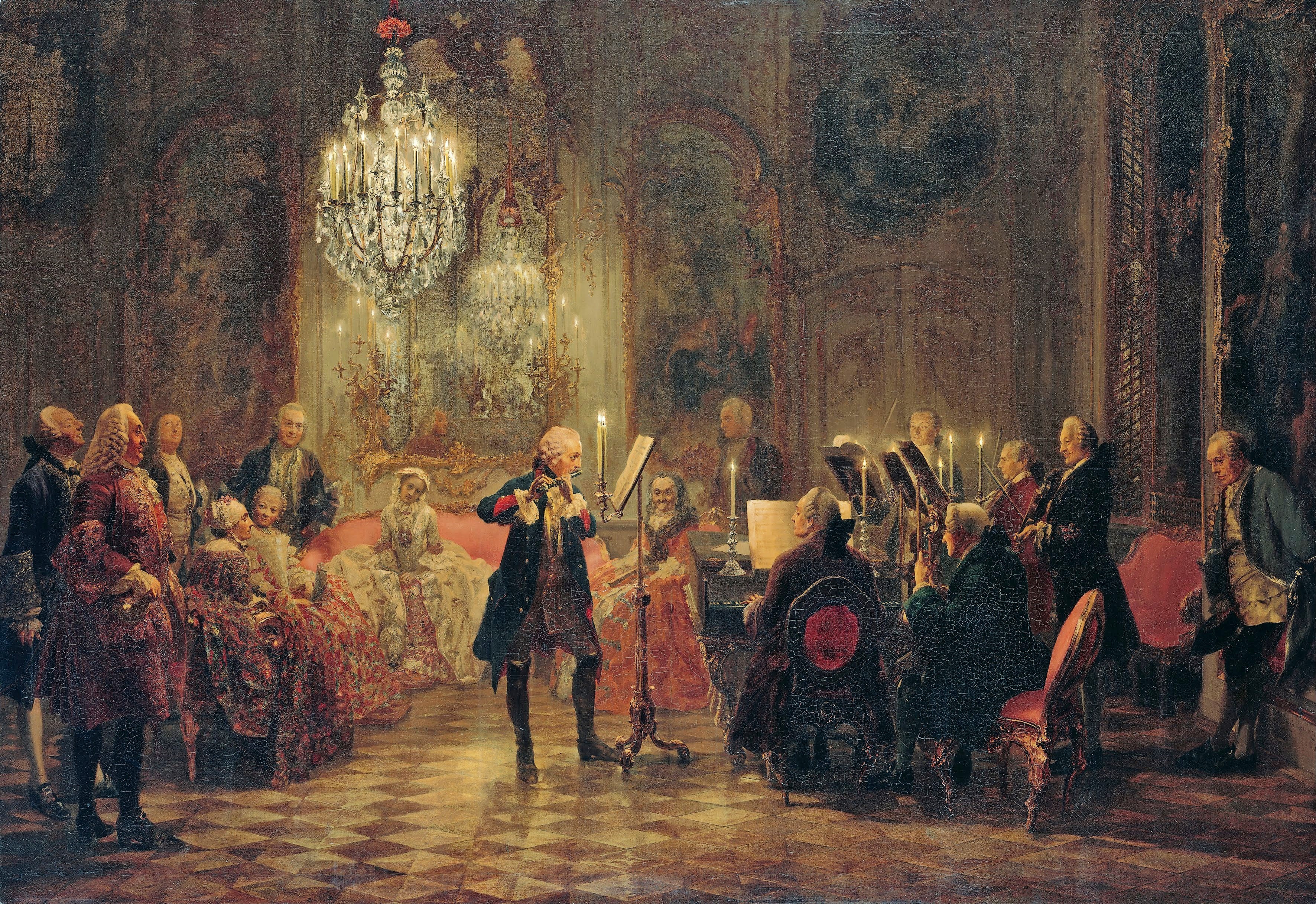
The memory of Frederick II had of course never entirely faded in Prussia, but the erection of the monumental statue unleashed a genuine boom among the population. Authors, artists, booksellers, and theatres satisfied the demand: long odes to the king appeared in the newspapers. Never were more plays performed dedicated to Frederick II — admittedly under the watchful eyes of the censors. Sheet music for the military marches then believed to have been composed by the king sold brilliantly, despite costing between one-third and two-thirds of a thaler per piece. Adolf von Menzel painted one flattering image after another of the "popular" king. The complete works of the literarily dabbling monarch were reissued in 18 volumes, at an enormous cost of 20 thalers for all 18 volumes.
If the most popular films of the UFA studios as late as the 1920s still took Frederick the Great as their subject, and if Old Fritz remains a brand recognised worldwide today, then this newly kindled and seemingly inexhaustible myth can with some confidence be traced back to the year 1851, when the equestrian statue of the most Prussian of all Prussian kings was erected.
The Frederick Monument as a Tourist Attraction
The equestrian statue stood in so central a location in Berlin that visitors to the city could not fail to notice it. References to it can indeed be found again and again in the letter literature of the time. Thus the American philosopher William James wrote to his sister Alice in October 1867: "After dinner I took a long walk along Unter den Linden and past the palace and museum. There are innumerable statues here (many of them equestrian), and you can hardly imagine how they illuminate the place."
George Bancroft, an American historian, former Secretary of the Navy, and United States minister to Berlin from 1867 to 1874, poked fun at the many statues. He had searched, he said, for "the imposing equestrian figure of the honourable Geo. Bancroft." Apparently, given the great number of equestrian statues, he could not imagine that any figure of distinction could have been left without such an honour.
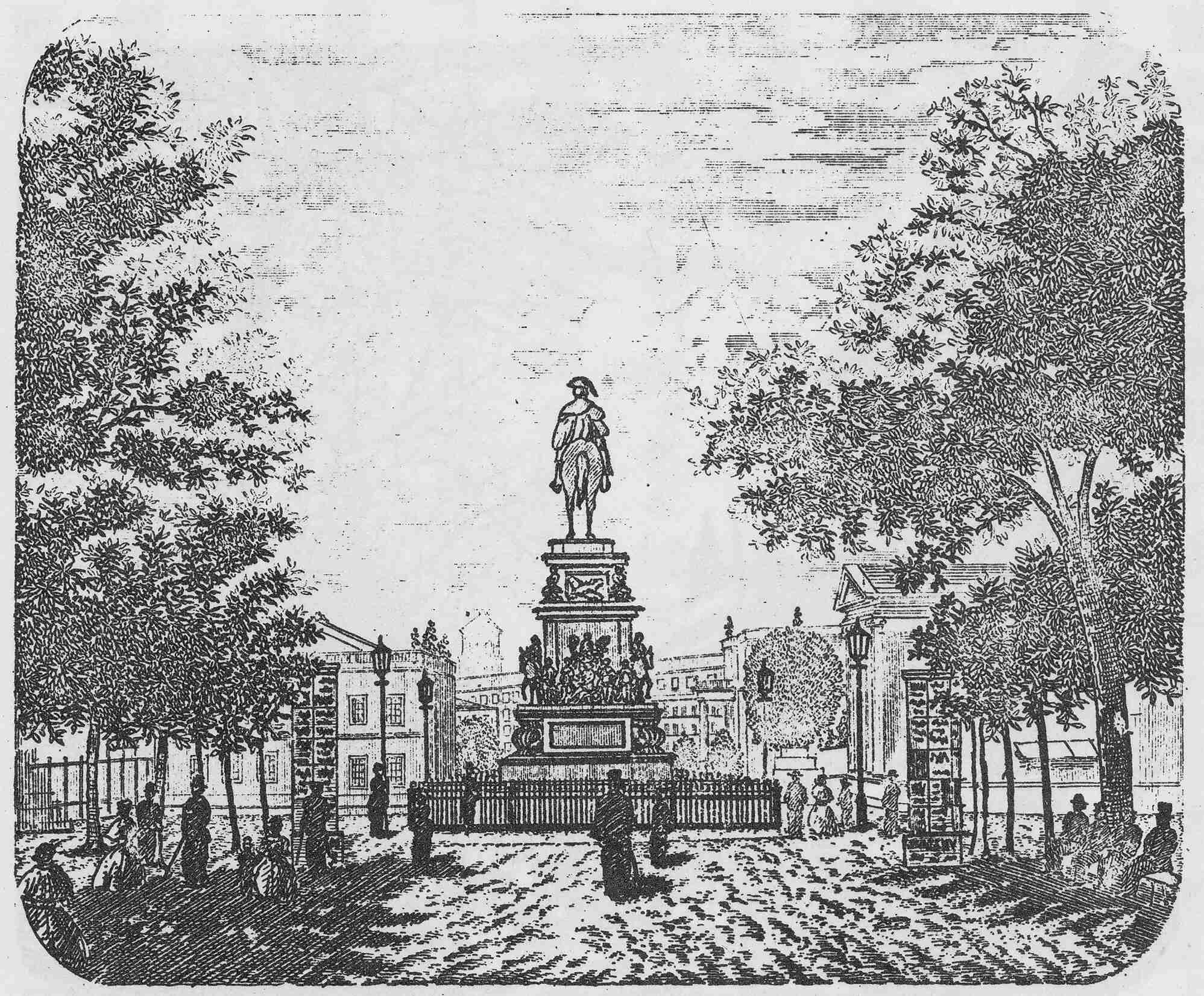
The greatest compliment to the statue of Frederick the Great came from the Japanese Iwakura Mission. Kume Kunitake included an illustration of it in his official report on the findings of the Iwakura Mission.
Picture caption: Unknown artist: Illustration featuring the monument to Frederick II, from Kume Kunitake's report on the Iwakura Mission, woodcut c. 1873.
What do Prussian gold medals have to do with Japan’s modernization?
More than one might initially suspect.
In the 1860s and 1870s, two Japanese diplomatic missions traveled to Europe to study the great powers of the West. During the first visit in 1862, Prussia made hardly any impression—so much so that the author Fukuzawa Yukichi simply omitted the chapter on Prussia from his later travelogue, citing a lack of time, as he wrote.
Just ten years later, everything had changed. When the Iwakura Mission
arrived in Berlin in 1872, it found a completely transformed nation: a
unified German Empire that had defeated the European great power France
and, within a decade, had risen to become the continent’s leading force.
This time, the chronicler Kume Kunitake devoted ten detailed chapters
to the country—more than to France, which the mission had spent twice as
long visiting.
What the Japanese diplomats saw had a lasting impact on their country: the German constitution influenced the Japanese constitutional debate, the universities were regarded as exemplary, and from then on, the Japanese military modeled itself on the German army rather than the French one. At a banquet, Bismarck personally told the delegation that only strength could ensure a country’s voice in world politics.