On June 7, 1840, Frederick William III died in Berlin at the age of 69, after 43 years of reign. With his death, an era came to an end. Only the reigns of Frederick II and the Great Elector had been longer.
Provisions made during his Lifetime
A plain gold medal commemorates his death (Lot 136). Its obverse bears the portrait of the deceased, while the reverse records his dates of birth and death. Similar medals had already been distributed in 1825, on the occasion of the death of Emperor Alexander I, to the "Alexandrians" — as the members of the Emperor Alexander Guard Grenadier Regiment No. 1 were called, of which Alexander I had been regimental commander.
In his own "testamentary decree" of December 1, 1827, Frederick William III stipulated that on the occasion of his burial, "all troops of the Guard Corps present at the parade on the day of interment or counted as part of the active strength ... shall receive a commemorative coin ... From the regimental commander inclusive upward, it is to be given in gold, likewise for my adjutants and for the two commanders of the Life Companies ...". Lower ranks were to receive commemorative medals in silver and bronze. In total, 58 pieces were produced in gold, 3,790 in silver, and 16,959 in bronze.
What is an Act of Homage?
Strictly speaking, Frederick William IV became King of Prussia immediately upon his father's death. A coronation was therefore not strictly necessary. However, for a legitimist ruler it was of particular importance to mark the transfer of royal authority to his successor through a formal ceremony. Yet in order to reduce the enormous costs of a coronation, no such ceremony had taken place since the accession of Frederick William I; instead, only a hereditary act of homage by the estates of the kingdom was held. This ceremonial of homage — a form of collective submission dating from the Middle Ages — also had a long tradition within the Holy Roman Empire.
Originally, lord and vassal had pledged protection and obedience respectively, along with the fulfilment of feudal obligations. In the early modern period, however, the act of homage evolved into a trial of strength between the prince and the estates: depending on the circumstances — most often concerning the debts accumulated by the predecessor which the estates were now expected to settle — the prince was required to grant more or fewer privileges.
In nineteenth-century Prussia, all of this belonged to the past. The act of homage was a ceremony that held great importance for Frederick William IV, given his particular affinity for the Middle Ages. In his convocation patent of August 10, 1840, he summoned the estates of all provinces. The representatives of the provinces outside the German Confederation — the Kingdom of Prussia with East and West Prussia, and the Grand Duchy of Posen — assembled on September 10, 1840 in Königsberg, while the representatives of the provinces within the German Confederation — Brandenburg, Pomerania, Saxony, Silesia, the Rhine Provinces, and Westphalia — gathered on October 15, 1840 in Berlin.
The Act of Homage in Königsberg
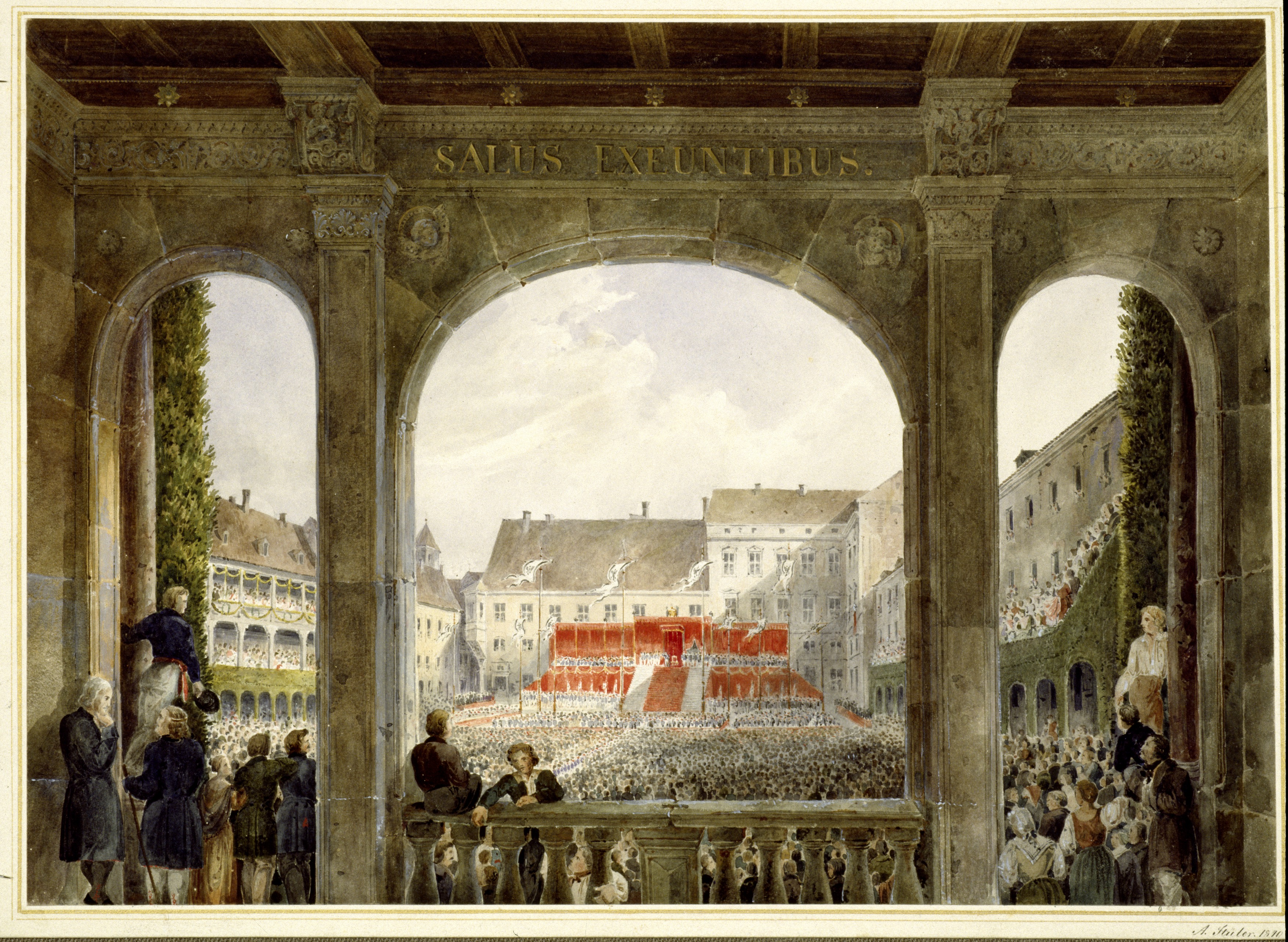
After the estates had presented the ruler with a commemorative address setting out their petitions, the formal oath took place in the afternoon. All those present pledged loyalty and obedience to the entire royal House of Hohenzollern. The ruler in turn promised that he would "be a just judge, a faithful, diligent, and merciful prince, a Christian king." In a stirring speech, distributed across the country in the form of broadsheets, he appealed to the assembled delegates for their support: "Will you help and assist me to unfold ever more gloriously those qualities by which Prussia, with its mere fourteen million inhabitants, stands equal to the great powers of the earth? — namely: honour, loyalty, the pursuit of light, justice, and truth, pressing forward with the wisdom of age and the heroic vigour of youth? Will you not leave or neglect me in this endeavour, but faithfully persevere with me through good days and ill — O! then answer me with the clearest, finest sound of our mother tongue, answer me with an honourable Yes! — (This Yes rang out mightily from all sides of the square, filled head to head with people, and in the expression of the many thousands of voices one could clearly hear the resolve and warmth with which the question had been addressed to the people.)"
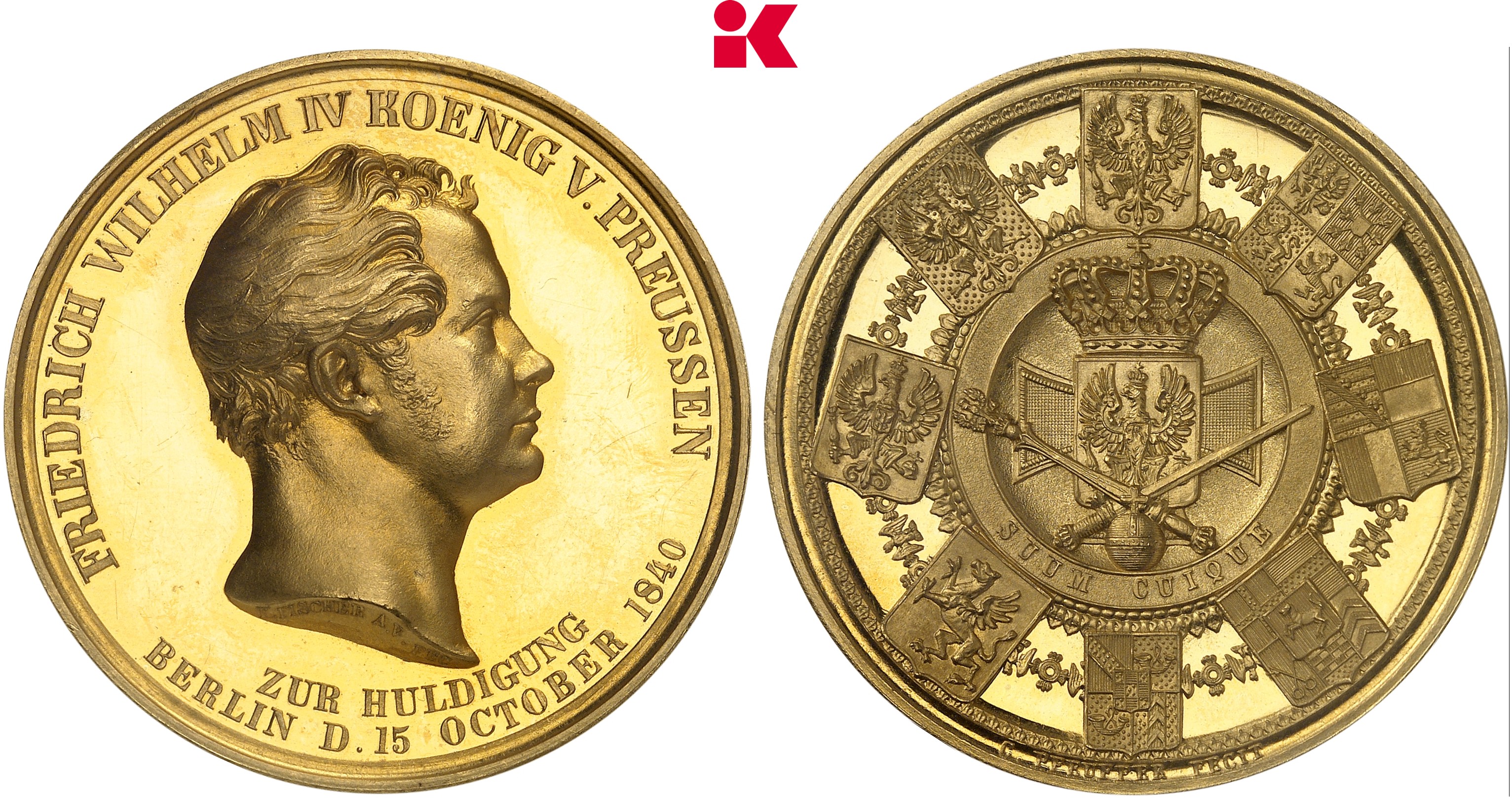
In memory of this celebration of unity, Frederick William IV commissioned medals, two examples of which are held in the Imperial Collection (Lots 141 and 142). The obverse bears his portrait with the title "King of Prussia," beneath which the date and occasion are inscribed. The reverse presents the coats of arms of all Prussian provinces, bound together by the chain of the Order of the Black Eagle — an order founded by Elector Frederick III in Königsberg on the eve of his coronation as King in Prussia. The order's motto, "Suum Cuique" (To Each His Own), appears along the lower edge of a raised ring encircling the central design, which shows the crowned coat of arms upon the Iron Cross, with the royal insignia in the foreground: sceptre, sword, and orb. This medal was not distributed solely to those present at the act of homage; Frederick William IV subsequently used it as a diplomatic and personal gift as well.
The Act of Homage in Berlin
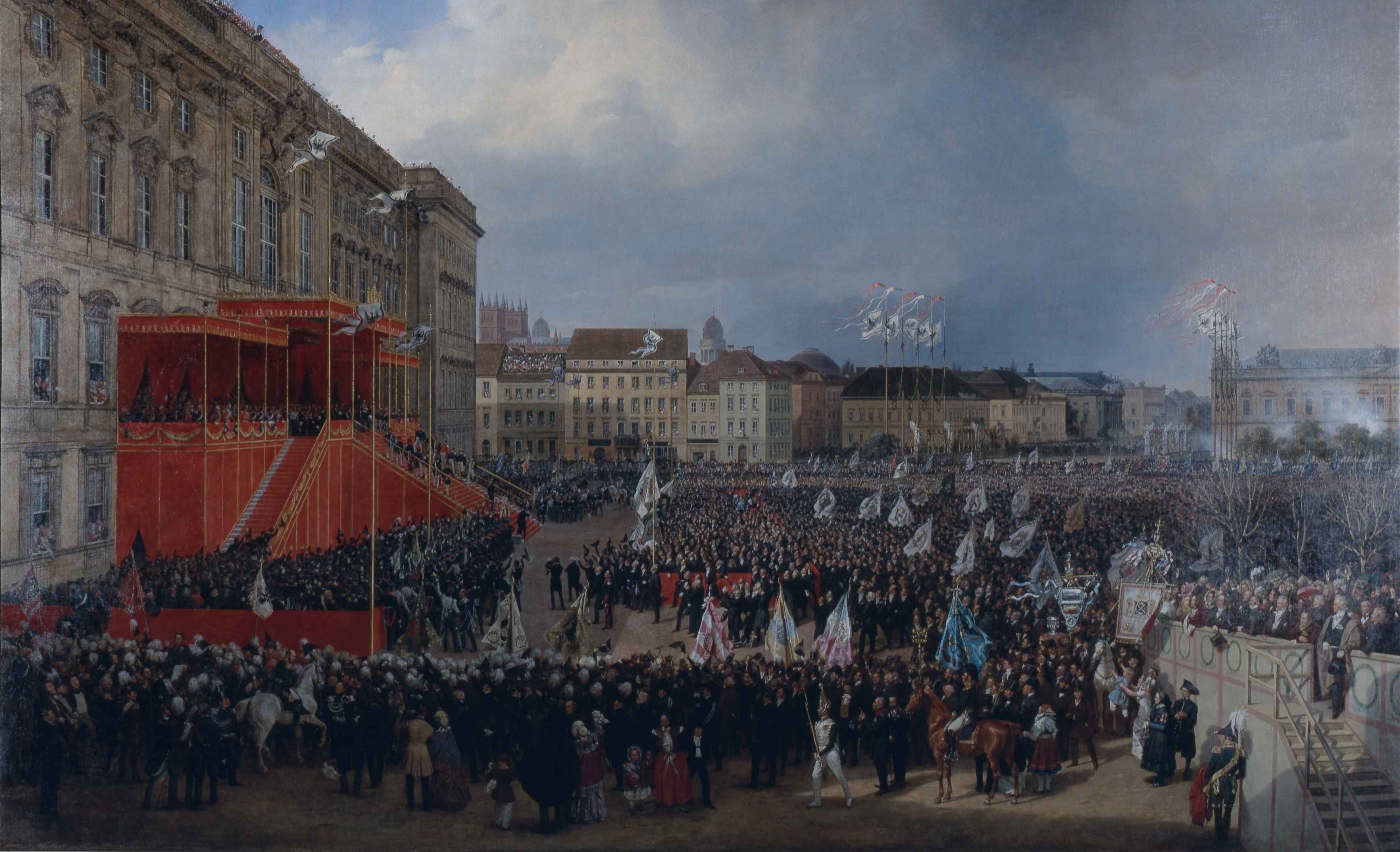
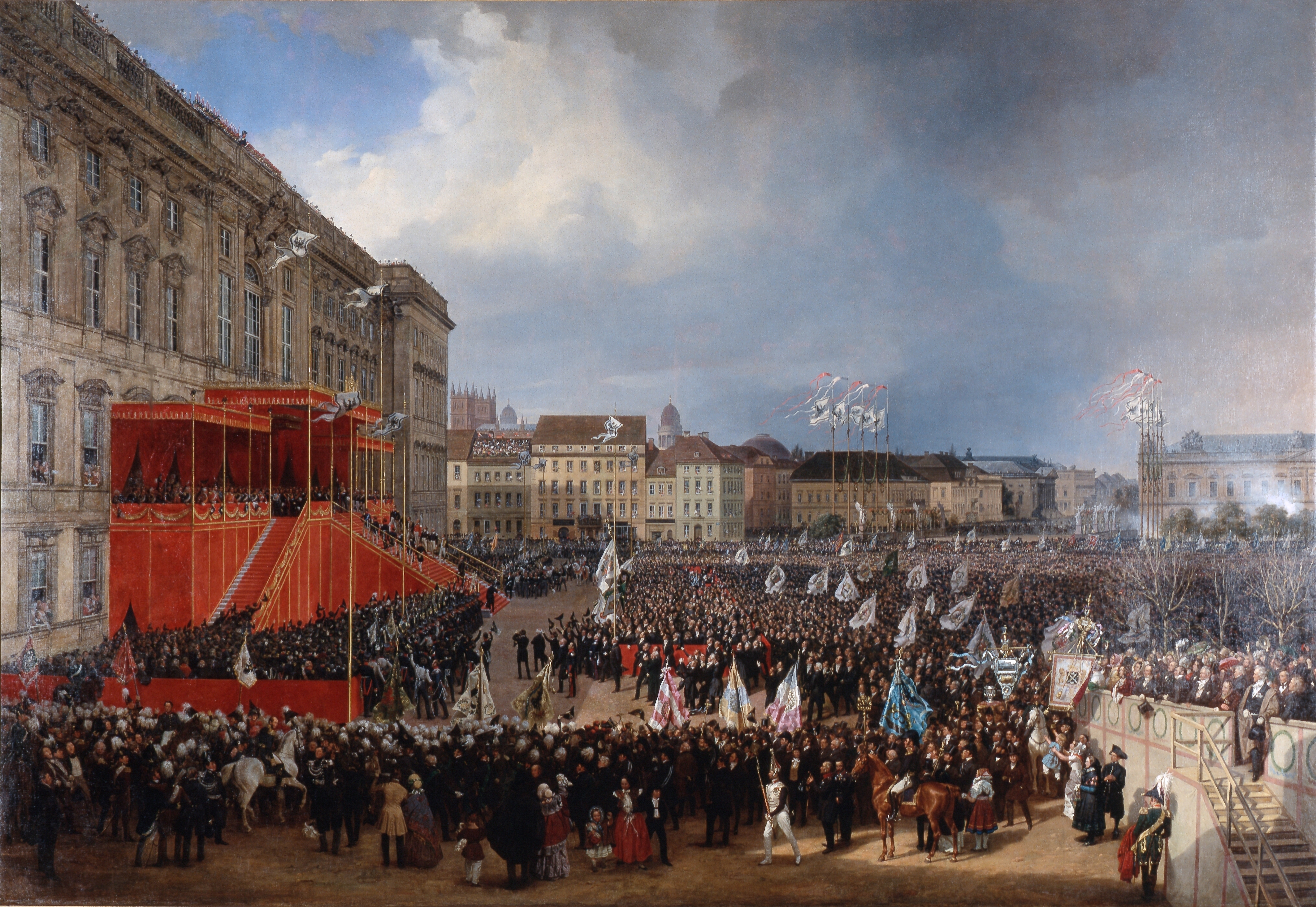
The festivities in Berlin were considerably more extensive. They lasted from October 15 to 20, 1840 and began with an impressive procession of all participants, leading from the City Palace to the Cathedral. There a celebratory service was held, before the formal act of homage and oath-taking took place, proceeding in much the same manner as in Königsberg.
This was followed by a banquet. Among the dishes served were Rhine salmon and Saxon pastries, while beef fillets, pheasants, partridges, game, and roast veal — from Brandenburg, Pomerania, and Silesia — formed the main course, all reflecting the occasion's programmatic character.
We are so well informed about the festivities because the events were recorded in numerous contemporary programmes, paintings, and graphic representations, intended to convey the occasion to all those who had been unable to attend.
The Homage Medals for the Berlin Celebration
Alongside the homage medals for Königsberg, medals were also produced for Berlin, two gold examples of which are held in the Imperial Collection (Lots 143 and 144).
In addition to the commemorative medals distributed to participants, commissioned by the king, the young die-cutter Carl Heinrich Lorenz designed medals also commemorating the act of homage (Lot 140). Whether these were produced as an official royal commission or whether a private medallist created them for commercial purposes remains uncertain. Much points to the latter — for instance, the absence of gold strikings, the many different sizes, and the prominent use of bronze.
Furthermore, the reverse inscription — "I will be a just judge, a faithful, diligent, and merciful prince, a Christian king" — quotes from Frederick William's speech in Königsberg, which suggests the medals cannot have been produced before September 10, 1840. The fact that they simultaneously commemorate both events may likewise have been intended to broaden the potential customer base.
A late Act of Homage at Hohenzollern Castle
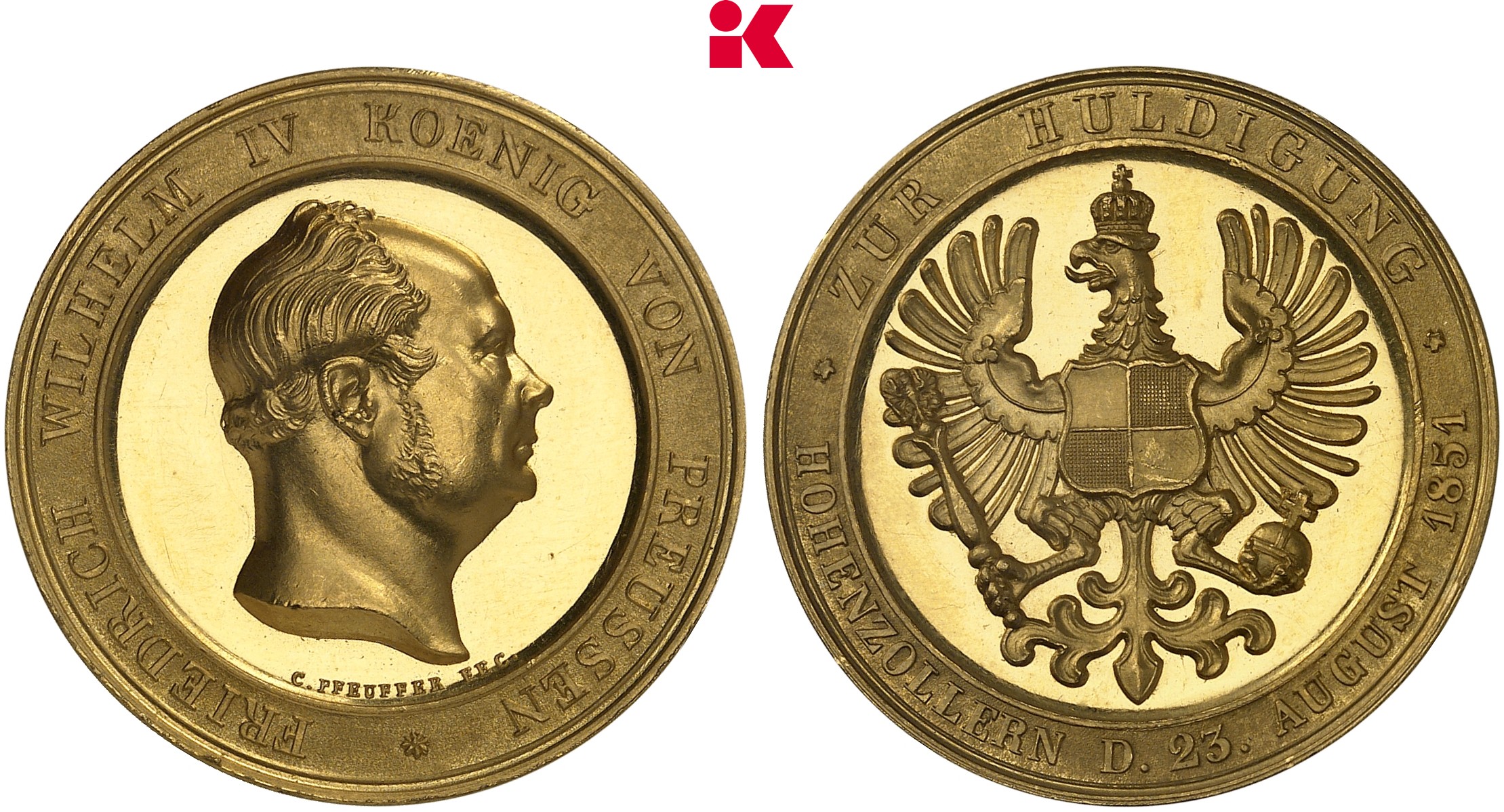
A further homage medal in the Imperial Collection dates from 1851 (Lot 171). It is considerably rarer than the medals of 1840 and has no connection with the acts of homage marking Frederick William IV's accession. Instead, it commemorates the fact that Prince Karl Anton of Hohenzollern-Sigmaringen and his cousin Frederick William Constantine of Hohenzollern-Hechingen, in the aftermath of the revolutionary events of 1848, had renounced their sovereignty over the two Hohenzollern principalities and formally ceded them to Prussia by treaty on December 7, 1849.
On August 23, 1851, Frederick William IV travelled in person to Hechingen to receive the act of homage from his new subjects: 300 deputies swore the hereditary oath of homage beneath the so-called "King's Linden Tree" in the courtyard of Hohenzollern Castle, the ancestral seat of the dynasty. On the same day, the king founded the Royal House Order of Hohenzollern, with the motto: "Vom Fels zum Meer" (From Rock to Sea).
This was to be the last act of homage received by a Prussian ruler. Voluntary oaths of submission before a sovereign, grounded in the principle of reciprocity, were no longer compatible with the concept of the new nation state.