



- How Germany developed from an agricultural patchwork into a united industrial nation.
- Which different currencies and customs restrictions hindered trade in Germany.
- Which important milestone linked the different currency areas and led to the introduction of a common imperial currency.
In the years between 1800 and 1914 Germany developed from an agricultural patchwork into a united industrial nation. We know the important stages from the textbooks: from the student protests after the Congress of Vienna to the failed revolution of 1848 and Prussia's three "wars of unification" to the founding of the German Empire.
So was the German nation state a result of patriotic sentiment combined with the enormous ambition of Prussia as a military power? That would be too short-sighted, for the economy also played an essential role. Customs restrictions and different currencies of the countless small states inhibited trade and felt increasingly medieval to the citizens. Countries like France and Great Britain had long since become a unified economic area and discussed free trade with other nations. Germany was still a long way from that.
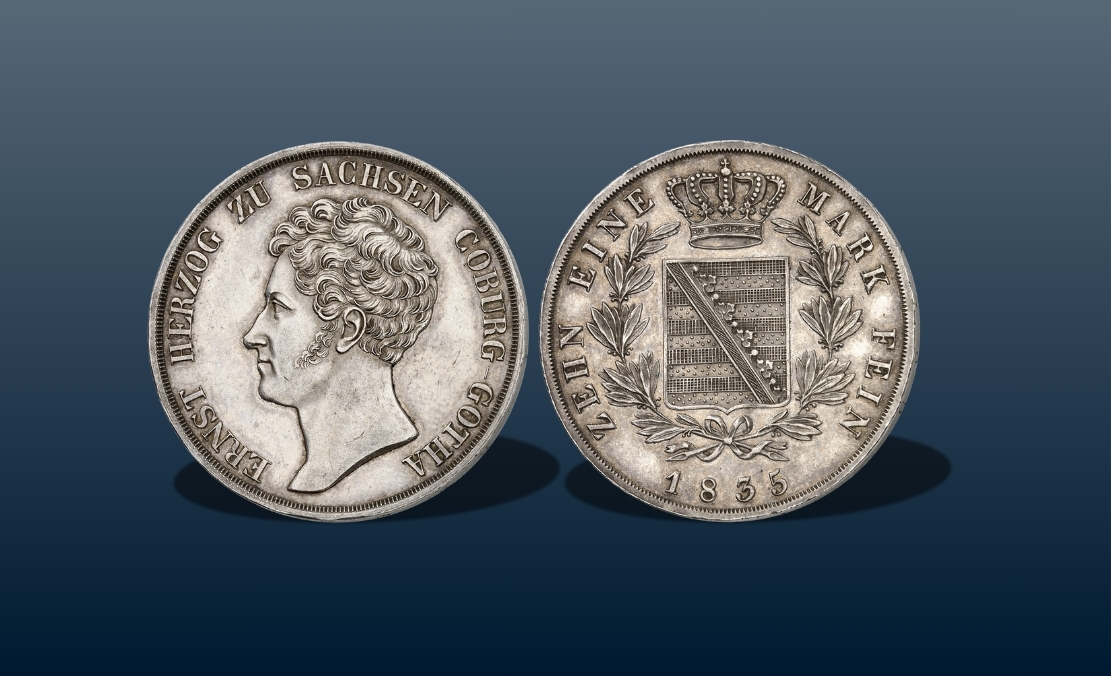
Therefore, the German politicians of the 19th century endeavoured to facilitate the exchange of goods and to harmonise the currencies. Coinage treaties gradually paved the way for a common imperial currency. Let us illustrate this development with the example of the coins of the double duchy of Saxe-Coburg and Gotha, some rare and outstandingly preserved pieces of which can be found in Künker Auction 388, offering a North German private collection on 22 June 2023 under the title "Thaler and Mark".
In the late 18th century, the German territorial states minted their own coins according to different minting feet. While the Scheidemünzen circulated only in their own country, the Kurantmünzen were intended for cross-border trade. Therefore, their value was determined by their silver content. At the centre of this weighting system since the Middle Ages was the Cologne mark, a unit of weight that corresponded to about 234 g of silver. The basic question was therefore how many coins were minted from one Cologne mark of silver. Prussia, for example, had introduced a 14 thaler foot in 1750, which meant that 14 thalers were minted from the 234 grams of fine silver. This coinage foot dominated the North German region around 1800.
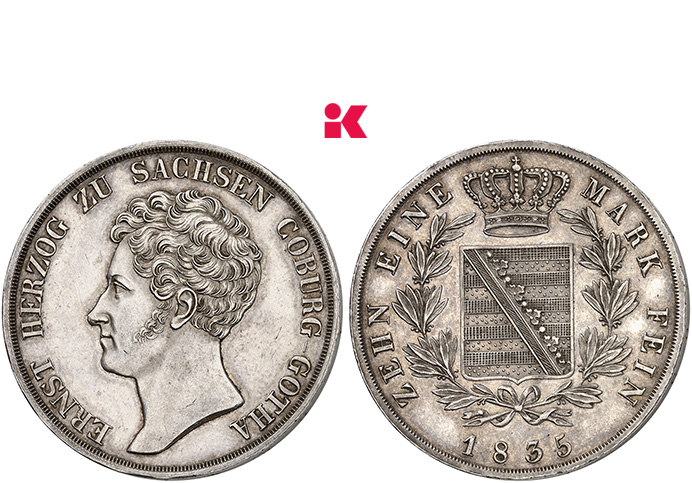
The Duchy of Saxe-Coburg and Gotha went a different way. This convention thaler from 1835, minted under Duke Ernst I, shows us that. The name of the coin derives from the 1753 minting convention between Austria and Bavaria, with which a new silver coin replaced the old imperial thaler there. This convention thaler prevailed in large parts of southern and western Germany, including the Saxon duchies. The inscription itself tells us more about the foot of the convention thaler. We read "ZEHN EINE MARK FEIN". So 10 such thalers were minted from one Cologne mark of silver and thus corresponded - at least in terms of fine weight - to 14 Prussian talers. And now it gets complicated. Since the guilder was the central currency of account in southern Germany, the value of each thaler was calculated in guilders. But since the price of silver was constantly changing, the rate of the (Prussian) thaler also changed. Thus a merchant was faced with the problem that the (South German) invoice guilder was difficult to put into relation with the (Prussian) thaler. For this reason, the coin convention of 1753 defined a thaler that could easily be converted into guilders.
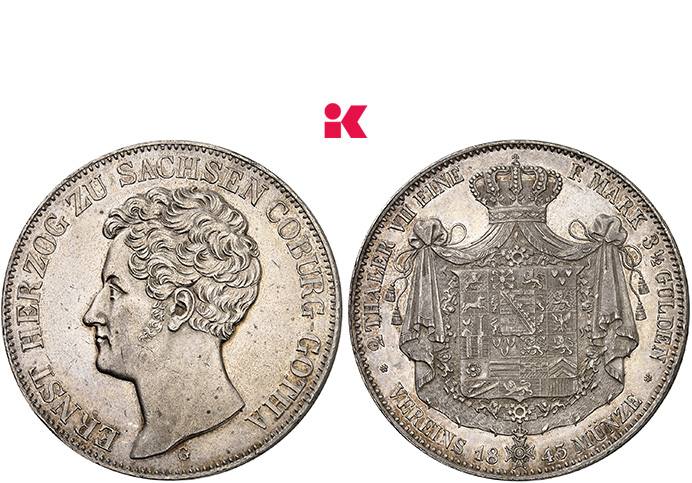
A double thaler from 1843 takes us to the next phase. It is the result of far-reaching reforms. The German Customs Union had already been founded in 1833. This not only ensured that troublesome customs barriers were abolished, but also provided for a future standardisation of currencies. The Munich Coinage Treaty of 1837 and the Dresden Coinage Treaty the following year were a breakthrough in this respect. The newly founded South German Mint Association defined the Cologne mark as 24 1/2, not 24 guilders as before. This made possible a clear value relationship between the (South German) guilder and the (Prussian) thaler: 1 thaler was equivalent to 1.75 guilders.
This new exchange rate was cemented by a new Kurant coin, which was recognised throughout the entire area of the Zollverein. This is why it was given the name Vereinsmünze. This double thaler from 1843 is such a Vereinsmünze. The inscription on the reverse shows a double value: "2 THALER VII EINE F. MARK 3 ½ GULDEN". This coin is therefore worth 2 Thalers according to the Prussian 14 Thaler foot or 3 ½ Gulden if one calculates in the South German 24.5 Gulden foot.
Duke Ernst I of Saxe-Coburg and Gotha had a substantial interest in these adjustments to the coinage, because they helped him directly. We must be clear that Saxe-Coburg and Gotha was not one duchy, but a personal union of two duchies: Saxe-Gotha and Saxe-Coburg. And in the Duchy of Gotha they reckoned in Prussian talers, the more southern Coburg was a member of the South German Mint Association and reckoned in guilders. A common basis for its territories thus meant great relief.
The double thaler linked the North German and South German currency areas and was therefore of great symbolic importance. In everyday life, however, this coin was hardly used because of its high value.
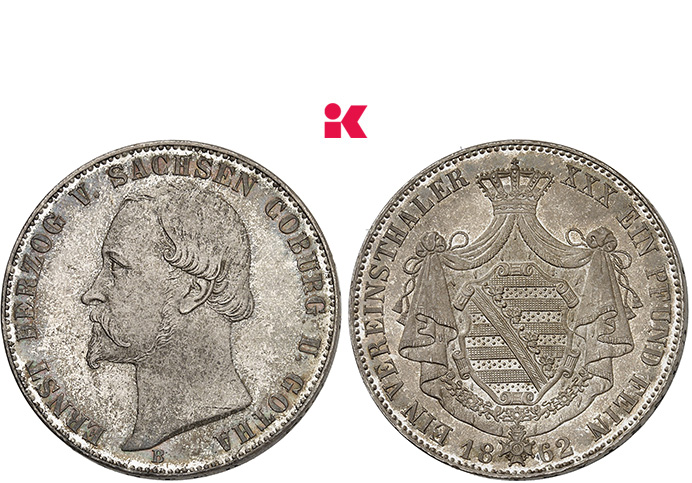
A further step towards unification was the Vienna Mint Treaty of 1857. For the first time there was a real community coin, the Vereinstaler. Here we see a specimen from 1862, minted under Duke Ernst II of Saxe-Coburg and Gotha. What was revolutionary about this coin was that the medieval Cologne mark no longer served as the basic weight, but the decimal inch pound, i.e. a smooth 500 grams of silver.
As the inscription on our coin, "EIN VEREINSTALER XXX EIN PFUND FEIN", tells us, 30 Vereinstaler were now minted from one pound of silver. The trick was that the fine weight of the Prussian thaler only changed by a fraction of a gramme.
With the Vereinsthaler, the currency areas were finally linked by a common main coin. In contrast, the fact that Austria and Liechtenstein joined the coinage area with the treaty had hardly any long-term consequences. Already in 1866, after the lost war against Prussia, they left the currency area again. Duke Ernst II of Saxe-Coburg and Gotha will certainly have welcomed the Vienna Mint Treaty. He was considered a great advocate of national unification and, unlike some of his neighbours, had sided with Prussia in the war against Austria. The victory over Austria is considered an important milestone on the way to unifying the empire under Prussian domination. After the victory against France in the war of 1870/71, the time had come: the German Empire was proclaimed in the Hall of Mirrors at Versailles.
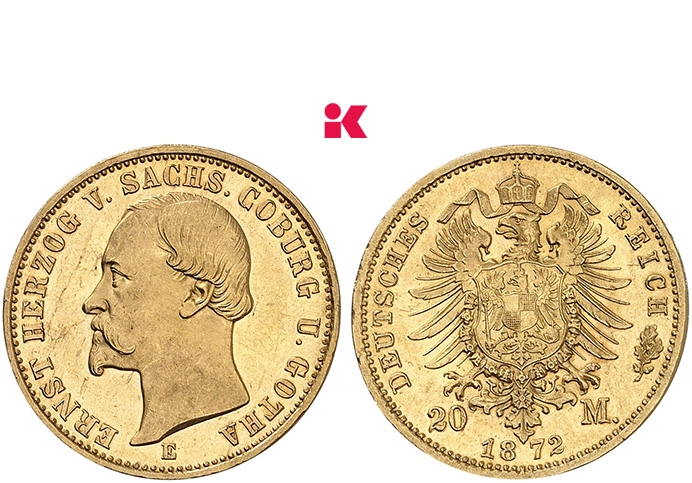
With the new empire came at last a uniform imperial currency, which was fixed by several coinage laws. Its basis was the achievements of the preceding decades. Now the often proposed decimal system was also introduced: 1 mark equals 100 pennies, simple and practical. The silver standard was abandoned and the gold standard on the British model was introduced instead. Let us take this fact into account by depicting a gold coin this time. It is the famous 20-mark piece of Saxe-Coburg and Gotha from 1872, known as the rarest type of all imperial gold coins. It shows that the specifications of the coins were uniform, but gold and silver coins were nevertheless issued in the name of the federal states and with the portraits of their princes.
The introduction of the imperial currency put an end to the protracted efforts of the 19th century to unify the coinage system. As in politics, Prussia had prevailed on the essential points here as well.