

.jpg)
A Military Career
All this was observed by an old general who had enjoyed great success under Maurice. Many said that he was of Armenian descent. However, historical sources tell us little about the origins of Heraclius the Younger, who was to save the Roman Empire through his courageous and thoughtful intervention. The first ancient sources that mention him date to 586, when he commanded the center of the Battle of Solachon against the Sasanians under the emperor’s son-in-law Philippicus. He was then sent on a reconnaissance mission into enemy territory. In the following years, Heraclius appeared time and again historical accounts. He is portrayed as a capable general who fulfils his duties with pragmatism, strategic skill and courage. We do not know exactly when Heraclius took over the office of Exarch of Africa. It must have been sometime during the final years of Maurice’s reign. We can assume, however, that this office was the result of the fact that his abilities were held in high esteem at the imperial court.
.jpg)
Heraclius and the Exarchate of Carthage
The Exarch of Carthage had far-reaching powers. It was his duty to protect the enclave of Africa from attacks, as it was rich, fertile and therefore of great strategic importance. To this end, the exarch had full military and civil authority. He needed this power to ensure that the grain, olive oil and wine produced in Carthage arrived in the capital, as these resources were indispensable for the supply of the population there.
The Revolt of Heraclius
However, this also gave the old general the opportunity to cause lasting disruption in the capital by withholding food supplies. The wealth of his province provided him with sufficient resources to raise his own army. Add to this the excellent network Heraclius the Elder had built up throughout his military career, and he was well placed to overthrow Emperor Phocas, whom many contemporaries considered to be incompetent. Heraclius did not have to fear retribution. Phocas was far too busy dealing with the Sasanian invasion to send an army to Carthage.
.jpg)
Taking Over the Consulate
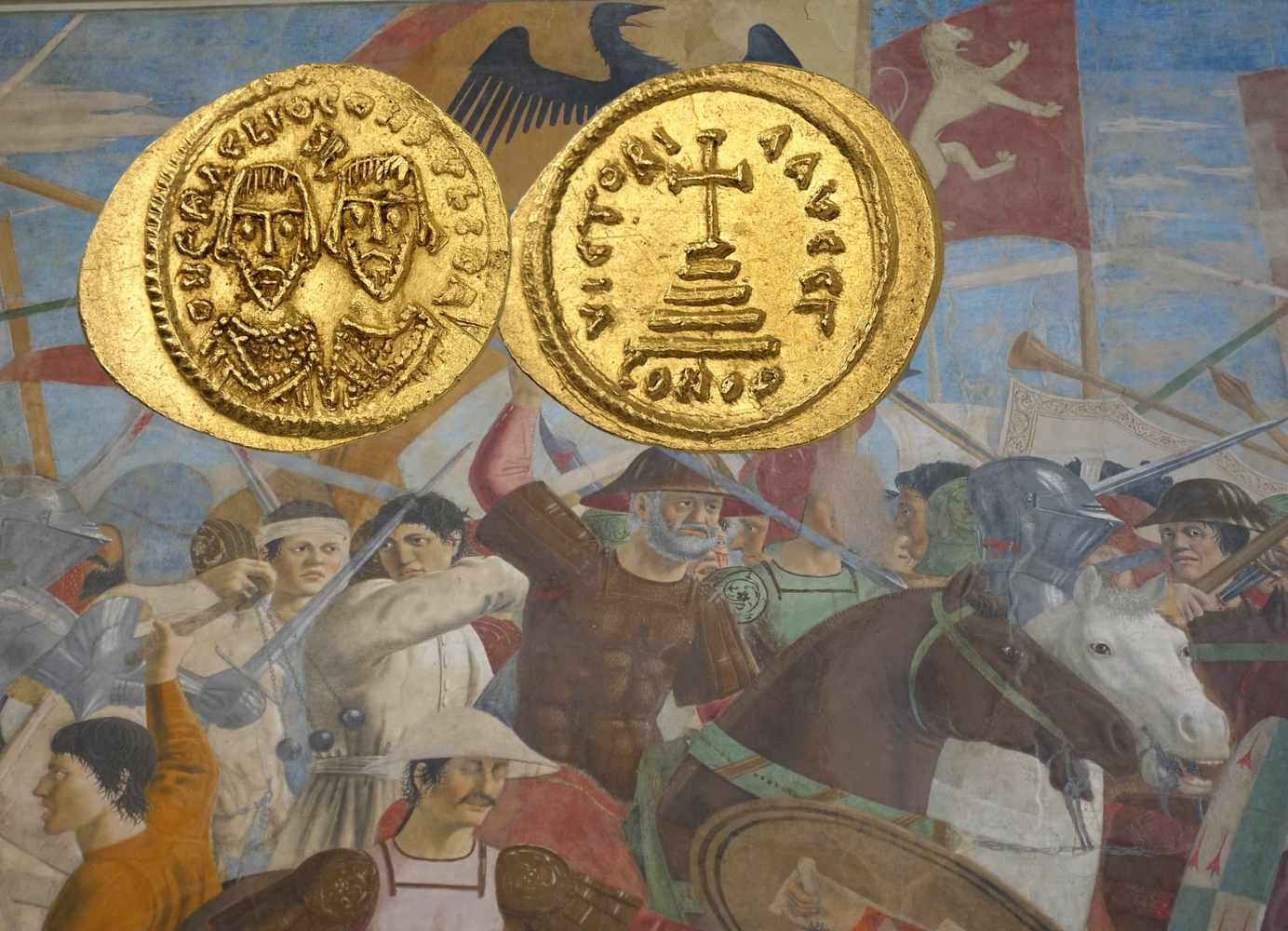
Heraclius had another card up his sleeve – the same one that a general named Vespasian had used to his advantage centuries earlier: he had a son of the perfect age who had already enjoyed some military success. Thus, the Exarch of Carthage sent his son into the fray. The first step was for both of them to jointly assume the office of consul. We do not know whether they were appointed officially by the Senate of Carthage or whether Heraclius did so with his own authority. What we do know is that they thus laid claim to power, albeit tentatively. Although no private individual had held this title since Justinian I, it was not the title of augustus either. “Consul” left room for negotiations in case it would become necessary to find agreement with Phocas or another emperor. Coins from Carthage and Alexandria recall these events. They are very similar to the obverse of our specimen. The inscription on the reverse, however, does not refer to imperial victory but to consular victory.
.jpg)
On all these coins, Heraclius the Elder and Heraclius the Younger are portrayed wearing the typical attire of a consul. The famous Diptych of Boethius, which is now housed in Museo di Santa Giulia in Brescia, shows us what this attire looked like. The ribbon-like folds of the embroidered robe are characteristic, and are looped over each other in such a way that the hands remain free to hold insignia. This robe was a later version of the Roman trabea, known as loros in post-Justinian times. The ensemble included an ivory scepter, often adorned with an eagle or a cross, and a mappa. The mappa was simply a folded cloth with which the consul signaled the start of the popular circus games. The shoes were also significant. While only the emperor had the right to wear crimson-colored shoes, the consuls wore eye-catching footwear, which can be seen in detail on the diptych.
.jpg)
Byzantine emperors had themselves portrayed time and again on coins wearing the attire of a consul. This example was created in 603 under the opponent of Heraclius. Phocas wears the typical robe, holds the eagle-tipped scepter in his right hand and the mappa in his left. The only clear difference is the imperial crown, as Heraclius the Elder programmatically decided to have himself depicted without it on his coinage.
Civil War
Heraclius the Younger advanced on Constantinople with his fleet and army. En route, he conquered wealthy Egypt and the important trading hub of Cyprus. The expert author of the catalog of an important private collection of Byzantine coins, auctioned at Sotheby’s on 2 November 1998 as lot No. 198, attributes a previously unpublished coin to a mint on the island of Cyprus. Its obverse was created with the same die as our specimen. The reverse, however, (still) refers to consular victory – as the models from Carthage and Alexandria did. It would be reasonable to interpret the unique coin on offer as the next step in this revolt. Did young Heraclius feel powerful enough now to challenge the incumbent? Or did the craftsman at the mint of Cyprus simply use an old reverse die?
.jpg)
An Attack on the Capital
October 610, Heraclius the Younger marched into the capital at the head of his army. The city surrendered to him without a fight. By that time, Phocas was said to command only his bodyguards and a vigilante group comprising strong men from two of the four circus factions, the Blues and the Greens. However, both the bodyguards and the Greens defected to Heraclius. Thus, the capital was won. Phocas was killed and his head was carried through the city on a lance. Heraclius the Younger assumed power. We know little about what became of his father. The old general did not feel compelled to play a central role in his son’s new reign. He disappeared from history. Unlike his predecessor, Heraclius the Younger was to become one of the most capable rulers of the Byzantine Empire. He succeeded in defeating the Sasanians once and for all and he returned the True Cross – an event that the Orthodox Church still celebrates with a major festival today. However, the fact that his victories ultimately paved the way for the Arab conquests was an irony of history that no Byzantine could have anticipated.