


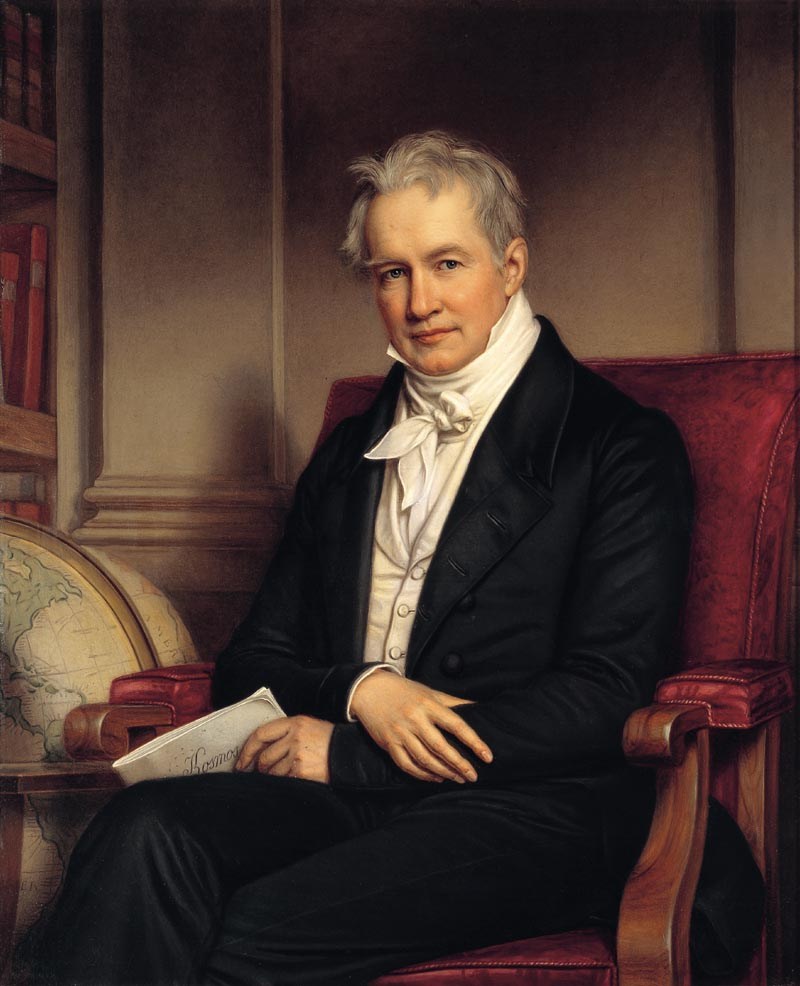
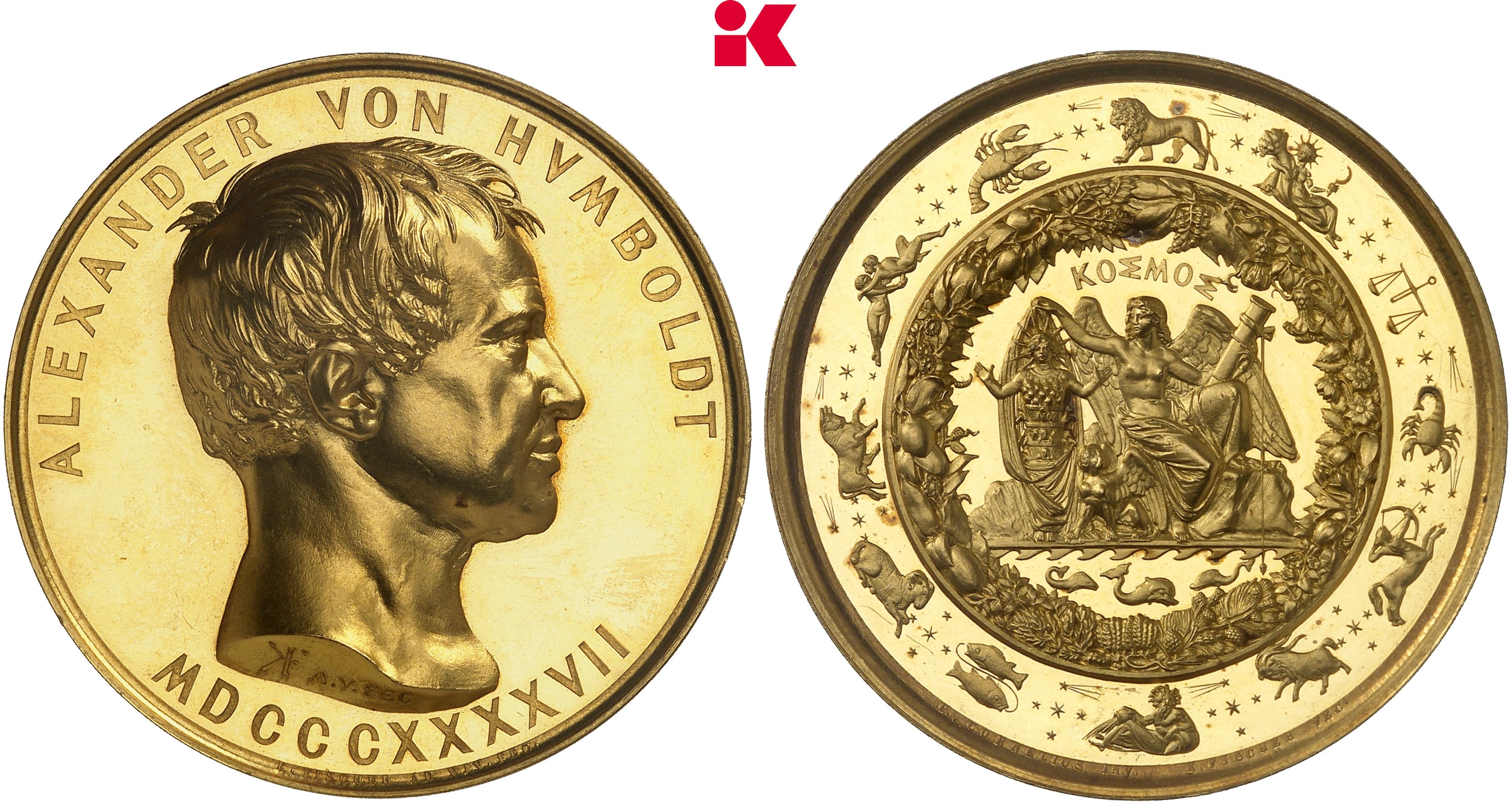
"In 1845 and 1847, the first two volumes of Kosmos. Entwurf einer physischen Weltbeschreibung (Cosmos: A Sketch of a Physical Description of the Universe) by the Prussian world traveller and scholar Alexander von Humboldt (1769–1859) appeared. On the occasion of this event he was honoured with this medal, for which Peter Cornelius (1783–1867) produced the design and which was executed by Karl Fischer (1802–1862).
The medal was struck at the Berlin Mint by order of the Prussian king and on the commission of the Director General of the Royal Museums, Ignaz von Olfers (1793–1872). The first striking order specified one gold medal, ten examples in silver, and 50 examples in copper." ¹
We know, however, that Alexander von Humboldt himself possessed a gold example of the medal that is not identical to the example in the Berlin Coin Cabinet. We also know that Humboldt's example — described in the catalogue as "a gift of H.M. King Frederick William IV" — was sold as No. 356 in an auction conducted by the royal auctioneer Theodor Müller on 17 September 1860 in Humboldt's apartments. ²
The Imperial Collection holds an example of this rare medal in gold (Lot 154). It belonged to the medal collection of Emperor William I and passed from his estate into the Hohenzollern Museum. Frederick William IV also owned an example. The Kosmos Medals in gold are, however, of the greatest rarity. Fewer than a handful of these pieces exist, and to our knowledge not one has come onto the market since 1860.
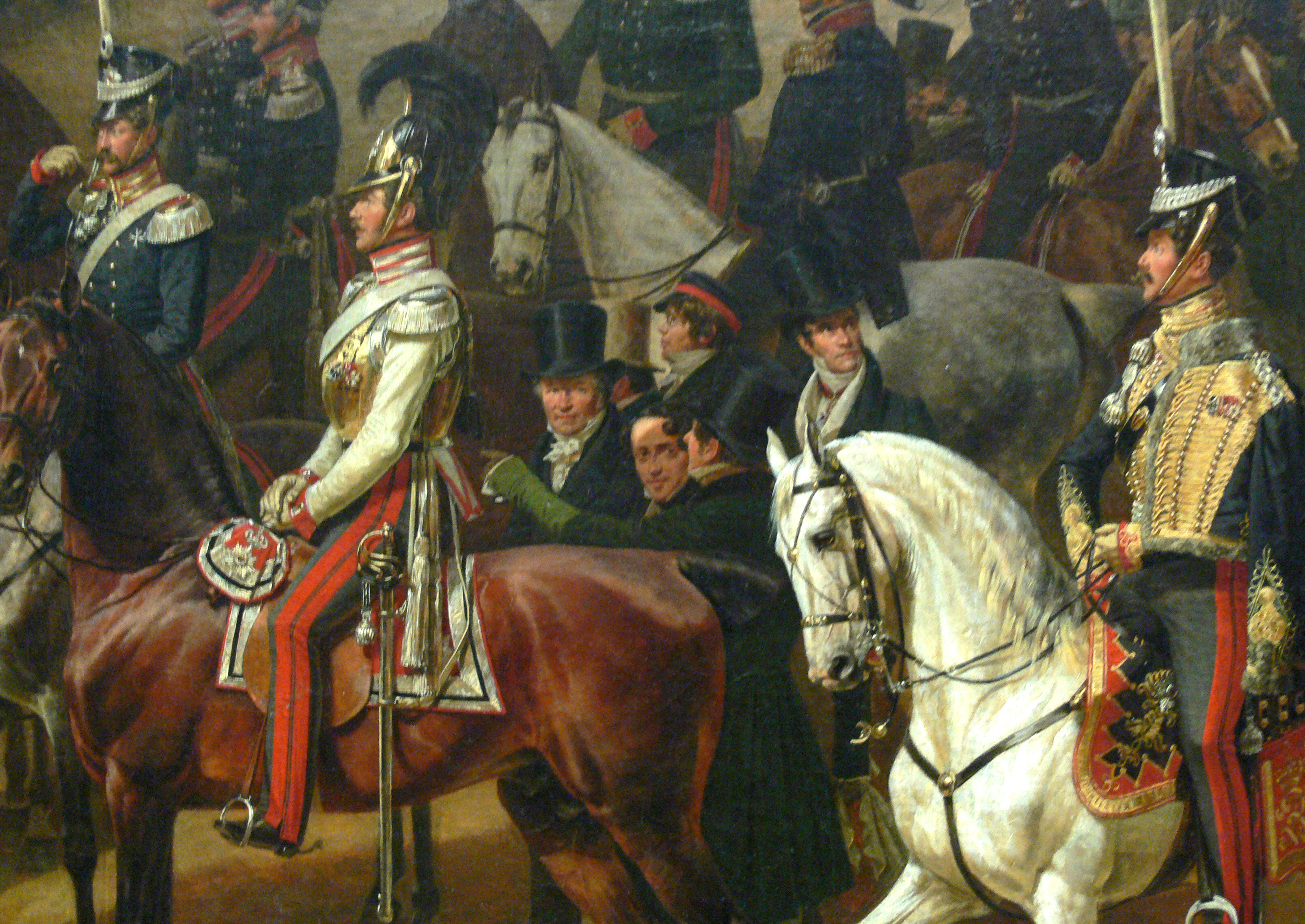
Alexander von Humboldt at the Berlin Court
Alexander von Humboldt needs no introduction. The German explorer is one of the most celebrated natural scientists of the nineteenth century. Remarkable is his holistic approach: when we speak today of ecosystems, Humboldt had already anticipated this thinking through his comprehensive descriptions of the lands he explored.
As the son of the chamberlain of a Prussian princess, Alexander von Humboldt had, so to speak, a close relationship with the Prussian royal court from birth. Frederick William II was his godfather. After Humboldt as a young man had become financially independent through a substantial inheritance, he was drawn out into the wider world, where he undertook the research expeditions that were to make him famous.
These at the same time ruined him financially, so that in 1805 he agreed to return to Berlin. In recognition of this, Frederick William III granted him an annual pension of 2,500 thalers and appointed him Royal Chamberlain. No specific obligations were attached to this position, but it was expected that the celebrated guest would shine at royal receptions, read to court society from his latest works, occasionally undertake a diplomatic mission, and serve as a guide for the king when occasion permitted — for instance when Frederick William III, attending a congress in Verona in 1822, also visited Venice and Rome.
Humboldt preferred the stimulating metropolises of Paris and London to the still somewhat provincial Berlin, but when he returned there permanently in 1827, he did so also in order to write Kosmos — a comprehensive survey of his scientific research.
What Work of Humboldt's Lies Behind the Title "Kosmos"?
The word Kosmos is borrowed from the Greek, where it describes the order of the world. Humboldt adopted it as the title for lectures he delivered in Berlin from the autumn of 1827 to the spring of 1828. He spoke freely and without a manuscript, allowing his audiences an unencumbered access to the understanding of nature. To prevent the unauthorised publication of transcripts of the lecture — which had been received with great enthusiasm in Berlin — Humboldt decided to write a work of his own under this title. Two volumes were planned, to appear in December 1829.
Humboldt was unable to keep to the ambitious schedule. The first volume, which was of course dedicated to King Frederick William IV, appeared in 1845. Two years later the second volume was published — this being the specific occasion for the Kosmos Medal.
At this point Humboldt was well aware that his work was far from complete. Further volumes followed. Their completion became a race between the ageing scholar and time itself, and his approaching end. Rarely did he go to bed before three o'clock in the morning. Death took the pen from his hand in 1859. The fifth volume of Kosmos remained a fragment.
The Kosmos Medal
The reverse of the Kosmos Medal is remarkable not least because it draws upon ancient models while at the same time giving artistic expression to Alexander von Humboldt's new understanding of nature. On the reverse, a winged genius sits amidst a mountainous landscape. In his left hand he holds a large telescope with which to gaze into the heavens. A plumb line is attached to it, with which depths can be measured.
With his right hand he draws back the veil from a cult statue of Artemis Ephesia, which is easily recognisable by her many breasts and the clearly visible relief plaques with animal heads on her lower body. Artemis Ephesia developed in the nineteenth century into a personification of nature.
Between the genius and Artemis the Sphinx is depicted. The young Oedipus solved her riddle with the answer "Man." In the lower segment of the circle, the sea is suggested through a classicising motif in which dolphins swim — their depiction also recalling ancient models. Around this winds a luxuriant wreath of more or less exotic plants, embedded in the zodiac and constellations. Through his imagery, Peter Cornelius encapsulated the essential areas of Humboldt's research: earth, oceans, mankind, plants, and animals, united with the surrounding universe into what the scholar understood as the Kosmos.
Humboldt greatly valued this imagery. A framed preparatory drawing hung in his apartment. As an inscription cited in the auction catalogue of Humboldt's estate informs us, ³ this drawing originated not only from Peter Cornelius — named on the medal as its sole creator — but also from the considerably less well-known Heinrich Asmus. The picture, set in a magnificent wooden frame, was a personal gift from King Frederick William IV to Humboldt.
There can scarcely be a medal of greater significance for the history of research in the nineteenth century. It honours the outstanding achievements of the most celebrated natural scientist of that era, whose publications continue to shape our thinking to this day.
Footnotes
¹ See https://ikmk.smb.museum/object?id=18205202, accessed 30 March 2026.
² Katharina Lepekhina and Christian Stoess, Alexander von Humboldt und seine Münzen und Medaillen. In: Geldgeschichtliche Nachrichten 307 (January 2020), p. 400 with n. 49.
³ Ibid., p. 396 with n. 14.