

It was not until the comparatively advanced age of 58 that George IV was crowned British king in 1820. He had already been serving as Prince Regent since 1811 for his ailing father King George III, who suffered from porphyria.
Politically, he succeeded in achieving the emancipation of Catholics — that is, their legal equality with Anglicans. During the first five years of his regency he was preoccupied with the struggle against Emperor Napoleon and the French Continental Blockade. In his private life, George attempted to isolate his unloved wife Caroline of Brunswick and to have himself officially divorced from her.
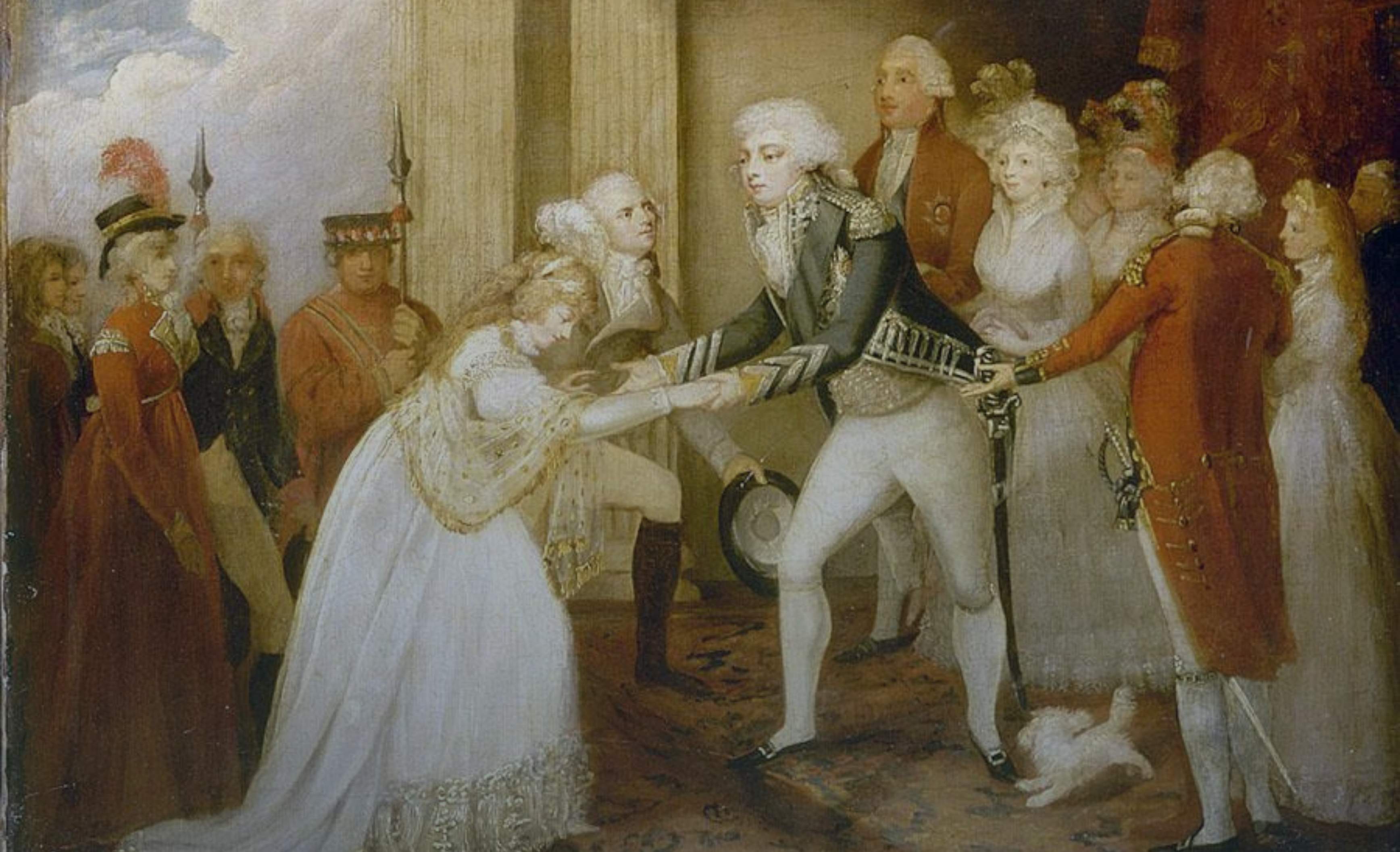
Image caption: Unknown artist: The arrival of Princess Caroline of Brunswick-Wolfenbüttel — the future Princess of Wales — being greeted by her future husband George, Prince of Wales, at Carlton House, London 1795.
Marriage and Matrimonial Crisis
George had accumulated enormous gambling debts through a dissolute lifestyle, which Parliament intended to settle only with the consent of the Prince of Wales to marry his Brunswick cousin Caroline. From their very first meeting, the couple were united in mutual antipathy. Nine months after the wedding night — which the heir to the throne endured only in a state of heavy inebriation — the couple's only legitimate child, Princess Charlotte Augusta, was born. Following the birth, George began to contemplate separating from his wife. The poor state of the couple's relationship was perceived by the public as well: while the prince's supporters shunned his wife, large sections of the British press sided with the princess. From 1797 they lived apart, though their daughter remained with her father, who rarely permitted her access to her mother. George claimed sexual freedoms for himself while refusing to countenance the same in his wife, from whom he lived separately. At his insistence, a high-ranking investigative commission was appointed in 1806 to examine Caroline of Brunswick's conduct — the so-called Delicate Investigation.
A Public Mud-Slinging Match
In January 1813, Caroline's legal adviser Henry Brougham drafted a letter to the Prince Regent demanding Caroline's rights as a mother. When the Prince Regent left the letter unanswered, Brougham leaked it to the press. Almost all newspapers printed it in full. The prince retaliated by leaking the charges from the Delicate Investigation to the newspapers; Brougham responded with the findings of the investigation, which had cleared Caroline. The mud-slinging contest played out in public increasingly undermined George's standing. Many newspapers once again took the side of the princess. With the assurance of an annual allowance of £35,000, Caroline of Brunswick left Great Britain, travelled through Europe and North Africa, and eventually settled in Italy.
Attempt at Divorce
After George officially became king on 29 January 1820, he refused to recognise his wife as queen. He had a bill drafted that would authorise Parliament to annul the marriage by simple majority if the queen were found to be unworthy of her office — the Pains and Penalties Bill. To achieve this end, the king had witnesses bribed in Milan to provide evidence compromising Caroline. The newspaper The Times sharply criticised the bill on the grounds that only one spouse was to be examined. On 5 June 1820, Caroline of Brunswick returned to England and was greeted by crowds with frantic enthusiasm.
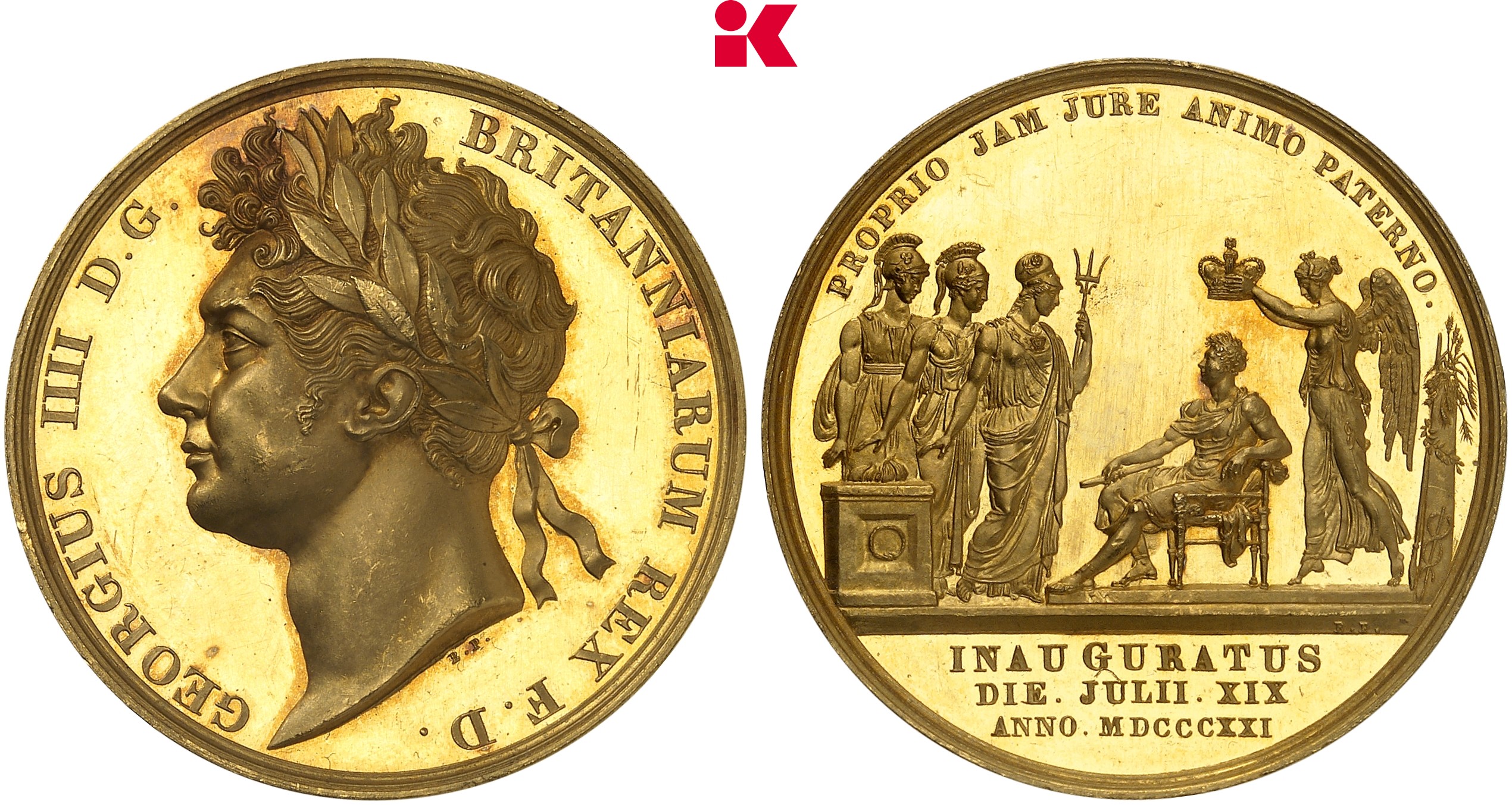
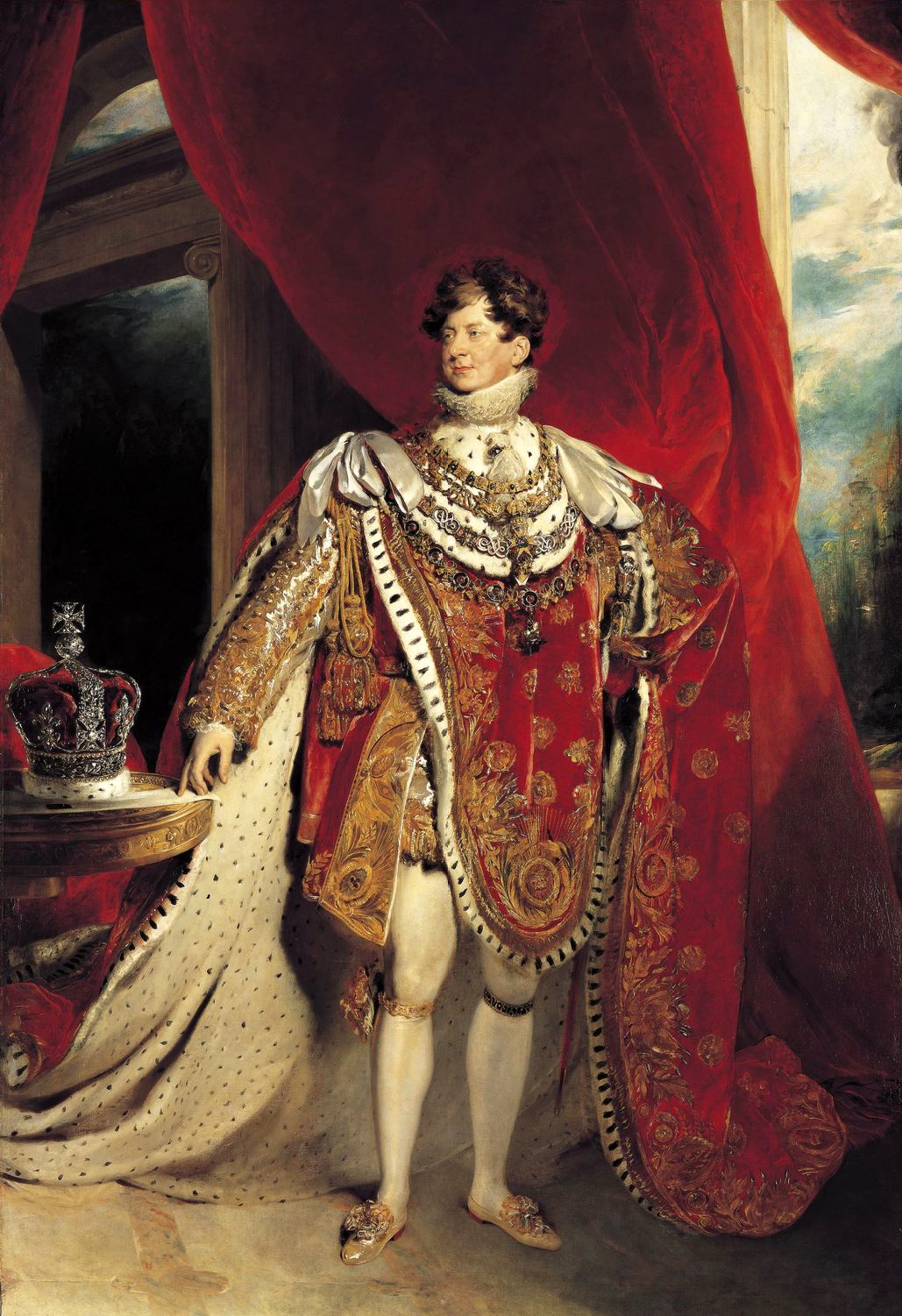
The hearing of the bill in the House of Lords took place on 17 August 1820. Henry Brougham was able to demolish the credibility of the bought witnesses under cross-examination. The king's reputation reached its lowest point as a result of the proceedings, and his coronation therefore did not take place until a year later, on 19 July 1821. The king's extravagant tastes drove the total cost of the festivities to twenty-four times the cost of his father George III's coronation 58 years earlier. The obese George IV suffered so greatly under the heavy new robes and the new crown on that hot July day that he later declared he would not endure such hardships again for any additional kingdom. The medal, by contrast, presents an idealised portrait of the king in the style of a Roman emperor.
Image caption: Thomas Lawrence: King George IV, painting 1821.