

by Ursula Kampmann
Christian Andreas Cothenius (1708-1789) was the personal physician to Frederick II and reorganized the Prussian military hospital system. In his will, he stipulated that a sum of 1,000 gold talers, invested at five per cent interest, should be used to promote medical research. In keeping with the spirit of the Enlightenment, he specified that the Academia Leopoldina-Carolina should propose prize questions, with the person submitting the most remarkable answer being awarded a gold medal every two years, funded by the interest on his capital.
.jpg)
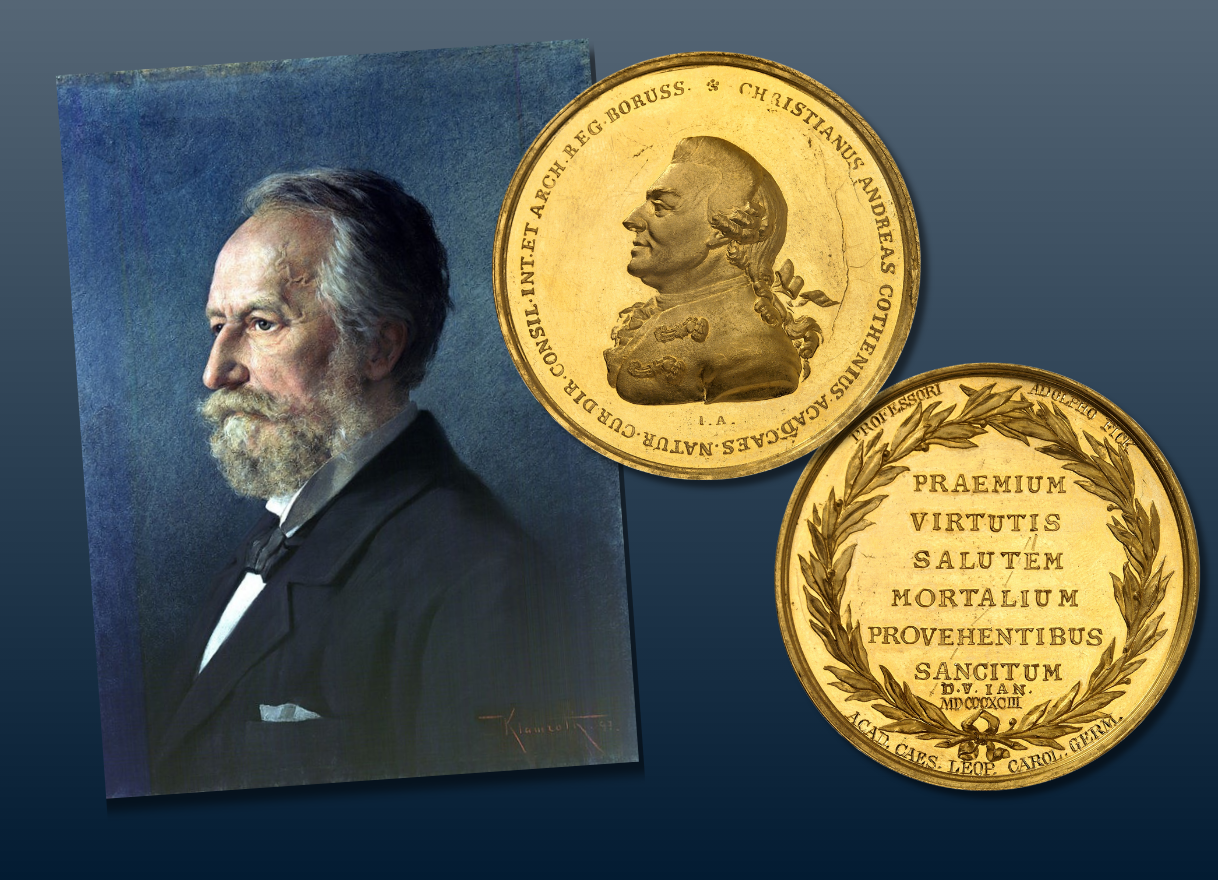
Cothenius had the medal of 60 talers – a value he also determined himself – designed during his lifetime and had the die produced at the Berlin mint. Jacob Abraham, a Jewish engraver who had worked as die cutter and royal engraver at various Prussian mints since 1752, was responsible for the design. The obverse of the medal features the bust of its founder, the reverse bears a Latin inscription within a laurel wreath. Its translation reads: “In recognition of the diligence of those who promote the welfare of mortals.” Below this, added later and therefore somewhat compressed, is the date of the benefactor’s death. The original design did not factor in the possibility of engraving the name of the award winner. Consequently, the winner’s name also appears rather squashed at the upper rim of the medal.
The Academia Leopoldina-Carolina: Finances and Competitions
The academy responsible for these awards was founded in Schweinfurt in 1652 as a private society of some physicians. In 1687, Emperor Leopold granted the association of natural scientists the Grand Privilege, thereby conferring upon it the coveted status of a “national” academy, making it independent of all territorial princes. In 1712, Charles VI confirmed these privileges and permitted the society to be known as the Leopoldinisch-Carolingische Akademie der Naturforscher. The Leopoldina-Carolina was one of the most important natural science societies of the late 18th and the 19th centuries.
Cothenius served as vice-president for many years and was familiar with the academy’s financial problems. Thanks to his initiative, and after interest was first paid on 5 January 1791, twelve prize questions were formulated between 1789 and 1817, which led to five prize-winning contributions. However, the upheavals of the French Revolution caused serious problems for the Leopoldina-Carolina, and consequently for the Cothenius competition. The society’s headquarters were located in the residence of its president, who happened to live in Erlangen – a city that changed hands five times between 1791 and 1812. Each time, the authorities demanded detailed information about the society, its members and its finances – especially after the publisher of its journal was shot on Napoleon’s personal orders in 1806.
When the then renowned botanist and mycologist Nees van Esenbeck became president, his main concern was not coming up with new questions for the Cothenius competition. Funding was scarce in all areas, to the extent that the president decided to use not only the interest, but also part of Cothenius’ capital, reallocating it from its intended purpose in order to address the numerous financial shortfalls.
In 1858, Dietrich Georg Kieser took over the office. He ensured that the capital supposed to finance the medal was refunded and increased to 1,200 talers. On 1 August 1859, he had a prize question published for the first time in 42 years: Does pustula maligna caused by the injection of trypanosomiasis protect against typhus, plague or yellow fever? Could injecting cattle with the typhus (plague, etc.) contagion cause disease in them in the same way that cowpox is caused by injecting cattle with variola.
However, the era of prize questions had come to an end by the second half of the 19th century. Scientists no longer worked on demand, but on a long-term basis. Therefore, by the 1 September 1861 deadline, only one answer had been received. The jury attested that the answer had “a subject matter that was far removed from the prize question” and there were “many objections” to the author’s argument. For the next two prize questions there were no answers at all – a good reason to consider a new approach.
The Most Important Scientists of Their Age
The new Leopoldina-Carolina statutes were introduced in 1872, and the society has not held competitions since 1876. Instead, it awards the Cothenius Medal to distinguished scientists in recognition of their achievements in mathematics and astronomy, physics and meteorology, chemistry, mineralogy and geology, botany, zoology and anatomy, physiology, anthropology, ethnology and geography resp. scientific medicine. Many Nobel Prize winners have received the Cothenius Medal, including Iwan Petrowitsch Pawlow, Otto Hahn and John Carew Eccles as well as renowned figures such as Rudolf Virchow and Konrad Zuse.
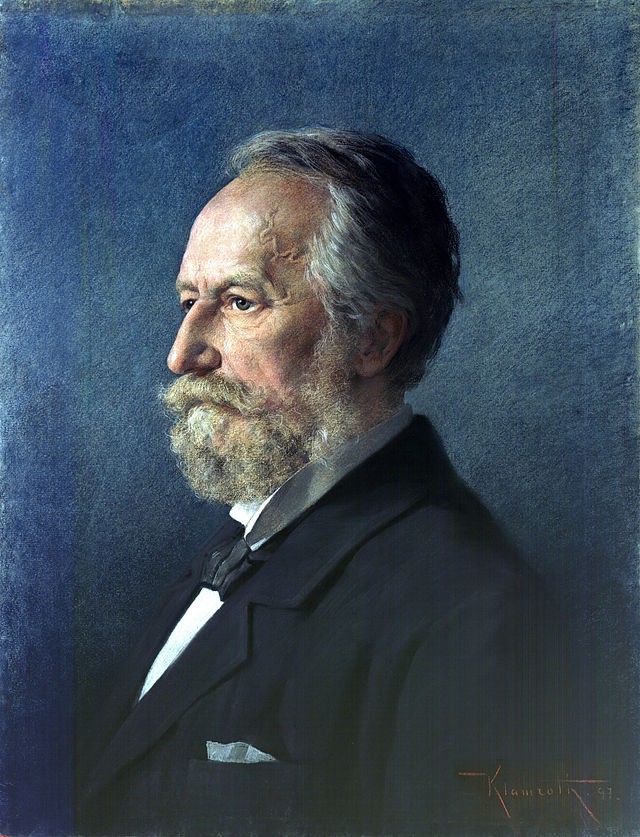
Adolf Fick: A Pioneer of Modern Physiology
In 1893, Adolf Eugen Fick received the Cothenius Medal. Born in Kassel in 1829, the physician was one of the great pioneers of modern physiology. He was not content merely to describe bodily functions, as physiologists had done for centuries. Instead, he wanted to understand how the body worked. Having studied mathematics, he began to apply mathematical and physical methods to the human body.
In 1851, he received his doctorate for a thesis on astigmatism, a visual impairment which he attributed to errors in the curvature of the cornea. Fick then turned to research. In 1853, he qualified as a professor in Zurich, where he first taught as an associate professor and then, from 1862 on, as a full professor of physiology. In 1868, he moved to Würzburg, bringing worldwide recognition to its Institute of Physiology.
Among other things, Fick studied how substances were transported through the human body. To describe his theories, he formulated Fick’s laws of diffusion, which is still valid today, and he invented the plethysmograph, an instrument used to record blood velocity and detect changes in arterial volume.
He also researched circulation and cardiac output. In 1870, he used Fick’s principle to calculate cardiac output based on oxygen consumption and the arteriovenous concentration difference in oxygen.
He also investigated how muscles function and how energy is released for this process. This is the context of the invention of the pendulum myograph for measuring muscle twitches. Also notable is the applanation tonometer, which made it possible for the first time to measure intraocular pressure. The Imbert–Fick law, which is applied in this process, is still of crucial importance in ophthalmology today.
Adolf Fick is now recognized as one of the great innovators of 19th-century medicine, paving the way for modern medicine.
A Unique Testimony to Modern Medical History
With the Cothenius Medal from the possession of Adolf Eugen Fick, Künker offers a unique testimony to modern medical history. This item is sure to spark interest among all those whose collecting activities focus on medicine, its representatives and its history.
Sources:
Hermann Knoblauch, Geschichte der kaiserlichen Leopoldinisch-Carolinischen Deutschen Akademie der Naturforscher während der Jahre 1852 bis 1887 mit einem Rückblick auf die Frühere Zeit ihres Bestehens. Halle 1889. https://ia801306.us.archive.org/27/items/geschichtederka00knobgoog/geschichtederka00knobgoog.pdf “Adolf Fick”. In: Würzburg Wiki. https://wuerzburgwiki.de/wiki/Adolf_Fick “Christian-Andreas-Cothenius-Medaille”. In: museum-digital-sachsen-anhalt https://st.museum-digital.de/object/100