


Pilgrims Rest and the First South African Gold Finds
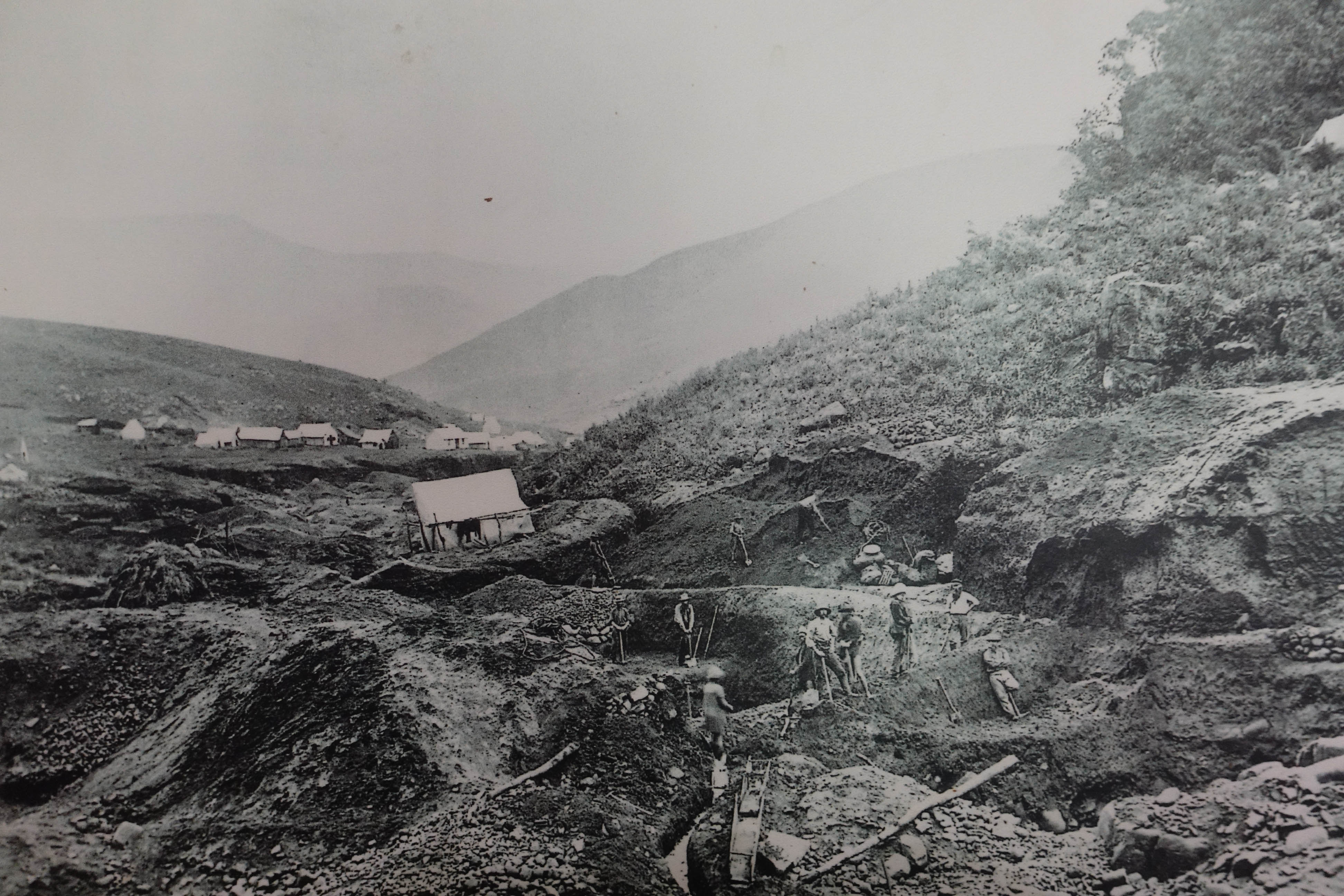
Around 1870, the ZAR — often referred to as the Transvaal — was on the verge of state bankruptcy. Its banknotes were not accepted abroad. Even within the country they circulated at no more than a quarter of their face value. Thomas François Burgers, president of the ZAR from 1872, saw this as one of the country's central problems. Gold-rich South Africa on the brink of bankruptcy? But at the time of Burgers's inauguration, the goldfields of the Witwatersrand had not yet been discovered. On 15 August 1873, the following report appeared in the pro-government newspaper Volkstem: "A group of three men extracted [at Pilgrims Rest] 28 ounces of gold (which I have seen), the result of six weeks of washing. Approximately one third consisted of beautiful gold nuggets, the pieces weighing between half and two and a half pennyweights [1 pennyweight = 24 grains = approx. 1.55 g, ed.], while the remainder consisted largely of fine gold." The extent to which this report is connected with Burgers's journey to Pilgrims Rest in the same month cannot be reconstructed. What we do know, however, is that the number of gold prospectors increased rapidly thereafter. By this point Burgers had already purchased a portion of the gold and made contact with his Consul General in London. On 9 February 1874 he informed him in writing that he planned to have coins struck bearing his portrait, and requested that the Consul General kindly set this in motion. He enclosed his portrait and 300 ounces of gold with the dispatch.
Image caption: Unknown photographer: Gold mining at Pilgrims Rest.
Fine Beard and Coarse Beard
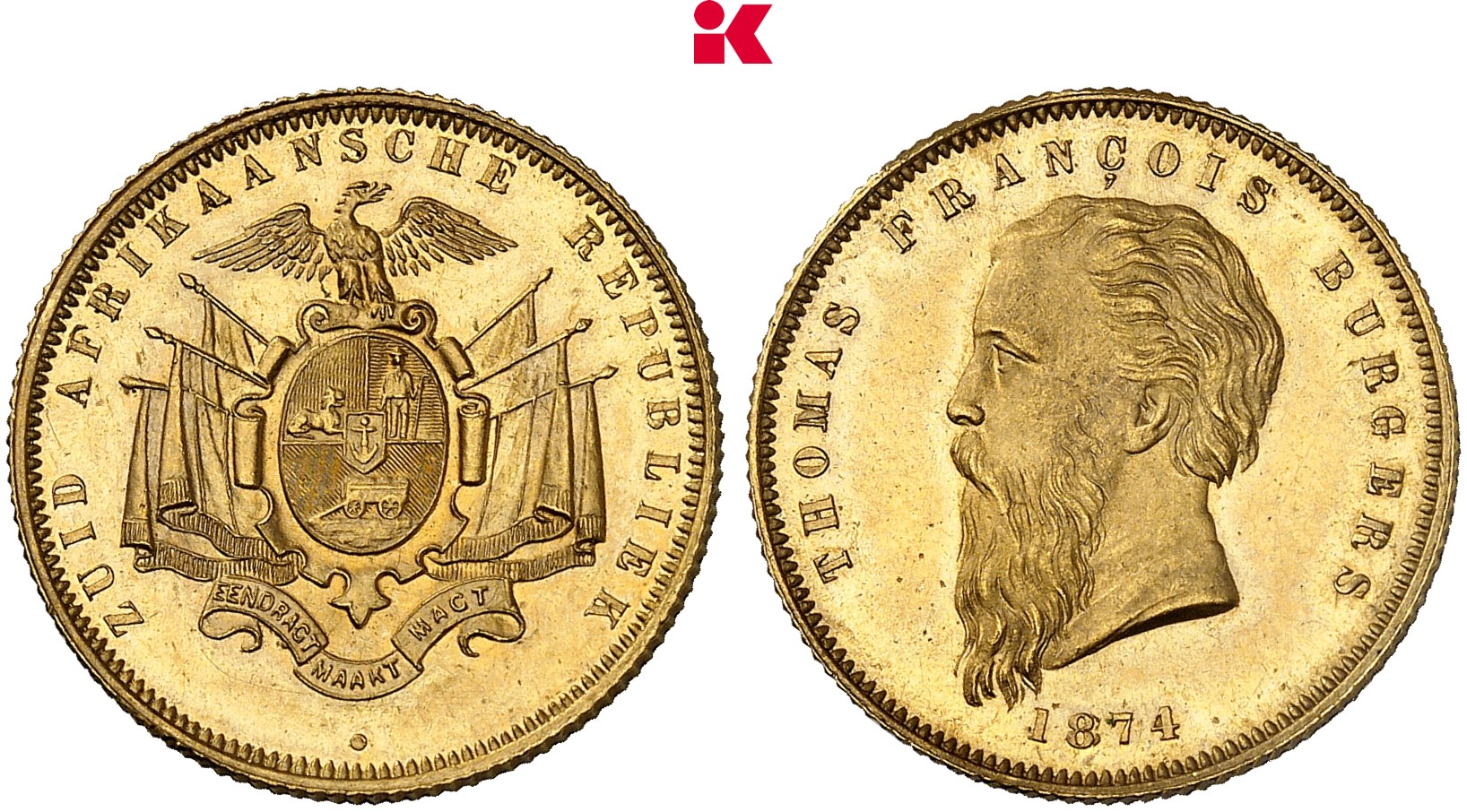
Wyon of the British Royal Mint accordingly produced the die, with which Ralph Heaton & Sons in Birmingham carried out the striking. In August 1874, the first 695 pieces reached the head of state of the Transvaal. Burgers presented his stable gold currency to the Volksraad. To his surprise, the 28 deeply devout members of parliament did not share his enthusiasm. On the contrary — they were incensed at his presumption in having his own portrait placed on the coin. Only after two days of heated debate did the Volksraad agree to recognise the coins as legal tender under the name "Staatspond." The Burgers Pond played no role in monetary circulation, however. There were simply not enough of them, even though a further 142 pieces were delivered in September. It was not until the twentieth century that numismatists recognised the later deliveries to be a variant. The original die had broken and a new one had been produced. The two varieties are therefore referred to as the "fine beard" and the rarer "coarse beard."
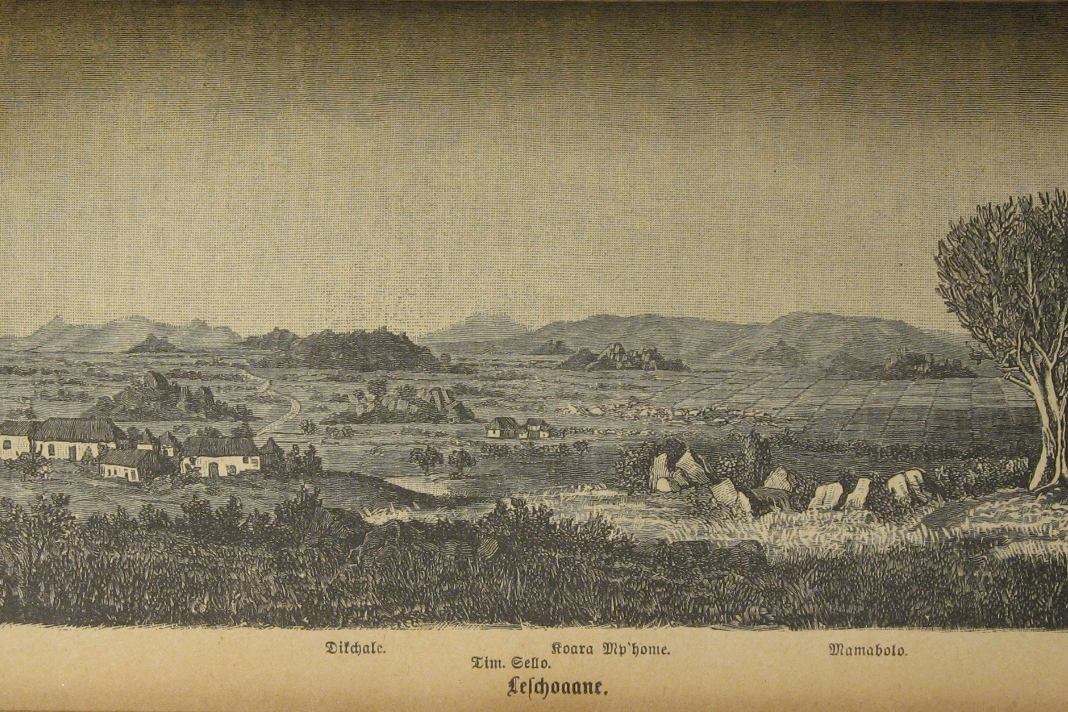
Image caption: Unknown artist: Mphome Mission of the Berlin Missionary Society, print (postcard) 1886.
How Did a Rare South African Coin Come into the Possession of the German Imperial House?
We have no written source documenting how the Burgers Pond entered the collection of the Hohenzollern Museum. It may of course have been a diplomatic gift, but formal diplomatic contacts with the Empire did not begin until considerably later. Paul Kruger travelled to Berlin for the first time from 7 to 10 June 1884, leading a delegation to meet with William I and Bismarck. Private contacts between Berlin and the Transvaal, however, had existed long before this, since the Berlin Missionary Society was very active there. Prussian clergymen served at South African mission stations, seeking to bring the indigenous population their religion and what was then regarded as education — as many other European missionary societies were doing at the same time.
We regard this today with scepticism. In the nineteenth century, by contrast, missionary work met with broad approval and a high willingness to donate. To collect donations, missionaries would regularly travel back to their homeland, give accounts of their area of work, and bring with them exotic objects, which they would often present to generous donors.