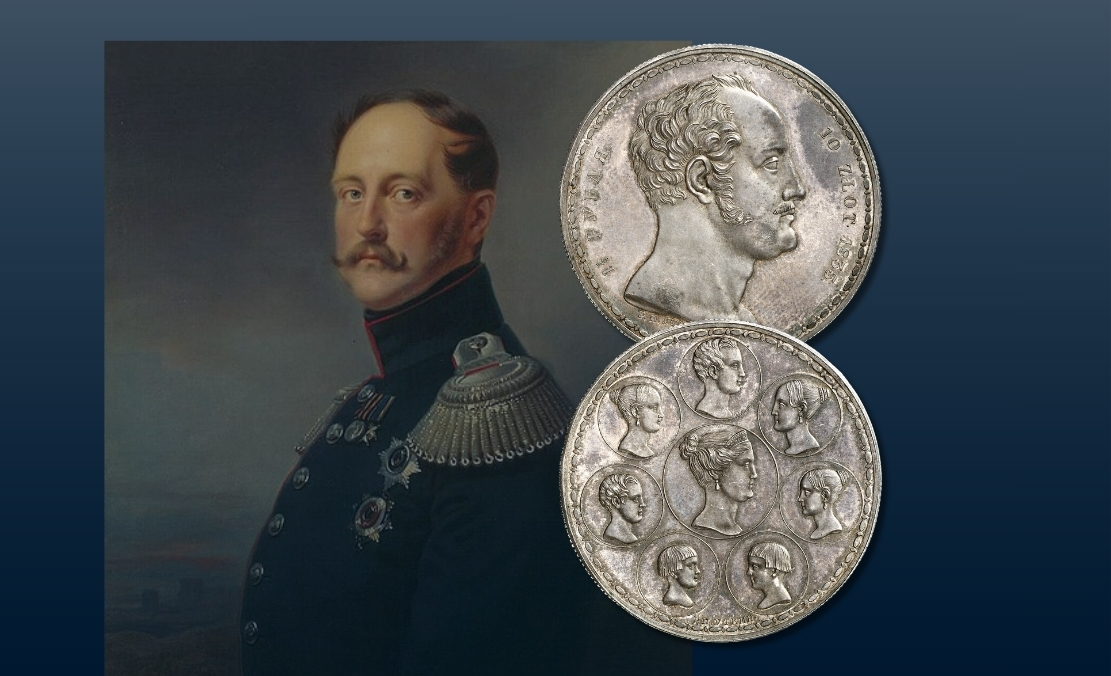


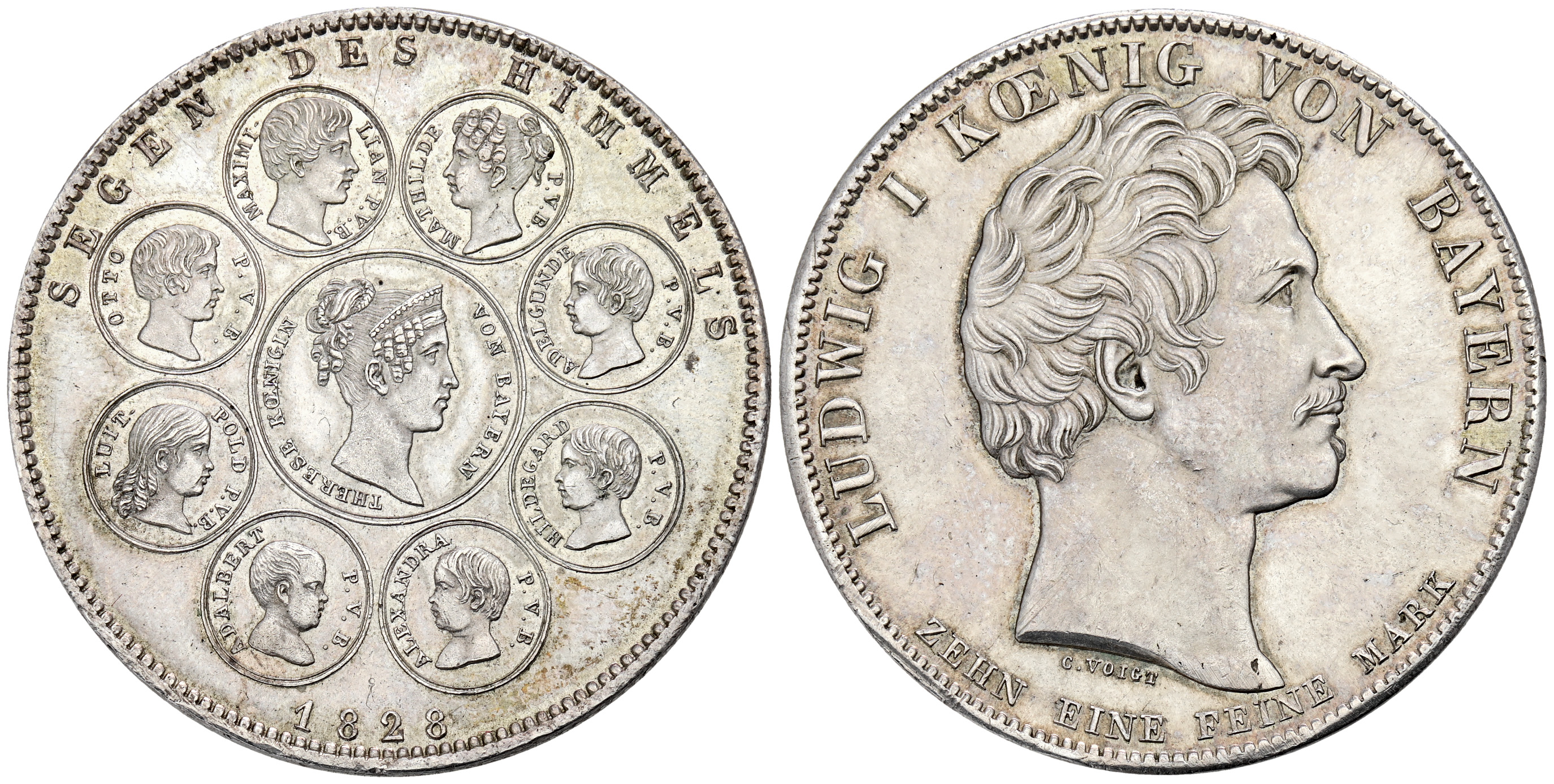
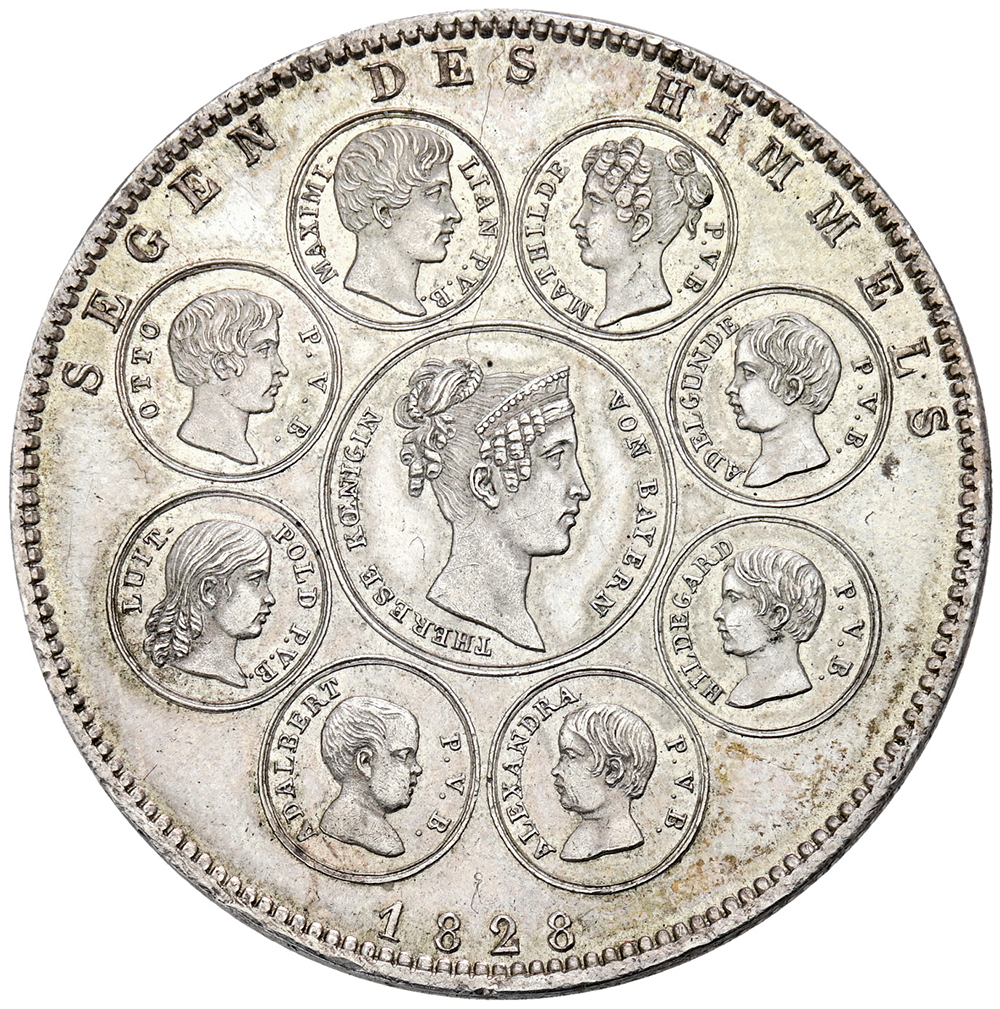
In September 1835, Russian Ambassador Prince Grigory Ivanovich Gagarin sent a coin from Munich to Russian Minister of Finance, Count Yegor Frantsevich Kankrin. The coin the ambassador was so thrilled about and that was intended to complete the coin collection of the St. Petersburg Hermitage was one of the “historical thaler” of Bavarian King Louis I (1825-1848) from 1828. It showed the monarch’s portrait on the obverse and a depiction of his family (his wife and his eight children) on the reverse – called by the inscription “Segen des Himmels” (‘blessings of heaven’) (fig. 1). Since the 10th anniversary of the Tsar’s rise to power was approaching, Count Kankrin decided to commission a similar coin. With this “family rouble” one of the most coveted rarities of the history of Russian coinage came into being, which, by the way, was the only contemporary coinage that showed the facial features of the ruler.
Minister of Finance Kankrin commissioned the young but very skilled die cutter Pavel Petrovich Utkin with the production of the dies, who was working as a medalist at St. Petersburg Mint only since January. In the strict numismatic sense, the term “family rouble” isn’t quite correct because the minted nominal value rather is 1 ½ rouble or 10 złoty. Circulation coins of the same Russian-Polish denomination were manufactured under Nicholas I already in 1833 and 1835 in the Mints of St. Petersburg and Warsaw.
- Alexander (II), April 17 –March 1, 1881 (Tsar 1855-1881).
- Maria, August 6, 1819 – February 9, 1876 (married to Maximilian Josèphe Eugène Auguste Napoléon de Beauharnais, Duke of Leuchtenberg 1817-1852).
- Olga, August 30, 1822 – October 18, 1892 (married to King Charles I Frederick Alexander of Wuerttemberg 1823-1891).
- Constantine, September 9, 1827 – January 13, 1892 (Grand Duke of Russia).
- Nikolas, July 27, 1831 – April 13, 1891 (Grand Duke of Russia).
- Michael, October 13, 1832 – December 5, 1909 (Grand Duke of Russia).
- Alexandra, June 12, 1825 –July 29, 1844 (married to Landgrave Frederick William (II) George Adolph of Hesse-Kassel-Rumpenheim 1820-1884).
In the beginning of December 1835, Utkin presented the first draft (fig. 2). In contrast to its Bavarian model, the Russian imitation had only had a very short inscription. The coin showed neither the title of the monarch nor a statement referring to the planned occasion of its being issued (the 10th anniversary of the beginning of his rise to power). Instead, only the year, 1835, and the nominal value (1 ½ РУБΛЯ. – 10 ZŁOT) as well as the full name of the die cutter (Р.П. УТКИНЪ) were stated on the coin’s obverse and reverse. In addition, the signature on the reverse wasn’t entirely correct because the family name lacked the grammatically required hard sign “Ъ“.

46 specimens were minted of this first pair of dies of which only 36 were given to the Minister of Finance to be presented to the Tsar. On December 6, 1835, the test strikes were presented by Kankrin to Nicholas I who approved of the idea of a commemorative coin, all right, but required that some changes were being made. Above all he was displeased with the depiction of his 36 year-old wife. She is said to have appeared older and reminded him too much of his mother-in-law.
Hence, Utkin made a second design according to the ruler’s wishes (fig. 3). In this draft, dating to 1836, changes were being made, in particular regarding the reverse: the medallion-shaped circles around the heads of the family members had been removed as well as the (wrong) signature. Most striking, however, were the changes about the portrait of the Tsarina: the double chin was flattened, and the entire character appeared “younger”. Nicholas approved of the new draft and ordered on February 2, 1836, for 100 pieces to be produced. The first die of this coinage, however, displayed cracks after only 50 specimens so that a new one had to be made.

On the third pair of dies (fig. 4) the die cutter’s signature on the obverse was again abbreviated to the initials П. У. (P. U. instead of R. P.) in Cyrillic script and moved from the edge on the neck truncation of the monarch. According to the wishes of the Tsar, 150 specimens were produced with these dies in three stages between 1836 and 1837. Allegedly, a gold pattern of this type was likewise being made (cf. Bitkin 890).

Even after these official emissions on the orders of the Tsar, the mint produced the family rouble from time to time as novodel by using the original dies, to be given away as present or to be collected (fig. 5). In the course of time, however, the edge of the reverse die chipped, the bigger the mintage the more. By commission of private persons further restrikes were produced until a part of the edge dropped away completely. This very part of the edge of the 4th section coins was roughly mended.

Because there was a continuous demand for restrikes of the family rouble and since the mint didn’t have suitable left in 1847, a fourth pair of dies was produced (fig. 6). A striking feature is that this design completely omits the signature of the die cutter. A probable reason for this is that Utkin suffered from an eye illness in the last years of his life and wasn’t able anymore to make the dies himself. They were produced by another medalist (probably one of his pupils) who, out of reverence for his master, omitted the latter’s signature. In the same year, in 1847, the mintage of restrikes from the St. Petersburg Mint was greatly diminished at the request of a number of influential Russian numismatists. Thus, only some extremely rare patterns from the last pair of dies are extant. The last family rouble of this fifth type was auctioned off 80 years ago in auction Hess 204 “Dubletten russischer Museen” (Frankfurt a. M. 1931), under lot no. 979. No entire set of all five family rouble variants have been sold at an auction so far.
In the end, no more than only very few test specimens of the family rouble were made to be given away as present or to be collected. This extremely rare coinage, therefore, is the only one of the Tsar which, apart from the medals, shows his portrait. All other circulation coins only depict his monogram (a crowed “N” above the Roman number “I”) and/or the Russian eagle. Not least because of this they range amongst the coveted rarities of Russian numismatics.