

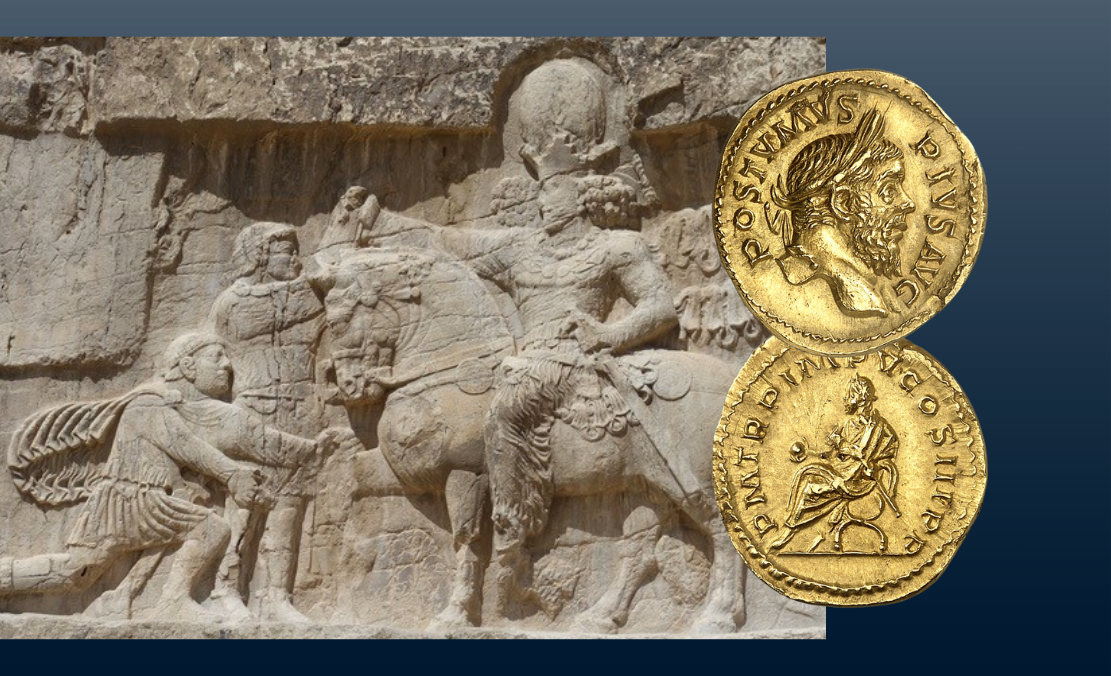

The capture of the Roman emperor Valerian by the Sassanid ruler during a battle near Edessa (Şanlıurfa / Turkey) sometime in the summer of 260 AD marked the darkest hour in Roman history. It was the first and only time that a Roman emperor fell into the hands of the enemy. This disaster affected more than just the military campaign itself. It shook the entire empire! The Roman gods had abandoned the sacred figure of the emperor. Who would now protect the citizens from the barbarians after the border defenses had been compromised?
The burden of responsibility fell on Valerian’s son, although Gallienus was already busy protecting the western part of the empire. His troops had just defeated the Juthungi near Augusta Vindelicorum (Augsburg / Germany), after they had spent months plundering and murdering without punishment in northern Italy. Now it was time to defeat the Alamanni, who had also crossed the Limes to ravage northern Italy. Gallienus only managed to stop them just outside Milan after they had left Aventicum (Avenches / Switzerland) in ruins. Beyond the Limes, the Franks and the Germanic tribes were waiting for any sign of weakness that would allow them to pillage Roman territory.
This means that Gallienus could not really afford to march east. But he could not afford not to march either. The Sassanids were advancing. They had conquered the wealthy city of Antioch (Antakya / Turkey) and had laid waste to Cappadocia and Cilicia. In addition, there were the numerous uprisings of local rulers trying to salvage what they could. To avoid completely losing the trust of his subjects, Gallienus had to go east to avenge his father and regain the lost territory.
Local Interests Vs. the Empire as a Whole
.jpg)
Saloninus vs. Postumus
.jpg)
A Nightmare for Any Historian
And this is where the guesswork begins for us as historians. Written sources concerning the Gallic Empire are so sparse and so unreliable that they are more confusing than helpful. Coins play a crucial role in reconstructing the events, but their interpretation is open to debate.
For example, why did Postumus like to depict Hercules of Deuso on his coins? Was he a local deity in Cologne (Deutz)? Or did the god get his name from the place where Postumus had won his first victory (Deuso)? Or does Hercules’ connection to the Germanic god of thunder, Donar / Thor, point to Postumus’ Germanic-Batavian ancestry (Diessen)? Anything is possible; nothing is proven. You can decide for yourself and come up with your own hypothesis.
.jpg)
Elmer’s Epoch-Making Work
Coins of the Gallic Empire are highly sought-after and valued collector’s items, especially in Germany. What other coins combine local history with the history of the Roman Empire quite so perfectly? Added to this, the coins have been excellently cataloged for decades.
After all, Georg Elmer published his catalog of the coinage of the Gallic emperors in 1941. While elsewhere, coins were still being cataloged by metal, Karl Pink’s star pupil realized the ideas of the Vienna School for the first time in a comprehensible way. He reconstructed the ancient minting plan and presented the issues in a chronological order. This was revolutionary at the time – and is now common practice regarding Roman numismatics.
Thanks to its brilliance, Elmer’s work became the unquestioned authority for generations when it came to identifying coins of the Gallic Empire. The young scholar himself did not live to test his theories. He fell in 1944 in Merošina, near Niš, in present-day Serbia.
.jpg)
Cologne or Trier?
This background nudged scholars to take one of Elmer’s major hypothesis for granted: Based on a few coins whose inscriptions could be deciphered as Colonia Claudia Ara Agrippinensium (= Cologne), Elmer concluded that almost all coins of the Gallic Empire were minted in Cologne. For stylistic reasons, he separated two groups and relocated their minting sites to Trier and Milan.
Elmer’s hypothesis, which was vehemently defended by Carl Friedrich Zschucke, has only recently been questioned by numerous scholars. The most compelling of their arguments is the discovery of a number of coins near Porta Nigra in Trier in 2005. It is clearly not a hoard. Rather, its composition suggests that it is the remains of a coin workshop that was active under Tetricus. Taking this find into account alongside the hoard evidence and stylistic considerations – I will spare you the exact reasoning at this point – there is much to suggest that most of the coins that Elmer assumed were minted in Cologne were in fact produced in Trier.
But what about the pieces that are actually marked as products of the Cologne mint? No one doubts the interpretation of their inscriptions. However, it is now rather assumed that Postumus opened a second mint in Cologne at some point in 268. The antoniniani with the distinctive mint mark and the depiction of Moneta recall its opening.
Jerome Mairat, who published the RIC’s latest volume on the Gallic Empire in 2023, admits himself that some questions remain unanswered. Time will tell to what extent future finds will modify this picture.
.jpg)
The Defenders of the Rhine Border
Let us take a quick look at what the coins reveal about Postumus. There is a surprising number of ships depicted on them. This indicates the importance of the fleet under Postumus. These ships were used to transport troops quickly. They carried soldiers to the areas where border incidents had been reported much faster than would have been possible on foot or horseback. The light naves lusoriae were so easy to maneuver that the soldiers could operate them themselves. This meant that no additional rowers were needed, who would have taken up valuable space.
.jpg)
In the Shadow of World Politics
Gallienus was unable to take immediate action against Postumus. His forces were tied up in the east. This gave Postumus the time he needed to establish his rule. At the height of his power, he was recognized by the legions of Germania, Gaul, Raetia, Hispania and Britannia. The last two were particularly important. They were home to large gold and silver mines, the yield of which allowed Postumus to mint enough coins to pay his troops. However, the star of the Gallic Empire began to fade when these two provinces returned to be controlled by the empire.
But that was not yet the case. It was not until 267 that Gallienus was able to return from the East to the West. He attacked Postumus in his heartland, but was wounded during a siege – possibly of Trier. Gallienus withdrew. Aureolus, who commanded the garrison in Milan on Gallienus’ behalf, revolted and submitted to Postumus. The emperor could not accept this. Milan was the military center of northern Italy. Therefore, Gallienus changed his course of action and moved to Milan, where he was murdered during the siege in September 268. His successor, Claudius Gothicus, ended the rebellion of Aureolus, before immediately marching towards the Balkans, where his presence was urgently required. Consequently, Postumus celebrated his decennalia unchallenged in 269.
.jpg)
Laelianus and Mainz
The beginning of the end of Postumus’ reign came with a rebellion in Mainz. There, the soldiers proclaimed Laelianus as their new emperor. Little is known about his short rule. It is debated whether Laelianus took over one of Postumus’ mints (Trier or Cologne?) for a short time, or established his own mint in Mainz.
In any case, Postumus succeeded in suppressing the uprising. What happened next was fatally reminiscent of the circumstances that had led to his assumption of power: while Postumus wanted to spare Mainz, perhaps to secure his long-time access to its resources, his soldiers demanded that it be plundered. Postumus was killed during the ensuing dispute.
Marius
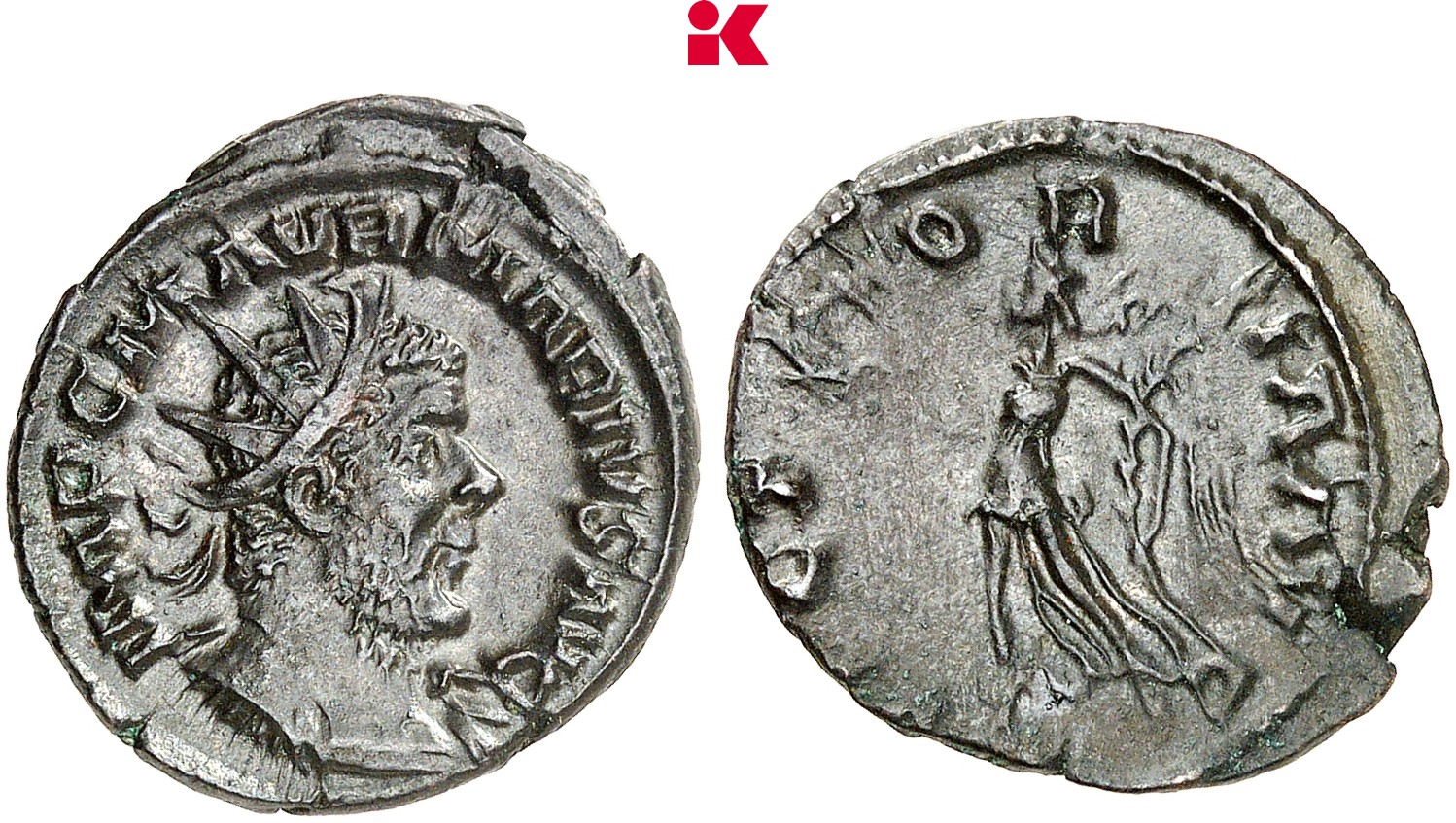
The army proclaimed Marius as Postumus’ successor. We know almost nothing about him. And that should come as no surprise. After all, according to Eutropius and Historia Augusta, he is said to have ruled for only two or three days before being murdered. However, numismatist do not believe this. Many of his coins have survived, and it would have been impossible to produce so many specimens in two or three days. Accordingly, estimates of his reign range from a few weeks to a few months. During this time, the Gallic Empire began to fall apart. Raetia had already returned to imperial control before Postumus’ death, and now Britannia and Hispania did the same.
.jpg)
Candidates from the Provinces
It was clear that the heyday of the Gallic Empire was over when Victorinus took over as emperor. He was from a wealthy and influential family in Trier, and had built his career under Postumus. We know that he had held the office of praetorian tribune, and took over the consulate together with Postumus in 268. He is best remembered for fighting the Aedui, who had allied with Claudius Gothicus in an attempt to reunite Gaul with the Roman Empire. It took seven months for Victorinus to quell the uprising. However, he too was assassinated shortly thereafter, in 271.
.jpg)
Tetricus
It is said that it was Victorinus’ mother who held the Gallic Empire together. She made the soldiers proclaim C. Pius Esuvius Tetricus as the new emperor. He, too, was from an important family – but not from Trier but from Aquitaine. Members of his family had served in the Senate, and Tetricus himself had been senator before becoming governor of his native Aquitaine. Now he established his official residence in Trier. He is said to have no longer used the mint in Cologne – but a unique piece from the Zschucke Collection contradicts this claim. Its reverse bears the mint mark CA. It appears that the Cologne mint remained active under Tetricus. Tetricus was an administrator, not a soldier. His army was defeated at Catalaunum (Châlons-sur-Marne / France) by the new emperor, Aurelianus, who had succeeded Claudius Gothicus. Aurelianus was of a different caliber to his predecessors. He succeeded in reuniting the Roman Empire under one ruler.
One of the reasons for this may have been that Aurelianus took a pragmatic approach. After Tetricus obediently participated in the triumphal procession of Aurelianus, he did not execute him, but instead appointed him to an administrative post.
It is remarkable that Aurelianus did not impose damnatio memoriae on the rulers of the Gallic Empire. This could perhaps be interpreted as a sign of respect, whereby Aurelianus silently acknowledged that Postumus and his successors had defended the west for the Roman Empire, while the emperors had been busy in the east. It was thanks to men like Postumus that there was something left to reorganize for Aurelianus, and Diocletian after him, enabling them to bring about another peak of the Roman Empire.
Bibliography:
Georg Elmer, Die Münzprägung der gallischen Kaiser in Köln, Trier und Mailand. Bonner Jahrbücher 146 (1941)
Andreas Luther, Das gallische Sonderreich. In: Die Zeit der Soldatenkaiser. Eds.: Klaus-Peter Johne. Berlin (2008), pp. 325-343
Jerome Mairat, Roman Imperial Coinage. Volume V.4 The Gallic Empire (AD 260-274). London (2023)