

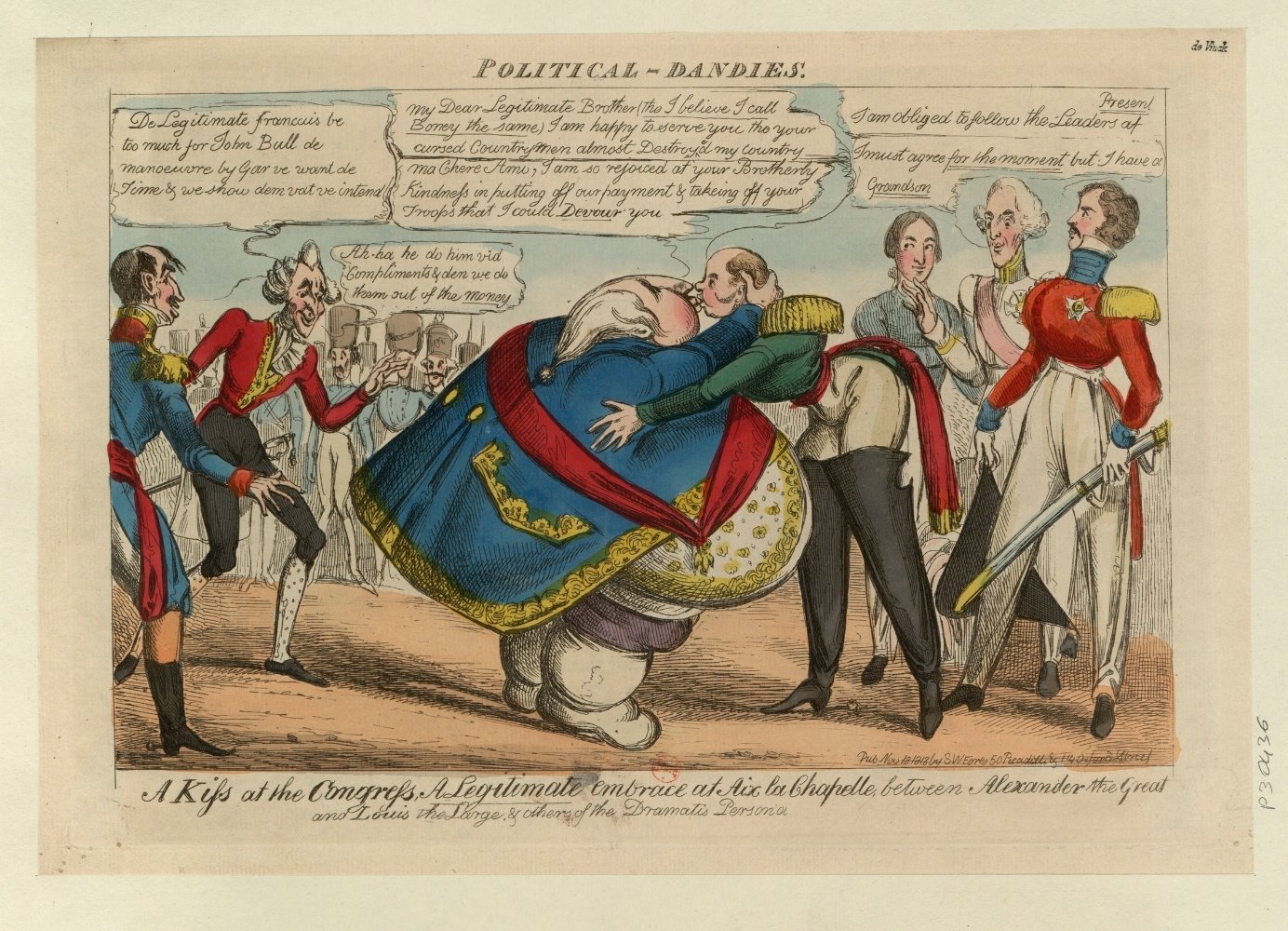
From 29 September to 21 November 1818, a gathering of high-ranking politicians took place in Aachen to negotiate the withdrawal of the Allied occupation forces from France, which was in the process of paying the final instalment of the reparations agreed at the Congress of Vienna. Among those present were Alexander I, Francis I with his Chancellor Prince Metternich, Frederick William III and State Chancellor Prince Hardenberg, the Duke of Wellington, and the new French Foreign Minister, the Duke of Richelieu. The brilliant French diplomat Talleyrand was no longer in attendance — he had lost influence because he was considered too liberal for the new regime.
The Congress of Aachen was in general conducted under the sign of reaction. Alexander I presented a memorandum "On the Present Condition of Germany," in which he called for strict measures to monitor the activities of intellectuals — a demand that was to have far-reaching consequences.
Image caption: William Heath: Contemporary caricature entitled "A Kiss during the Congress, a legitimate embrace in Aachen between Alexander the Great and Louis the Corpulent, together with other figures of the occasion." Coloured copperplate engraving, 1818. Depicted from right to left: Frederick William III, the Duke of Richelieu, Louis XVIII, Alexander I, the Duke of Wellington(?), Prince Metternich, and an unknown figure.
Idea and Commission
The idea of commemorating the congress on a medal did not arise until a year later. On 14 October 1819, the Aachen antiquary Carl Franz Meyer — appointed Prussian Privy Councillor by Frederick William III during the Aachen Congress — addressed a memorandum to the king suggesting that a medal be struck to commemorate the Congress of Aachen as well, since medals had also been produced on the occasion of earlier congresses held in the city. The king liked the idea. On 6 November he commissioned State Chancellor Hardenberg to provide suitable designs, who in turn approached the Academy of Sciences, which entrusted the task to its historical-philosophical class.
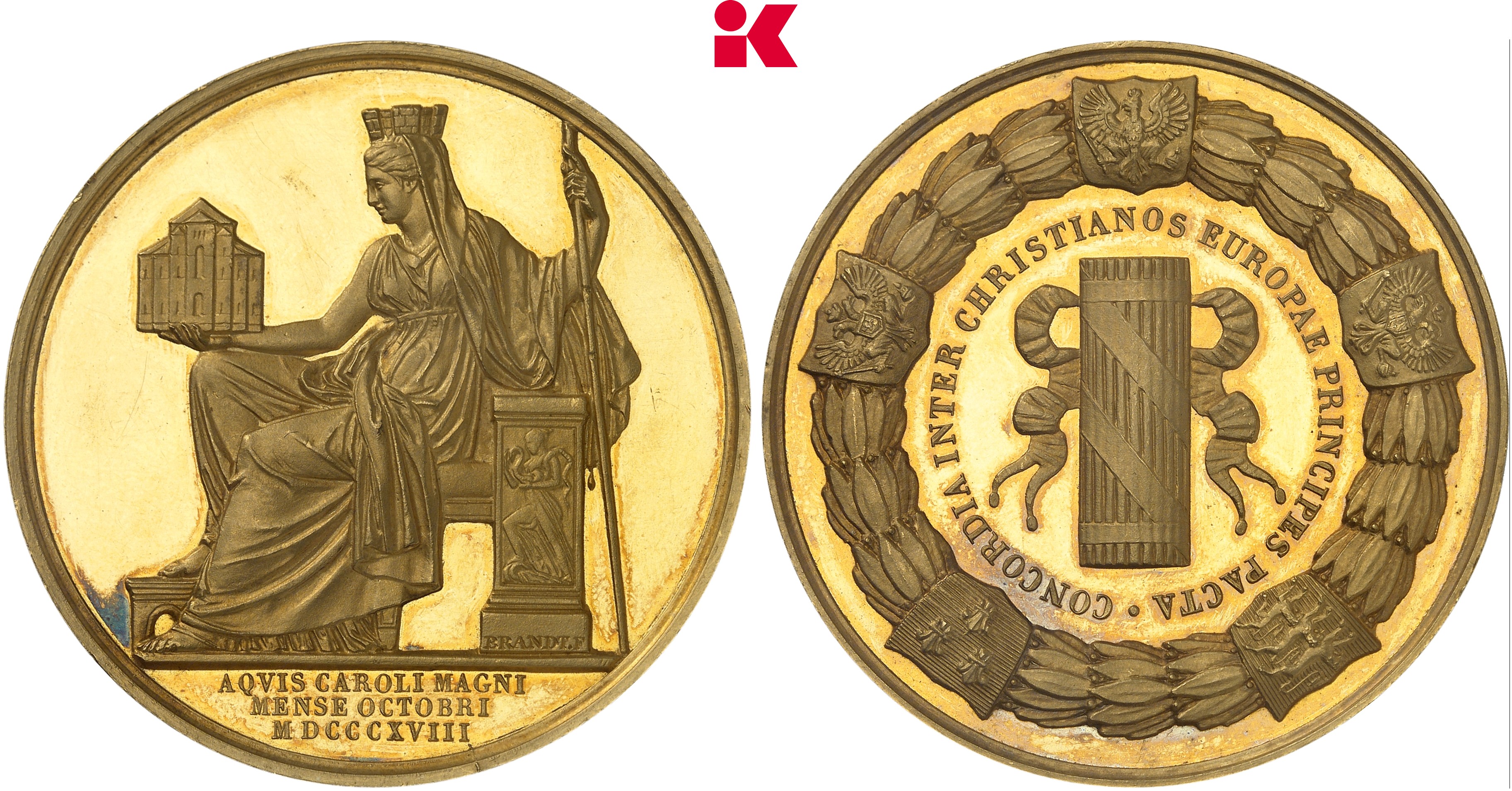
By 12 December, the report together with drawings was complete. The obverse of the medal was to show the three sovereigns — Alexander I, Francis I, and Frederick William III — with the inscription Consensus Principum (= Accord of the Princes). For the reverse, a personification of the city of Aachen was proposed, "with the mural crown upon her head, holding the former imperial sceptre in her left hand, and in her right the still-existing palace chapel of Charlemagne, above whose domed roof the image of the Virgin Mary, to whom the chapel is dedicated, appears seated." As an inscription the commission proposed Concordiae pactis inter christianos Europae principes (= On account of the concord through treaties among the princes of Christian Europe). This was chosen, the commission explained, because all the great Christian princes of Europe had participated.
The king found the designs unsatisfactory. In his view they were neither contemporary nor aesthetically appealing, and the inscription lacked precision. On 6 January 1820 he commissioned Karl Friedrich Schinkel to design the medal. The artist explained at length why he had departed from the Academy's proposal: "The ideas put forward by the Academy have been taken as a partial basis, but in terms of composition and characterisation a number of things have been given new motivation. On the principal side I have retained the personification of Aachen, but have drawn the magnificent chapel of Charlemagne precisely after its original form; and to identify the location more closely with reference to the change of name, which sits well here, I have placed a Hygieia at a spring beside the throne. On the reverse, the heads of the three monarchs proposed by the Academy might too greatly exclude the other two principal powers of Europe that participated in the congress; I have therefore believed it possible to correspond more universally to the subject by means of a laurel wreath, strongly twined in the antique manner, within which the arms of Prussia, Russia, Austria, England, and France are intertwined — a fasces in the centre — and the inscription Concordia Pactis inter christianos Europae Principes (= Concord through treaties among the Christian rulers of Europe)."
The Execution
The king approved the design, and Henri François Brandt — just appointed First Medallist of the Royal Prussian Mint — produced the dies. On 26 December 1821, Hardenberg presented the king with the first strikings in silver and gold. Brandt had stated in writing that he would guarantee up to 1,000 medals could be struck from the pair of dies. Should more be required, a second die would need to be cut. He would charge 100 Friedrichs d'or for each die. Should the king prefer an alternative payment arrangement, he was also prepared to be paid proportionally at 4 Groschen per medal.
A Gift for the Participants...
The king was more than satisfied with Brandt's work. He had 12 gold, 52 silver, and 6 bronze medals produced, which he sent to the congress participants as personal gifts.
...and a Sound Business for the Mint
The mint was thereafter permitted to strike medals to order. From September 1822, it sold the medal commemorating the 1818 congress in gold for 81 thalers, 15 silver groschen, and 9 pfennigs; in silver for 4 thalers and 20 silver groschen; and in bronze for 10 silver groschen and 7½ pfennigs. The detailed information on the creation of the medal commemorating the Congress of Aachen has been preserved because Hildegard Lehnert, granddaughter of Henri François Brandt, published a book in 1897 on the life and work of her grandfather, in which she evaluated archival material preserved in his estate.