

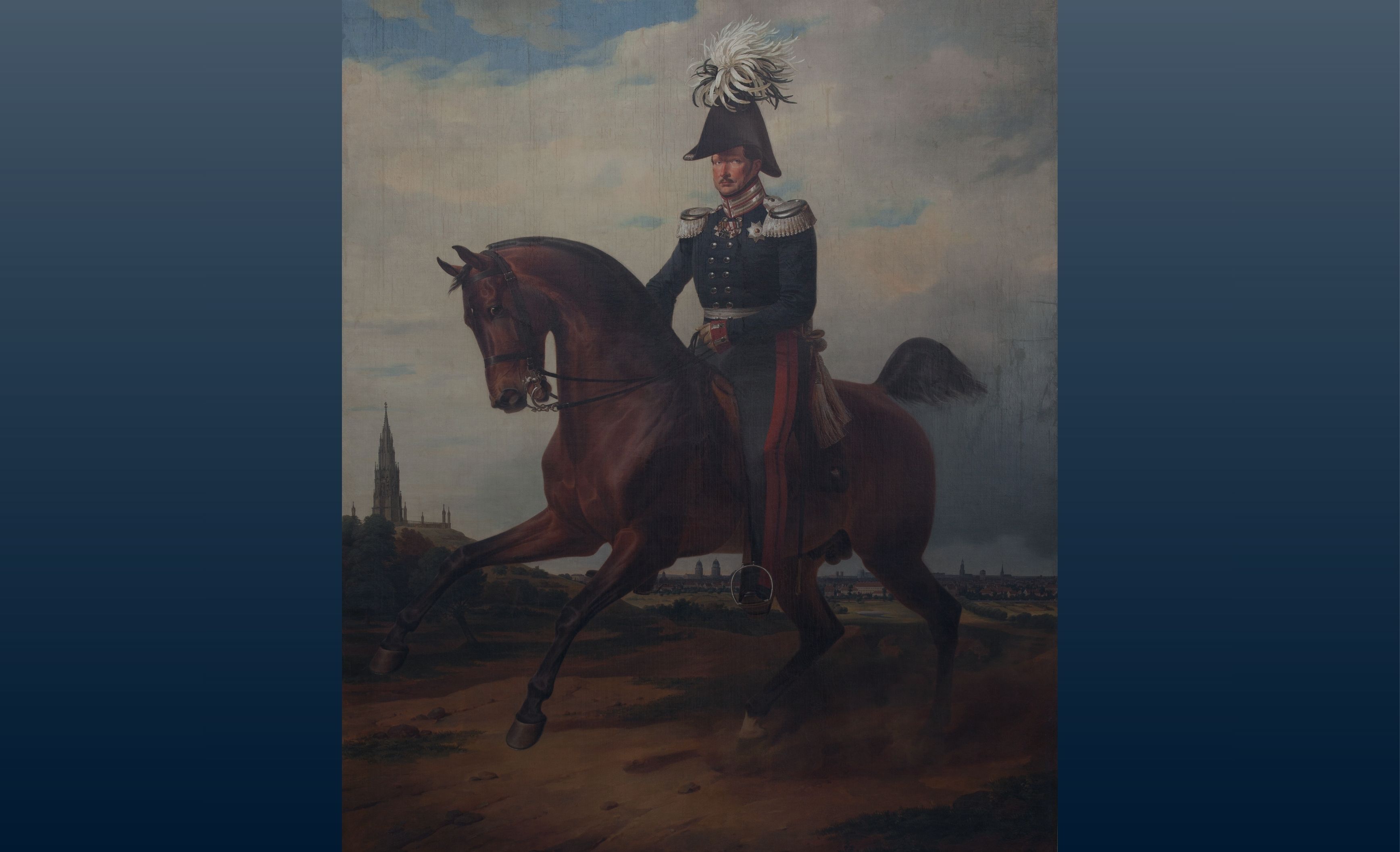
With his plan to erect a monument in honour of those who had fallen in the Wars of Liberation, Frederick William III was taking up an idea that had originated among the citizens of Berlin. He entrusted the architect Karl Friedrich Schinkel with the planning.
Image caption: Franz Krüger: King Frederick William III on horseback, with the Kreuzberg monument in the background, painting 1832.
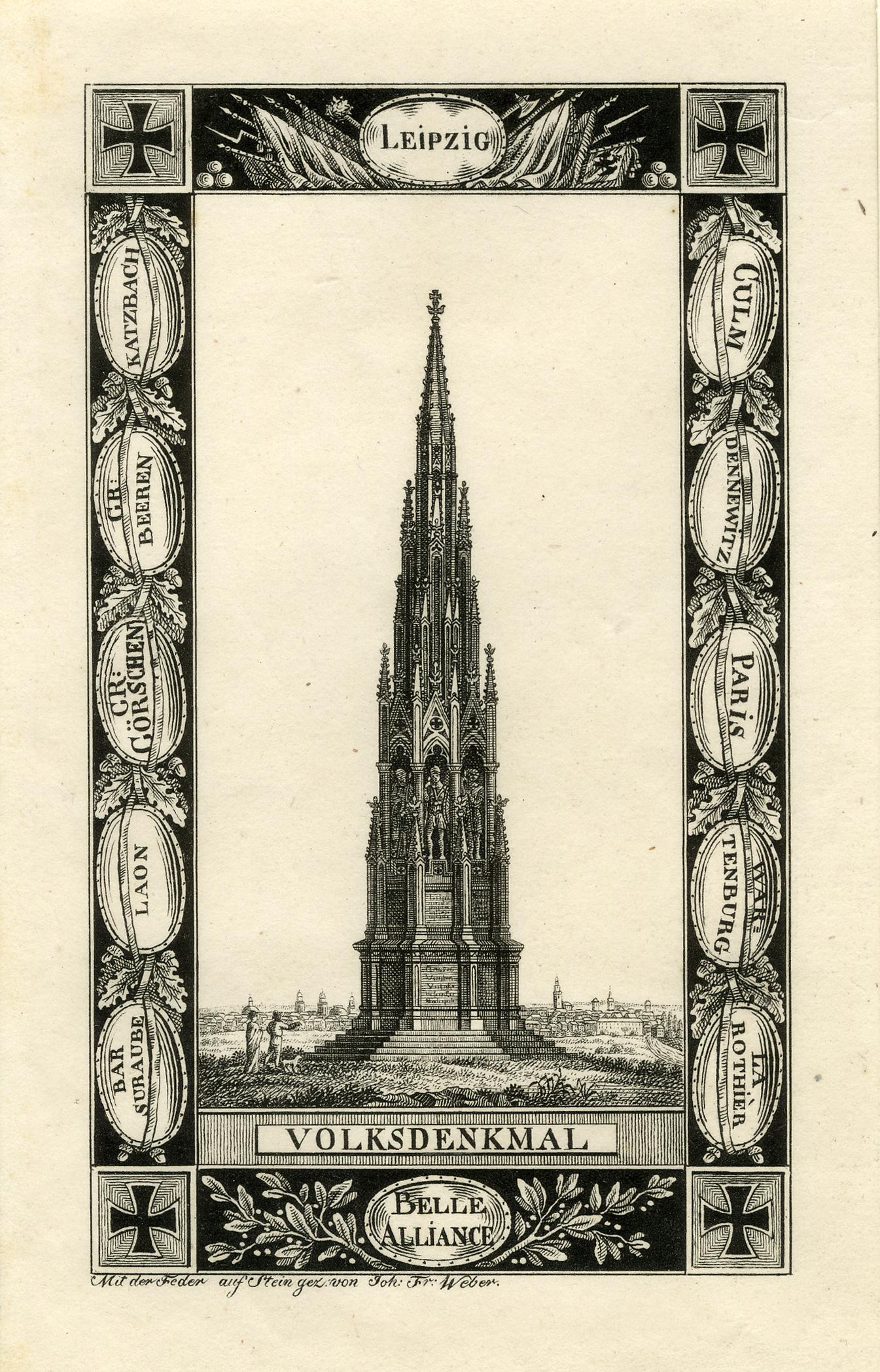
Plans for the Monument
Schinkel designed a vast Cathedral of Freedom whose gigantic dimensions exceeded the financial means of a Prussia bled dry by war. The grand project was therefore reduced to a tower of 19 metres in height, crowned by an Iron Cross. This was deeply symbolic. The Prussian population had made iron a patriotic metal through the campaign "Gold gave I for Iron." The Iron Cross was moreover a military decoration created by Frederick William III in 1813. The neo-Gothic style of the monument carried symbolic meaning and drew upon Romantic motifs. In the age of Romanticism, Gothic architecture was perceived — historically incorrectly — as the quintessentially German style. The highest point of the Tempelhofer Berg, as it was then known, was chosen as the site for the monument. The location was isolated, far in front of the city, and exposed by its elevated position. The cross could be seen even from the Berlin City Palace.
Costs and Financing
The monument was commissioned by the Prussian king. The total cost is unknown. However, the Royal Iron Foundry, entrusted with the production of the individual components, estimated the cost of casting the separate parts of the monument and its figures alone at 20,646 thalers.
Image caption: Unknown artist: The people's monument on the Kreuzberg, Berlin, lithograph 1819.
The Foundation Stone
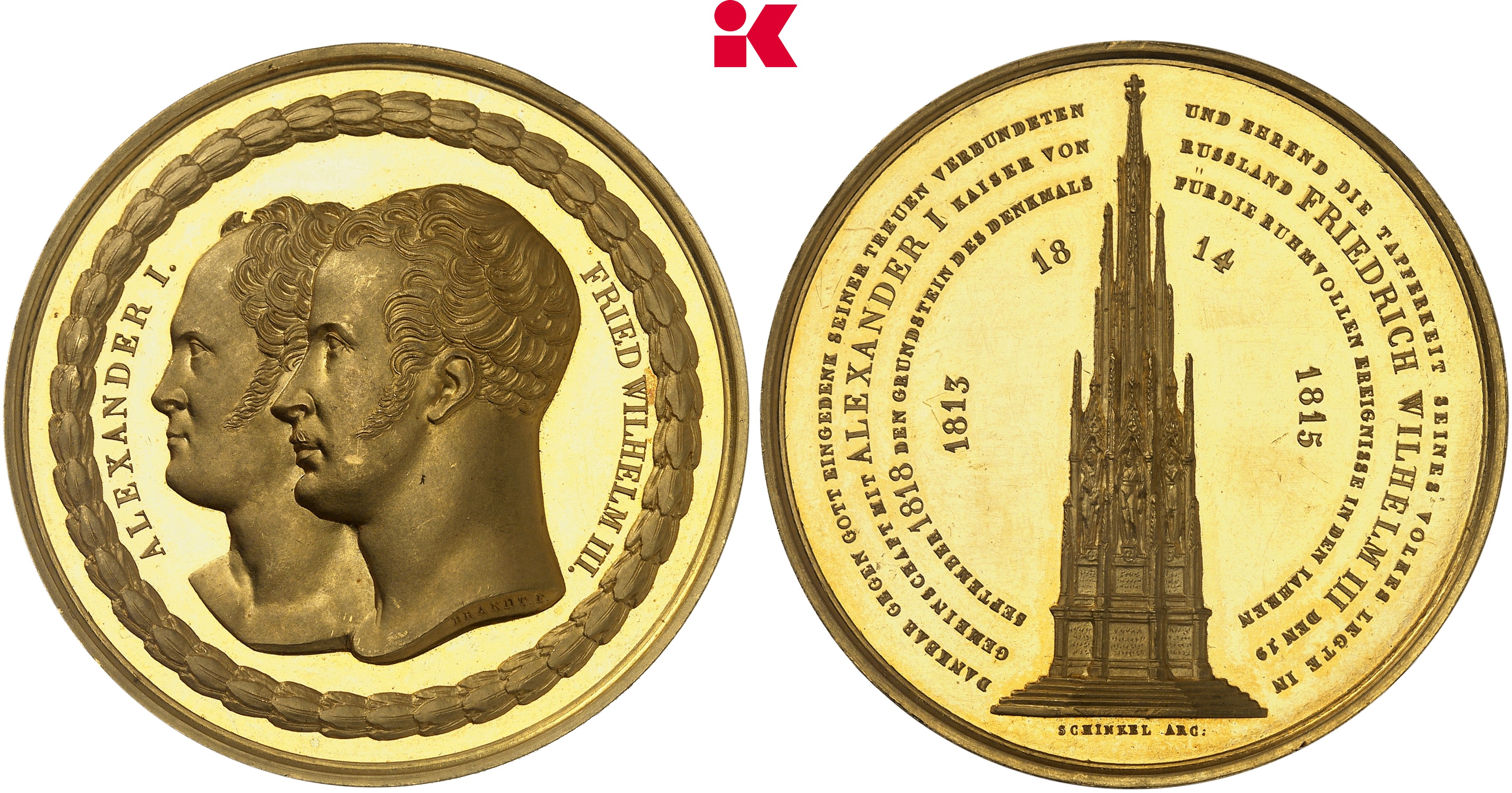
The magnificent gold medal from the collection of Emperor William I (Lot 288) was struck on the occasion of the laying of the foundation stone on 19 September 1818. The ceremony was a political and diplomatic spectacle in which not only the Prussian royal family but also Emperor Alexander I participated. In the presence of over 20,000 soldiers and 50,000 civilians, Alexander I — accompanied by salvoes from 56 cannon specially positioned for the occasion — delivered the three symbolic blows of the hammer upon the foundation stone. These were followed by the hammer blows of the king, the princes, and other dignitaries. On that same day, Frederick William III issued a cabinet order in which he dedicated this monument to the people. He announced that it would be completed within the course of a year.
The Inauguration
In fact, the inauguration did not take place until 30 March 1821. The date was deliberately chosen. It was the anniversary of the storming of Montmartre during the Battle of Paris in 1814 — a military success regarded as the decisive event leading to the (first) fall of Napoleon. On the occasion of the inauguration, the hill hitherto known as the "Tempelhofer Berg" received the name "Kreuzberg," which was later to be extended to the entire district.
A Question of Height
As the Berlin of the Gründerzeit period grew and buildings threatened to obscure the monument, the Berlin Police Headquarters issued a regulation prohibiting the erection of structures that would block the view. This prohibition lapsed on 14 June 1882, when the Prussian Supreme Administrative Court established that it was the task of the building authorities to avert dangers, not to pass aesthetic judgements. By this time, Emperor William I had already arranged for the monument — 18.83 metres tall and weighing 200 tonnes — to be raised hydraulically by placing it on an eight-metre-high plinth.