

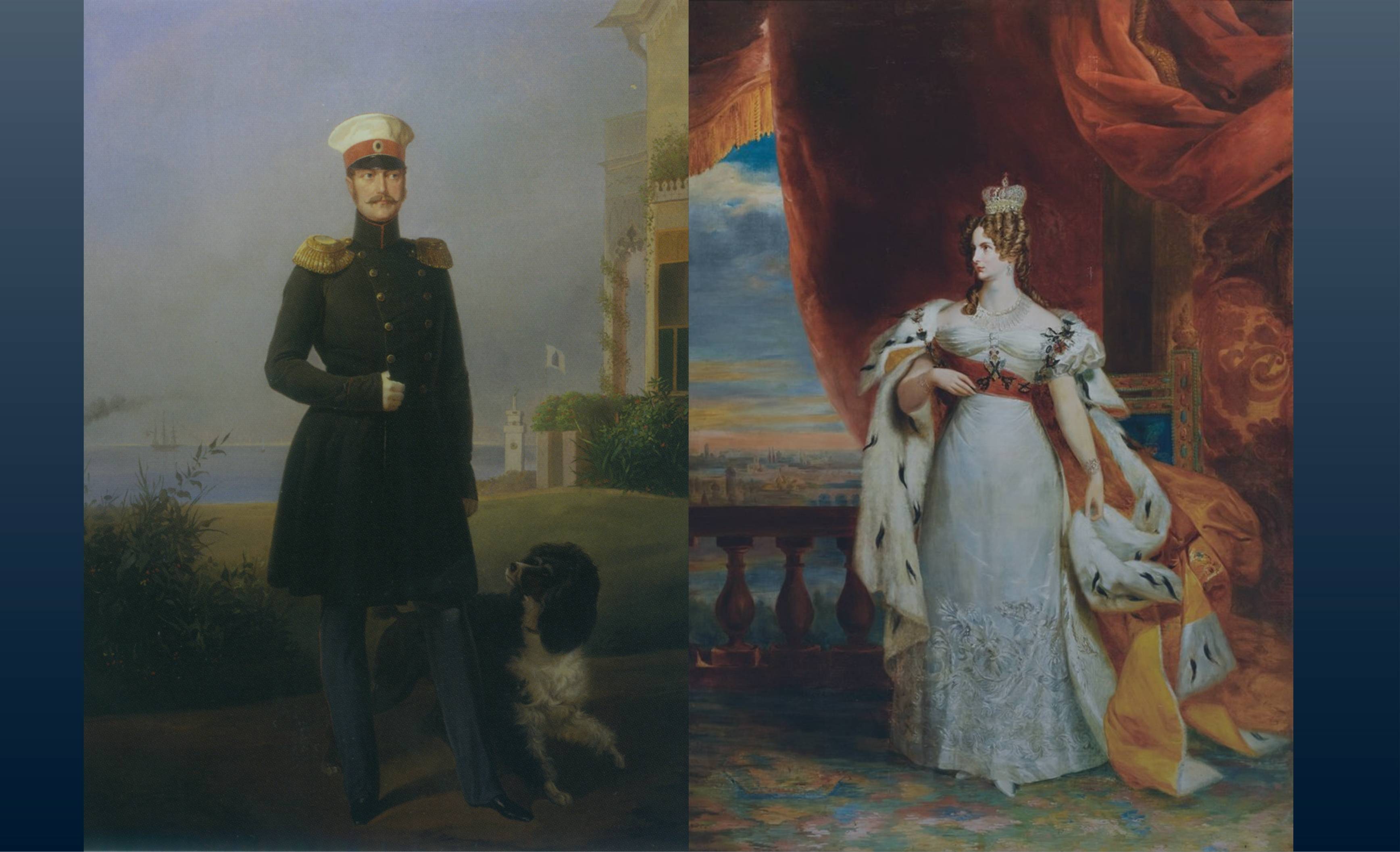
Alexandra Feodorovna, depicted at the centre of the reverse of the Family Rouble, was born in 1798 as Princess Charlotte of Prussia and thus as sister of Crown Prince Frederick William (IV) and Prince William (I).
Following Napoleon's banishment to the island of Elba in April 1814 and in preparation for the Congress of Vienna, Grand Duke Nicholas visited Berlin with his brother Michael in the autumn of that year. Negotiations regarding a marriage between Charlotte and Nicholas are said to have already taken place at this time. The two fell in love — as can be gathered from the correspondence and diary entries of the Prussian princess — most probably during Nicholas's second visit to Berlin in 1815. The young couple became engaged before his return to Russia, though two years were to pass before the wedding. In June 1817, Charlotte travelled with her brother William to St. Petersburg, where she converted to the Russian Orthodox faith and took the name Alexandra Feodorovna. On her nineteenth birthday, 13 July 1817, the marriage to Grand Duke Nicholas Pavlovich was solemnised. Although this appears to have been a love match, the union was intended primarily to serve the political strengthening of the alliance between Prussia and Russia.
Nevertheless, the marriage must have been exceptionally happy and characterised by deep harmony. When parts of the Winter Palace in St. Petersburg were destroyed by fire in 1837, Nicholas is said to have been relieved that a casket containing Charlotte's letters from the time of their engagement had survived the flames.
Just one year after the wedding, on 29 April 1818, Alexander — the future Emperor Alexander II — was born. With him, the couple visited various European royal houses, always presenting themselves as a happy and carefree family. Nicholas is said to have been a strict but loving husband and father.
Even from Russia, Charlotte maintained her close ties to Prussia through weekly — later monthly — letters to her two elder brothers, Crown Prince Frederick William (IV) and above all to Prince William (I). The relationship between the Russian emperor and Charlotte's brothers was warm, though it became strained after the Revolution of 1848.
In Berlin, William had made himself the enemy of the revolutionaries through his staunchly conservative conduct and was ordered by his brother to depart for exile in London in March 1848. Charlotte wrote to him in June 1848 urging him to take over the government in Prussia in place of his elder brother, but the heir apparent rejected this suggestion. Nicholas gave serious consideration to marching into Prussia in order to reverse the reforms.
Image captions f.l.t.r.
Igor Bottmann: Emperor Nicholas I before the Cottage at Peterhof, painting 1849.
George Dawe: Empress Alexandra Feodorovna, painting 1826.
The First Design after a Bavarian Model
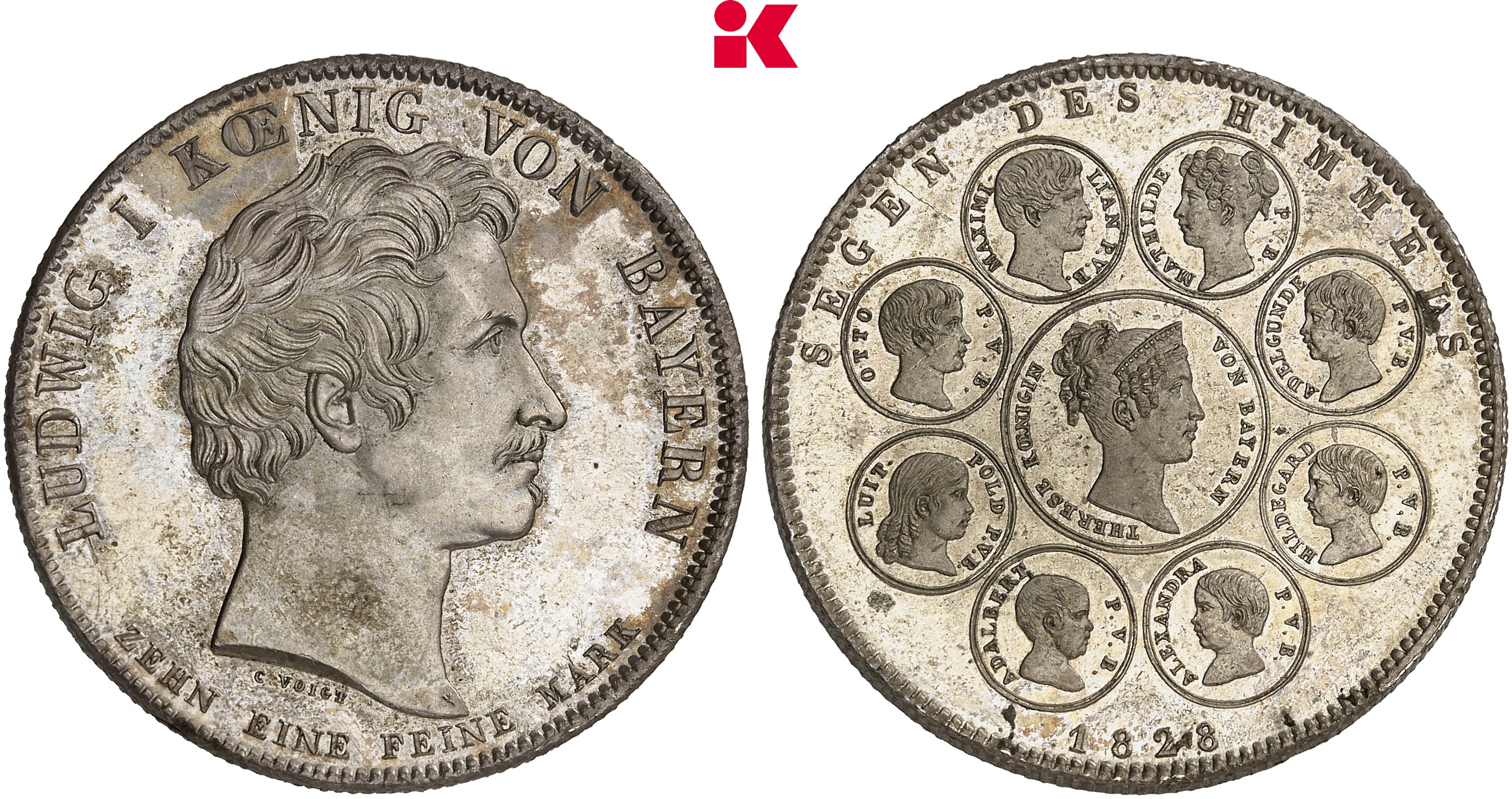
In 1828, Bavaria had issued the commemorative thaler "Blessing of Heaven" (Lot 227), showing on the obverse the portrait of Ludwig I (1825–1848) and on the reverse the bust of his wife Therese at the centre, surrounded by the busts of their eight children. This coin fascinated the Russian ambassador Prince Grigory Ivanovich Gagarin, who in September 1835 sent an example to Count Kankrin, the Russian Finance Minister.
Count Kankrin was equally taken with the Bavarian coin, and since the tenth anniversary of Emperor Nicholas I's accession to the throne on 24 December 1835 was approaching, the Finance Minister placed the commission for the so-called Family Rouble.
The First Design
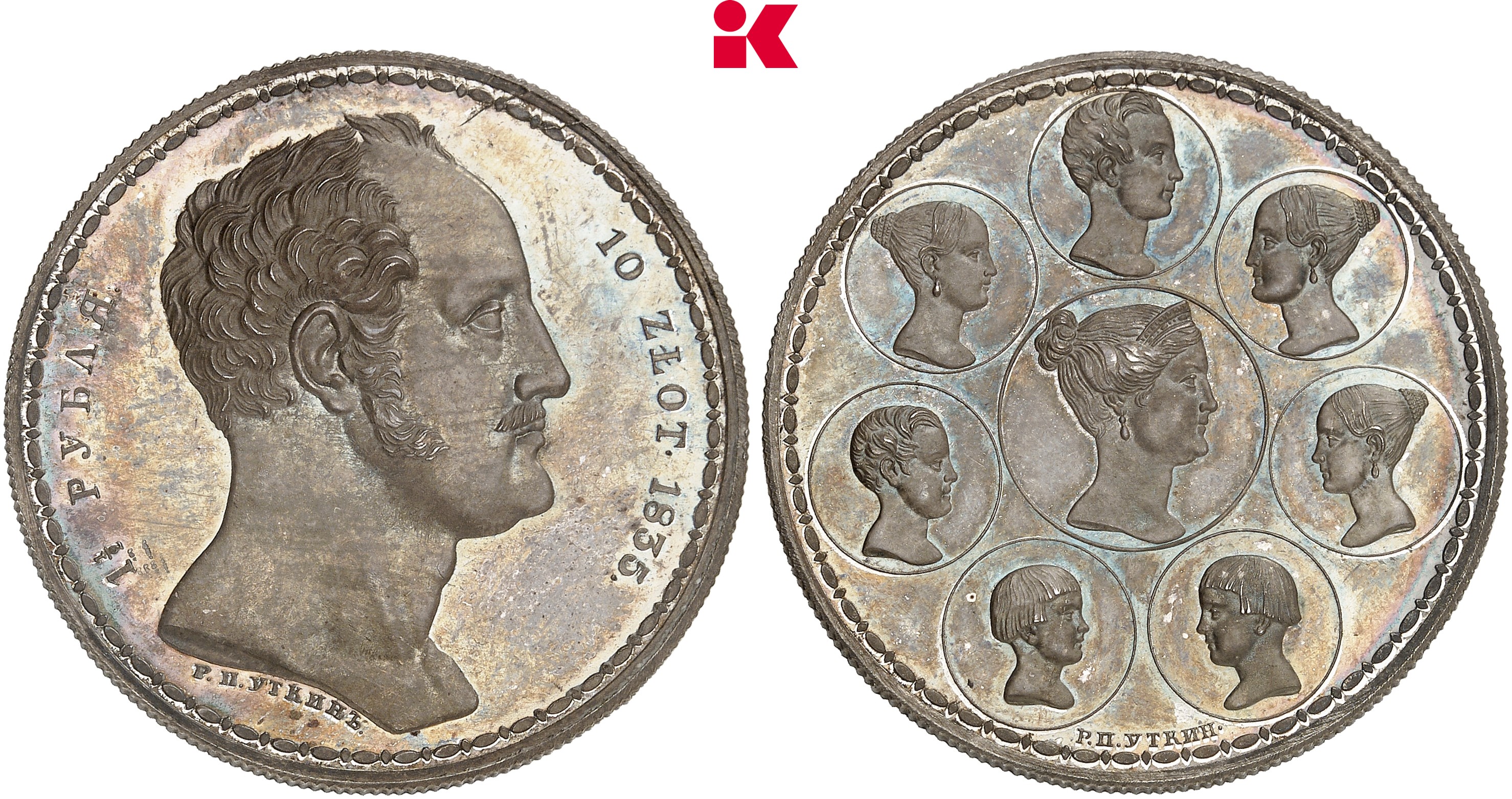
The commission from Kankrin was taken on by the still young but already highly talented die-cutter Pavel Petrovich Utkin. Since the Bavarian model depicted the ruler on the obverse, the Family Rouble became the only contemporary coin of Nicholas I also to show his portrait. On the reverse, Empress Alexandra Feodorovna was placed at the centre, surrounded by the busts of the seven children. At the beginning of December 1835, Utkin was able to present his first design. The iconography was still very close to the Bavarian model, though the legend had been significantly reduced: neither the name of the emperor or his family on the reverse, nor the occasion for the striking — the tenth anniversary of his reign — was mentioned.
Image captions f.l.t.r.
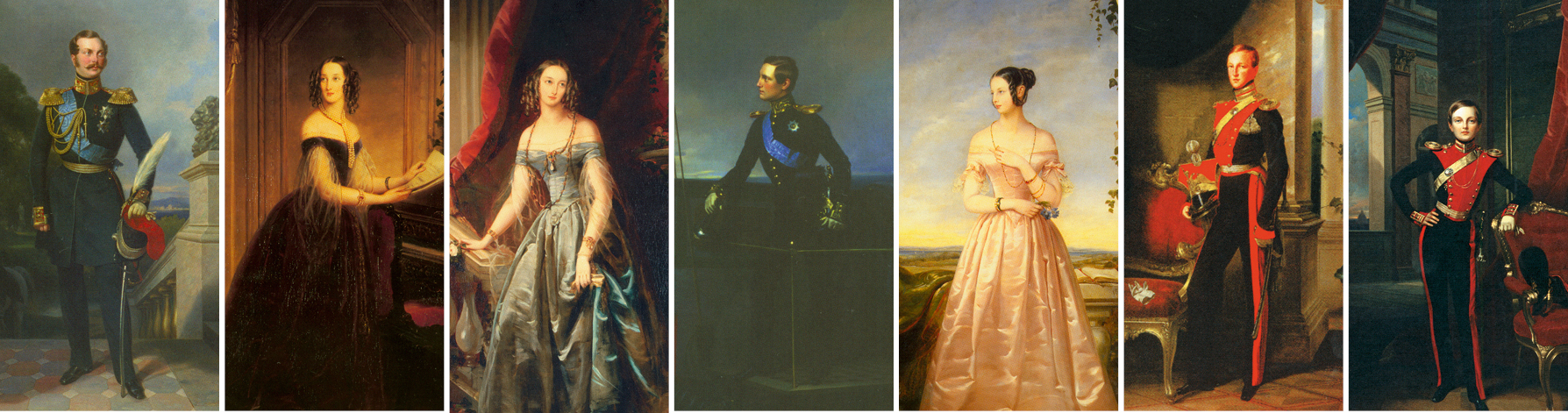
Franz Krüger: Portrait of Grand Duke Alexander Nikolaevich, painting 1847.
Christina Robertson: Portrait of Grand Duchess Maria Nikolaevna, painting 1841.
Christina Robertson: Portrait of Grand Duchess Olga Nikolaevna, painting 1841.
Franz Krüger: Portrait of Grand Duke Konstantin Nikolaevich, painting 1847.
Christina Robertson: Portrait of Grand Duchess Alexandra Nikolaevna, painting 1840.
Franz Krüger: Portrait of Grand Duke Nikolai Nikolaevich, painting 1847.
Franz Krüger: Portrait of Grand Duke Mikhail Nikolaevich, painting 1847.
The Emperor's Requests for Improvements
On 6 December 1835, Kankrin presented the emperor with 36 examples for his assessment. Nicholas I approved the idea of a commemorative coin but requested certain improvements to the first design. He was particularly dissatisfied with the portrait of his wife, which he reportedly felt made her look too old, on account of a double chin. From the second revised die, with a more youthful portrait of the empress, 50 examples were struck before it developed cracks and a third die had to be produced. From this third die, 150 pieces were struck in several production runs, as well as novodels — pieces struck after the official issues for gift and collector purposes using the original dies. A fourth die eventually became necessary when the edge of the third chipped. We do not know how the Family Rouble (Lot 297) came into the possession of Frederick William IV. It is conceivable that the coin was a gift from Nicholas to his brother-in-law. In any case, the present piece is a striking from the first, rejected pair of dies and is thus one of the rarest and most sought-after pieces in Russian numismatics.