

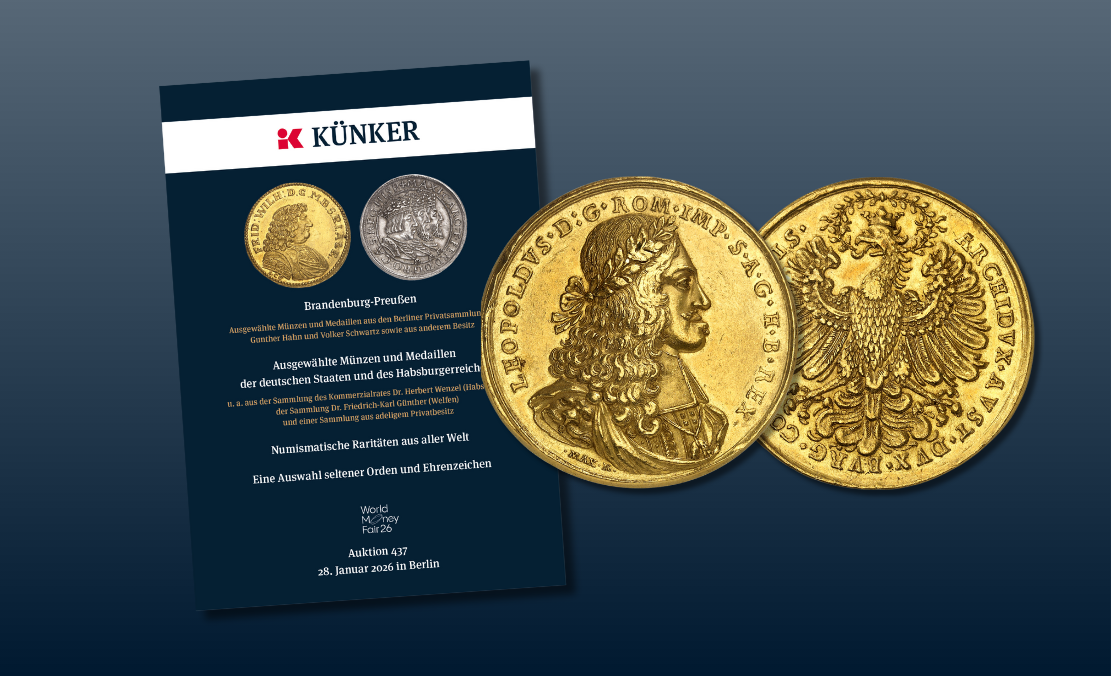


In Germany, the numismatic year begins with the World Money Fair, kicked off by our Auction Sale. What happens there sends an important signal. The prices achieved this year demonstrate that the market appreciates rarities, delivering high results. 694 lots with a total estimate of 6 million euros were on offer. The total hammer price of the auction was 9.5 million euros (excluding buyer’s premium!), approximately 60% more than the total estimate.
.jpg)
By now, it goes without saying that multiple gold coins are extremely popular with numismatic investors. This is proven once again by a 10-ducat coin from Nuremberg, distinguished by its sharp minting quality and its perfect condition. Dating from 1630, the piece is extremely rare. One side shows a winged putto standing frontally and holding the small and the large coats-of-arms of Nuremberg in its hands. The other side is dedicated to Ferdinand II. He is depicted in full regalia, with crown, scepter and coronation cloak, on a rearing horse. 1630 was the year of his greatest power. Wallenstein had just secured him a resounding victory in the Thirty Years’ War, leading the emperor to believe that he could reclaim all the possessions of the Catholic Church via the Edict of Restitution. However, he had overplayed his hand. When Gustavus Adolphus landed in Peenemünde on Usedom on 6 July, the Protestants welcomed "the Lion from the North" as a liberator and the course of the war changed. Künker’s experts had estimated the piece from the Erlanger Collection at 50,000 euros. Their comment stated that this coin had been minted using the modified die of the 1628 double taler. The year was changed to 1630, and the metal specification from ARGENT to AVREA*. The rarity was sold for 140,000 euros plus premium and taxes.
.jpg)
.jpg)
For example, a broad double reichstaler from Prague dated 1610 jumped from an estimate of 7,500 euros to a hammer price of 95,000 euros. You got that right. Despite a slightly weak strike on the portrait side and its very fine quality, the specimen fetched more than twelve times its estimate. The other results for coins from the Prague mint show that this sum was not an exception. A 1615 ducat, albeit of extremely fine quality, rose from 10,000 euros to 44,000 euros; a 1630 reichstaler increased from an estimated 7,500 euros to a result of 60,000 euros.
.jpg)
.jpg)
A 20-fold ducat of Leopold I in about extremely fine quality sold for exactly the estimated price of 200,000 euros. This piece was minted at an unknown date during Emperor Leopold I’s reign from the dies supplied by engraver Maximilian König in 1666 for a fee of 200 gulden. These dies were used to produce coins of 50, 30, 25, 20, 18, 15 and 12 ducats. These coins were not only commissioned by the emperor himself, but could also be commissioned by private individuals, as long as they had obtained imperial permission, supplied the mint with the necessary gold and covered the minting costs. This means that it was not only the emperor who used these coins as diplomatic gifts. For example, we know that in 1699, the emperor’s wife had two off-metal strikes with a weight of 20 ducats minted for her own purposes, and that, in 1670, court councilor Johann Franz Freiherr von Kaiserstein was granted permission to mint 15- and 20-ducat coins at his expense. Incidentally, attempts were also made to produce 10-ducat coins with these dies. However, this was unsuccessful as the blanks were so thin that the relief of the minting was no longer clearly visible.
.jpg)
Russia continues to set record prices, as demonstrated once again by the most expensive item at this auction. This extremely rare ducat of Peter I from the Red Mint in Moscow was graded MS61 by NGS, the highest grade in the entire series. The classic design features a portrait of the tsar with laurel wreath, armor and military cloak on the obverse, and on the reverse the Russian double-headed eagle with the tsar’s crown, on its chest the old Moscow coat-of-arms depicting St. George slaying the dragon. The estimate had been 50,000 euros. The final result was almost four and a half times that: 220,000 euros.
There are many other notable additions to report. See for yourself the results achieved by the coins you are most interested in. For those who are now a little disheartened by the high prices, here is our ceterum censeo: historical coins can be expensive, but they do not have to be. You can collect coins no matter your budget!