



- How the Crusades influenced coinage.
- Which designs the Crusader coins were minted after.
- Which coin designs were particularly popular.
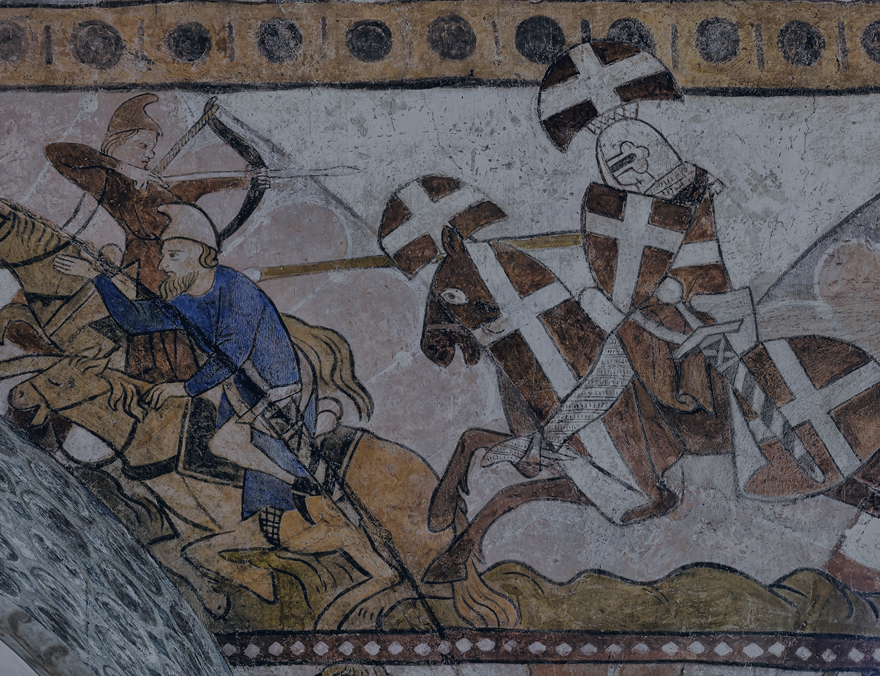
In 1095, in Clermont, France, Pope Urban II called for the liberation of the Holy Land from the hands of the Muslims, triggering the crusade wave of the High Middle Ages. In the First Crusade (1096 - 1099 AD), the European crusaders succeeded in conquering important territories in the Middle East. In the territories of Palestine and Syria, the four Crusader states were established: the Kingdom of Jerusalem, the Principality of Antioch, and the Counties of Edessa and Tripoli. The constant need for supplies triggered lively trade activities with the crusader states, from which primarily the Italian city-publics of Venice, Florence and Genoa profited as crusaders.
Of course, the minting of coins was not unaffected by the military conflicts.
The coins of the Crusaders include all coins of the four Crusader states, as well as the coins of the Order of St. John on Rhodes and the coins of the Christian states in the Aegean, which were founded after the conquest of the Byzantine Empire. In the coin images and inscriptions of the crusaders, European, Islamic and Byzantine design elements meet and form a unique connection. Gold, silver and copper coins were minted.
Between the First and Second Crusades (1099-1146) only copper coins based on the Byzantine model were apparently minted in Antioch and Edessa. After that, the crusaders began minting silver coins (approx. 1150-1250) based on the European model (denarii). Memorable coin images of the Kingdom of Jerusalem are, for example, the "Tower of David" of Baldwin III. (1143-1163) and the "Church of the Holy Sepulchre" under Amalric IV (1163-1174). Thought to have been minted since the 1140s, Crusader gold coins are underweight imitations of Arabic dinars with flawed legends. In 1251, Pope Innocent IV (1243-1254) banned these unchristian mintings of the coins, which from then on showed a cross in the coin image and had captions with Christian content - albeit still in Arabic script.
Immerse yourself in the coin history of an eventful epoch and experience the medieval cultural exchange between Orient and Occident in coin design with the Crusaders!
- Malloy, A. G. / Preston, I. F. / Seltman, A. J.: Coins of the Crusader States, 2. Auflage, New York 2004.
- Metcalf, D. M.: Coinage of the Crusades and the Latin East in the Ashmolean Museum Oxford, 2. Auflage, London 1995.
- Schlumberger, G. L.: Numismatique de l’Orient latin, Paris 1878-1822.
- Stumpf, G.: Der Kreuzzug Kaiser Barbarossas. Münzschätze seiner Zeit, München 1991.