



- Why the Habsburgs had such a strong influence on the history of coins in Europe.
- How the rivalry between Austria and Prussia is also reflected in the coinage system.
- How the monetary history of Austria developed after the laying down of the imperial crown.
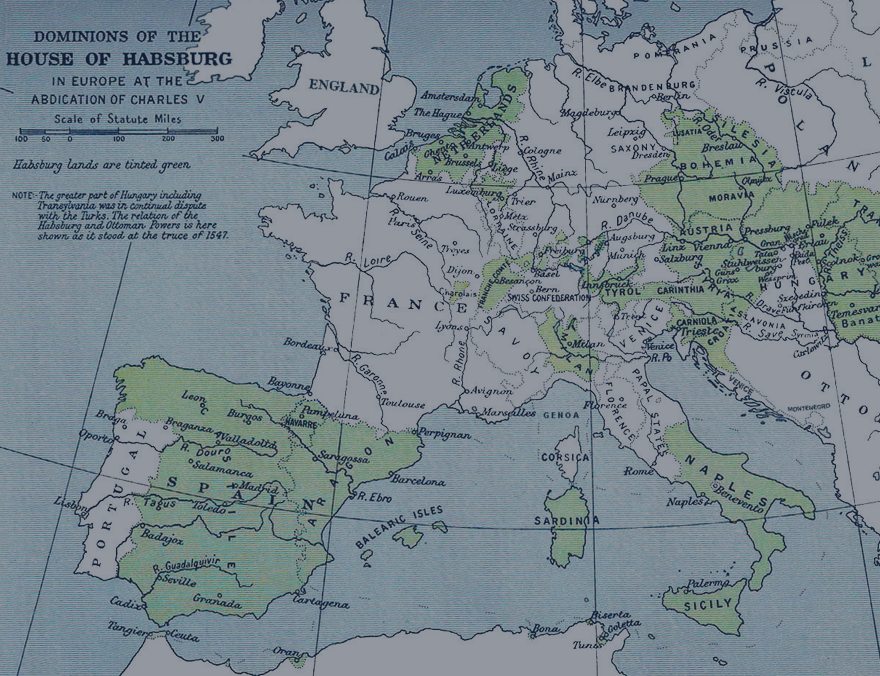
From 1438 until the end of the empire in 1806, the Habsburgs provided the German kings and Roman-German emperors almost without interruption. Thanks to a skilful marriage policy, the Habsburgs spanned a wide network of dynastic connections in Europe from the Middle Ages to modern times, which brought them rule over Bohemia and Hungary, Spain and Portugal, as well as Milan and parts of Lombardy, among others. True to the motto: "Bella gerant alii, tu felix Austria nube" – “Others may wage wars, you, happy Austria, marry!”
As a result, the Habsburgs also significantly influenced the coinage and monetary history of Europe in modern times. Among the rulers of the "House of Austria" (Casa de Austria) are such famous names as Charles V (1519-1558), Leopold I (1657-1705), Maria Theresa (1740-1780) and Franz Joseph I (1848-1916).
The oldest mintings are coins of the margraves and dukes of Austria from the 12th century. Under Archduke Sigismund "the Rich in Coins" (1446-1496), the first Austrian talers (Guldiner) were minted in Tyrol in 1486. With the imperial coinage orders of the 16th century, the monetary division of the Roman-German Empire took place into northern countries with a thaler account and southern countries with a guilder account. In the south, the currency in the Habsburg hereditary lands served as a model, which was reinforced by the Prussian-Austrian duality of the 18th/19th centuries.
In 1750, Austria changed its coinage system to a 20-guilder foot, intended as a countermeasure to the Prussian 14-thaler foot ("Graumannscher Münzfuß"). On September 20, 1753, an Austrian minting convention with Electorate of Bavaria was concluded on the basis of this foot, and thus the convention thalers were minted. On the mintings of the Habsburg coins themselves, the fineness was indicated in the form CONVENTION COIN or with the so-called "Aufzahl" as X or ZEHN EINE FEINE MARK (fineness = 1/10 of the Cologne mark at 233.856 g).
After Franz II (1792-1806) laid down the Roman imperial crown on August 6, 1806, Austria's influence on German coinage also declined. The last significant agreement involving Austria was the Vienna Mint Treaty of January 24, 1857. As the basis for coin weight, the 500 g customs pound was introduced instead of the Cologne mark. In northern Germany, 30 thalers and in southern Germany 45 guilders of Austrian currency and 52½ guilders of southern German currency were to be minted from the pound. This resulted in a currency ratio of 2 talers Prussian = 3 ½ guilders South German = 3 guilders Austrian.
The ducat, which was introduced as a commercial gold coin in 1857 by imperial decree, officially lost its validity the following year as a result of the Vienna Coinage Treaty, but was initially minted in Austria until 1915.
After the German-Austrian War in 1866, Austria and Liechtenstein left the German Confederation and the Treaty of Vienna. The monetary history of Austria-Hungary took its own development. The currency introduced in 1892 was based on the golden crown of 100 hellers. For the 60th anniversary of the reign of Emperor Franz Joseph (1830-1916) in 1908, a magnificent Austrian commemorative coin was minted (100 crowns "Austria in the Clouds"), which, due to its popularity, was issued again and again in the following period. In 1915, the minting of Austrian gold coins of 20 and 100 crowns was also discontinued as a result of the First World War.
Discover the history of one of the most important European ruling dynasties in the coinage.
- Corpus Nummorum Austriacorum. Leopold I. – Karl V. 1657-1740, Wien 1975.
- Eypeltauer, T.: Corpus Nummorum Regni Mariae Theresiae, Basel 1973.
- Jaeger, K.: Die Münzprägungen der deutschen Staaten vor Einführung der Reichswährung, Heft 3/4: Die Münzprägungen des Hauses Habsburg 1780 - 1918 und der Bundesrepublik Österreich 1918 – 1956, Basel 1956.
- Moser, H. / Tursky, H.: Die Münzstätte Hall in Tirol, 2 Bände, Innsbruck 1981.
- Moser, H. / Tursky, H.: Corpus Nummorum Tirolensium. Die Münzen Kaiser Rudolfs II. aus der Münzstätte Hall in Tirol 1602-1612, Innsbruck 1986.
- Serfas, H.: Habsburgs Universitäten, Hochschulen und Akademien und deren Nachfolger auf Münzen und Medaillen, Wien 2006.
- Voglhuber, R.: Taler und Schautaler des Erzhauses Habsburg, Frankfurt am Main 1971.