

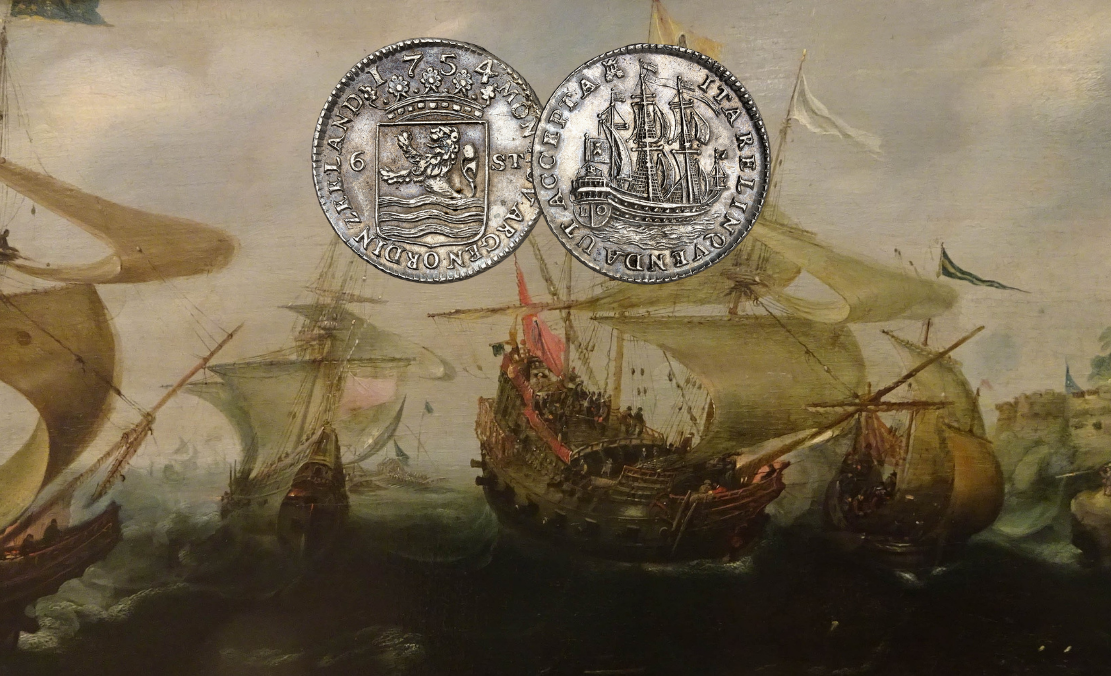
Numisnautics: Ships on Coins
In 2025, we will auction off the special collection of a "Numisnautiker" (= numisnautist). But what does numisnautics actually refer to? Briefly said, this term is a variation of the better-known word “numismatics”, i.e. the study of coins. The first part of the word is combined with “nautics”, i.e. the study of ships, which is derived from the Latin “navis” (= ship). Therefore, a numisnautist is a collector who collects all coins that depict ships, ship components or related motifs. The term was coined as "Numisnautiker" and "Numisnautik" in the 1970s by German numismatist Wolf Müller-Reichau. It became widespread in the German-speaking area thanks to an association and a magazine called “Flaschenpost” (message in a bottle). While numisnautics is a German phenomenon, collecting coins featuring ships is popular all over the world. This theme is even a classic among collectors of themed coins. You can be sure that a coin featuring ships in a prominent position will fetch a higher price than comparable pieces without ships.


Whether you are an experienced sailor or a true landlubber, collecting coins with ship motifs is a great way to satisfy your wanderlust. These small numismatic works of art will transport you within seconds to exotic places around the world and the most exciting moment in world history. No prior knowledge is needed, just a lot of curiosity. After all, you will need to acquire most of the knowledge on this subject on your own, always focusing on the specific coins and medals that you purchase. There are no limits when it comes to learning as much as possible about these pieces. You can study different types of ships and how they were constructed, learn about historical sea battles, get to know famous captains or discover the historical past of major port cities. Your most important tool should always be your magnifying glass, as past medal engravers designed their ships with an incredible attention to detail.
Depictions of ships have existed since ancient times, although often only parts of the ship were depicted. In Greek coinage, prora, stylis and aphlasta often represent the whole ship. If you want to see a complete ancient ship depicted on a coin, look for coins from the Phoenicians or the Romans. Generally speaking, it is a good idea to look for depictions of ships on coins from seafaring nations. England and later Great Britain are good places to start. However, ship depictions on coins reached their heyday in the 17th and 18th centuries, when great naval battles were fought by European nations on the Seven Seas. Dutch engravers in particular produced true marvels. But you will also find magnificent ship depictions on Danish and Swedish medals. Hamburg and its bank portugalöser coins are also a promising area, as the Hanseaten were proud of their international harbor and repeatedly depicted it on bank portugalösers. You can even find ships on coins minted away from the coasts, as many rulers had river ports and canals built.
19th-century medals are particularly affordable today, largely due to their sheer volume. Among them are magnificent pieces illustrating the transition from sailing to motorized shipping – a fascinating subject for all those interested in technology.
If you are looking for a suitable introductory topic for younger generations, numisnautics is ideal because countless ships were depicted on circulation and commemorative coins in the 20th century. This means that no matter how small your budget, you can find plenty of material to buy with pocket money, and you may also occasionally discover a piece in circulation while on holiday.
And this brings us to an important topic: money. Numisnautists will be delighted to learn that ships are one of the most popular themes on coins. This is why there is hardly any other field with such a wide price range. You can literally purchase coins featuring ships for as little as one cent, as the Greek one-cent circulation coin depicts a ship: an Athenian trireme. Conversely, those willing to spend five- or six-figure sums will also find plenty of material. Just consider the wonderful Hamburg bank portugalösers, which often depict bustling harbors with ships and can fetch five- or six-digit hammer prices.
We compiled a few typical pieces from our current Fall Auction Sales. They illustrate the wide range of prices.
.jpg)
.jpg)
.jpg)
.jpg)
.jpg)

Films at our Youtube-Channel: Ships on coins and medals
Bloody Flag and Scheepjesschelling
On 9 November 1670, the States of Holland and West Frisia decided to introduce a new coin. It depicts a ship with a very particular flag, the so-called Bloody Flag. We tell you more about the historical background.

The Hamburg Girobank and Its Portugalösers
Hamburg portugalöser coins often depict harbor scenes with many different types of ships. In 2019, we published an article on the history of Hamburg portugalösers.
Further reading in German
As stated above, there is very limited specialist literature on the topic of numisnautics. The introductory work was authored by the man who coined the term, Wolf Müller-Reichau. The title is “Naves in nummis. Handbuch der Numisnautik”. It can only be purchased from antiquarian bookdealers.
The same applies to the issues of “Flaschenpost”, in which members of the association explored numisnautic topics. However, the association has not been active for several years. But this should not stop you as it is most fun anyway to find pieces yourself in auction catalogs, at coin dealerships or coin shows.