

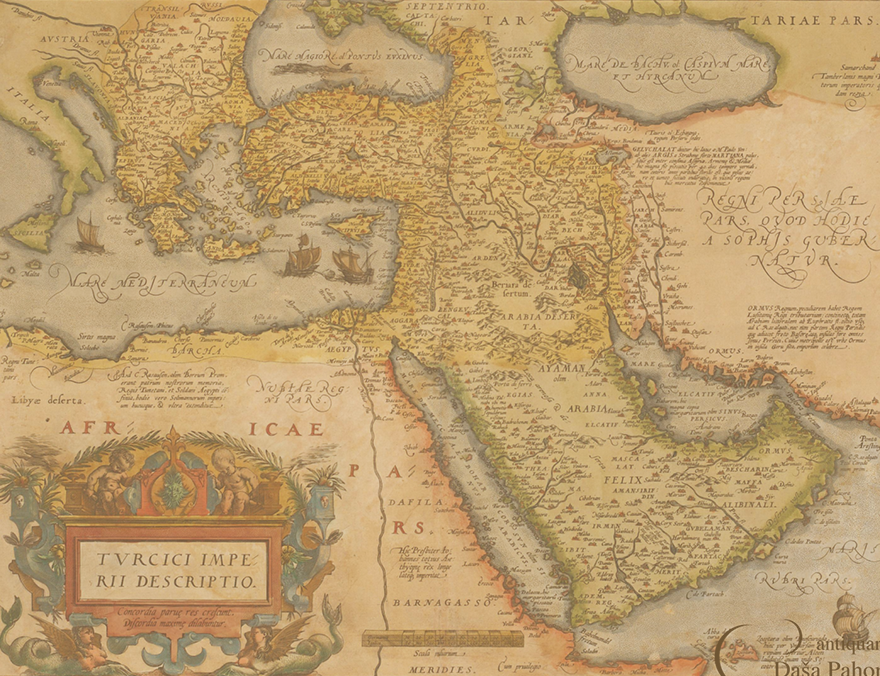


- How currencies and motifs of oriental coins were created.
- What makes Islamic-Oriental coinage special.
- Which collecting areas belong to the oriental coinage.
The history of Arabic coinage begins with the imitation of Byzantine and Sasanian types, since the conquerors of the territories previously ruled by Byzantium did not know their own coinage until the time of Muhammad. In addition to the sometimes quite free interpretation of their models, the mintings of Arabic coins also depicted the ruling caliph. Around 696/698, the Umayyad caliph Abd al-Malik (685-705) reorganized Oriental coinage.
Under the Umayyads, the dinar (derived from the Latin denarius) with a standard weight of 4.25 g was introduced as the standard gold coin in place of the solidus. As a silver coin, the dirham (derived from the Greek drachma) weighing 2.86 g replaced the Sasanian drachma. As an oriental small coin, the fils (derived from the Latin follis) was minted for local monetary transactions. In numerous transcriptions, this widely used Arabic copper coin also appears under the names fals, fuls, fulus, or falus. In modern Arabic, "fils" is often used as a synonym for money and the plural "fulūs," specifically for coins or small change.
Since in Islam the pictorial representation of humans and animals is forbidden, the oriental coins show since the Umayyads as a rule only written information. From 786/787 onwards, silver coins did show the caliph's motif, but - in contrast to European coinage - portraits of rulers were rather uncommon. Oriental coin designs, on the other hand, often show a precisely defined sequence of Koranic claims, together with the indication of the place and year of minting.
In the Islamic calendar, the year of minting is given after the year of the Hijra (AH = July 16, 622), i.e. the flight of the Prophet Mohammed from Mecca to Medina. Due to the Islamic counting according to lunar years with 336 days, the corresponding Christian year can best be calculated according to the formula (AH - 3.03%) + 622 = AD. Because of their rich textual content, the coin images of Islam are an excellent dating tool for archaeological contexts. In addition, historical Oriental coins are often the only source of information about the political, economic, and social background of the respective dominions. This makes coin collections of Islamic numismatics important testimonies of history.
With the differentiation of the Arabian Empire in the 9th/10th century into its own ruling dynasties, a multitude of possible collecting areas emerges: from the Middle Ages to modern times, from Europe to North Africa and Asia. In this context, one need only think of the oriental coins of the Hafsid Empire in Tunisia (1229-1574), the Caliphate of Cordoba (929-1031), the Ottoman Empire (from ca. 1299-1923), as well as the Mongols, Seljuks and Zengids.
Oriental coins also include the coinage of the important Kushan Empire in Central Asia and northern India from the 1st-3rd centuries A.D. The successors of the Indo-Greeks and Indo-Scythians developed, among other things, an extensive gold coinage that still bears witness to the wealth of the rulers. At the latest since king Vima Kadphises (around 90-100) the unified oriental coin design of the Kushan coinage is easily recognizable: On the obverse, the standing ruler is depicted next to a smoking altar, while on the reverse is the image of a deity, usually Iranian. In addition to gold coinage (staters), there are bronze and copper coins (aes and drachmas) for everyday payments.
As valuable historical witnesses, Islamic coins stand for much more than just classic collector coins - they serve as political documents of past dynasties. Large collections of Islamic coins from the Middle Ages and early modern times can be found in museums and coin cabinets all over the world. Even today, numismatists are fascinated by the inscriptions on Islamic coins, which in some cases reflect the historical balance of power more accurately than contemporary chroniclers could report. Even if the foreign script of the oriental coins may seem daunting to beginners at first: Due to the high degree of organization of the oriental coinage and the often well-illustrated literature, collecting success can be achieved quickly with a little practice.