

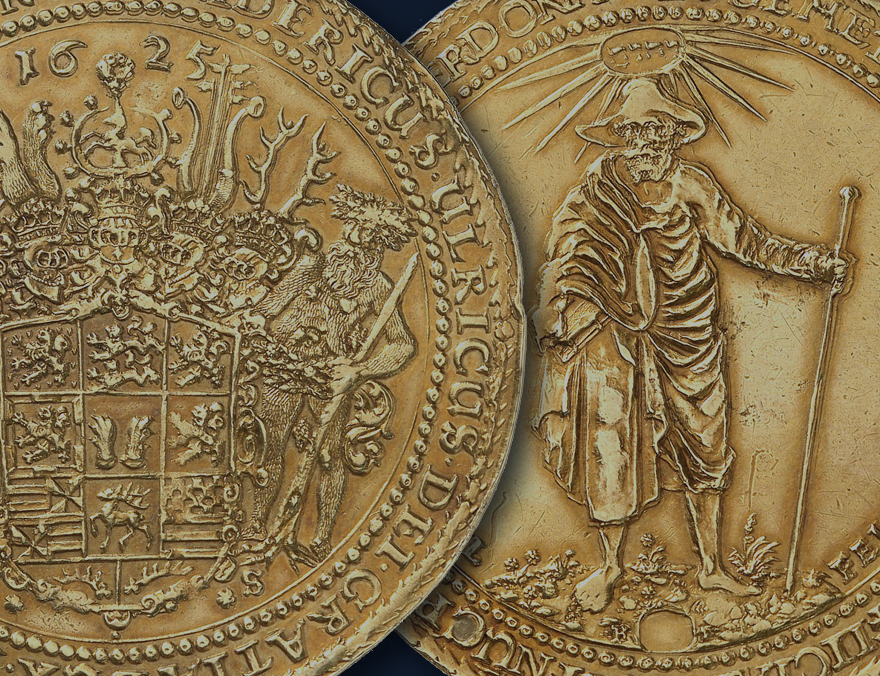


- Where the multitude of Old German coin varieties comes from.
- Which different collecting areas result from it.
- Which motifs reflect the eventful German history.
While other European states such as England, Spain or France had already become national states with centralized coinage by the end of the Middle Ages, Germany remained highly fragmented territorially until the founding of the German Empire after the Franco-Prussian War (1870/1871). This led to an almost unmanageable variety of circulating German coinage and minting institutions: From duchies and counties to bishoprics and monasteries to Free Imperial Cities.
Various efforts, such as the Imperial Coinage Orders of the 16th century or the Coinage Treaties of the 17th century, remained unsuccessful attempts to establish a uniform German coinage system and thus to make trade and travel easier. One would almost like to say: lucky for the modern collector of old German coins!
Whether Anhalt, Brandenburg and Saxony or Corvey, Esslingen and Magdeburg: the variety of mints can be the starting point for an extensive collection of old German coins for anyone interested in local history. Large Old German coins such as the North German thalers and South German guilders, which were mainly minted for trade, are just as attractive as the numerous small coins (land and particular varieties) used in everyday payments.
The ⅔ thaler, which acts as a "bridge denomination" between northern and southern Germany, with its variants issued by numerous German mint stands, can represent its own attractive collecting area of old coins. In addition, there are various attractive German gold coins (e.g. ducat, gold gulden, krone or max dÒr) and their various special forms – multiple pieces, river gold ducats, mining mintings and gold versions of base small coins – which, due to easily accessible literature, can lead to quick success in collecting. Medals and mixed types coined on various occasions, such as the Schautaler, represent an interesting collection area featuring equally interesting motifs.
The eventful history of the German Empire and its territories is reflected in impressive images in the minting of coins and medals. Whether the religious motifs of the Reformation period, the propagandistic war coinage of Frederick the Great or the medals of the 19th century for achievements in science and art - there is something for every taste and every historical interest in the old German coins.
Experience the diversity of old German coinage and take a piece of Germany's "shaped history" home with you.
- Arnold, P. / Küthmann, H. / Steinhilber, D.: Großer deutscher Münzkatalog von 1800 bis heute, 28. Auflage, Regenstauf 2013 (annually updated edition).
- Schön, G.: Deutscher Münzkatalog 18. Jahrhundert (1700-1806), 4th edition, Regenstauf 2013 (annually updated edition).
- Jaeger, K.: Die Münzprägung der deutschen Staaten vor Einführung der Reichswährung. Volumes 1-12, Basel 1951 and subsequent.
- Krause Publications (Krause/Mishler), Standard Catalog of German Coins (1501-Present), 3. edition, Iola 2011.
- Davenport, J. S.: German Secular Talers 1600-1700, Frankfurt 1976.
- Davenport, J. S.: German Church and City Talers 1600-1700, Galesburg 1975.
- Davenport, J. S.: German Talers 1700-1800, Galesburg 1958.
- Davenport, J. S.: German Talers since 1800, Galesburg 1949.
- Davenport, J. S.: Guldentalers and Silvergulden, Frankfurt 1982.
The catalogues cited can only give an overview of the collection area Pre-1871 German coins. A wide range of specialized catalogues exists on the individual areas, regions and cities for interested collectors.