

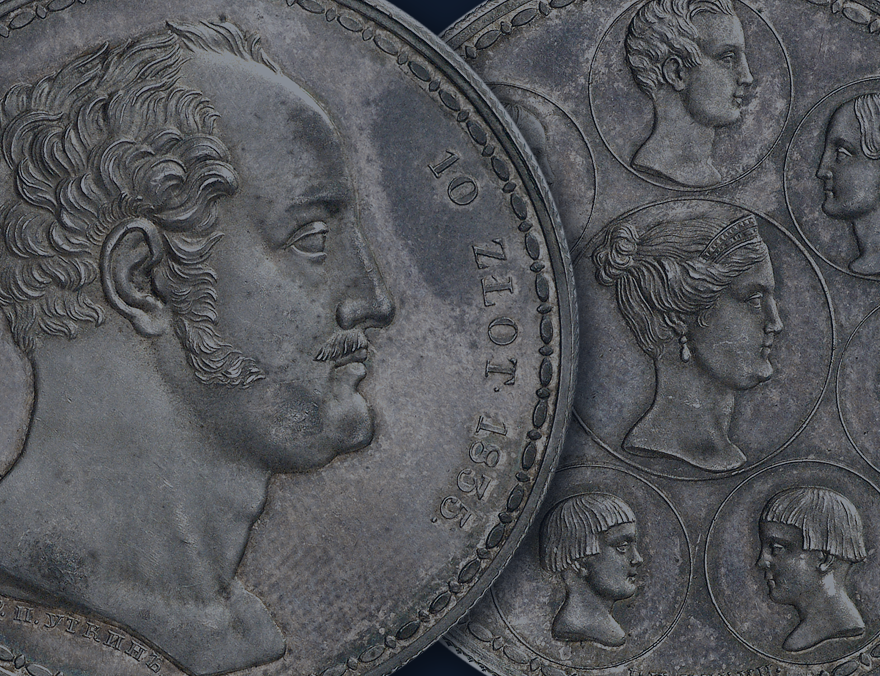


- What makes Russian coins so special.
- How values and motifs of Russian coins have evolved.
- Why coins from Russia are sought after by collectors.
The history of Russian coins is still comparatively young. The development of Russian coins cannot be directly traced back to ancient or medieval models, and yet they unfolded a wealth and splendor in an astonishingly short time. Their ornate coin and medal designs, as well as large-format gold and silver coinage, make coins from Russia popular collector's items for numismatists and investors.
The oldest Russian coin is the zlatnik or zolotnik, which translates roughly as "golden one." This first gold coin of Russia was minted from the 10th century under the Kiev Grand Duke Vladimir I and was in circulation until the beginning of the 11th century. Weighing about 4.27 grams, the coin later served as the basis for the Old Russian unit of weight, the zolotnik, which was used for gold and silver until 1920. The zolotnik, in turn, was subdivided into dolyas - a term used to indicate the fineness of precious metal in a coin, much like the term karat was used in Germany to indicate the fineness of gold.
Probably the best known Russian coin in the world is the ruble - the national currency in Russia. While many world currencies such as the American dollar derived their name from the silver thaler minted since the end of the 15th century, Russia took a numismatic special path with its coinage: the ruble, introduced under Tsar Peter I the Great (1682-1725), takes its name from the old Russian word for "to strike off" (rubit). This ancient name for Russian coins dates back to a time when pieces of solid metal ingots were still chopped off to make smaller means of payment.
Equally famous and sought after, the Imperial is a Russian gold coin worth 10 rubles. This coin was first minted in 1755 under Tsarina Elizabeth and features the motif of the sovereign. Beginning in 1879, under Tsar Nicholas II, the first semi-imperial and imperial coins were officially put into circulation at face values of 5 and 10 rubles, respectively.
The Russian coinage system was the first decimal-based modern monetary system (1 ruble = 100 kopecks). The fact that its structure is still valid after more than 300 years makes it one of the oldest current monetary systems in the world.
The most important Russian coin nominals:
- 1 ruble = 2 poltina = 4 Chetverak = 10 Grivenniki = 20 Pyatak = 100 kopeks = 200 denga = 400 Polushka
Even though the basic structure of the nominals was quite simple, the need to supply a huge empire with money produced a large amount of diverse types and coin designs. The exciting and varied motif design of Russian coins inspires numismatists from all over the world. In the Russian coin images, the great rulers of Russia appear before our eyes again and make Russian history literally "comprehensible".
In addition to the pure means of payment, various famous personalities and significant events in the history of Russia have also been captured in the medal image: From the Russian fleet expeditions of the 18th century to the battles against Frederick II of Prussia and Napoleon, to the imposing buildings of the industrial age.
Finally, collectors and enthusiasts will be offered a fascinating variety of Russian gold coins, silver coins and coins made of mixed materials. While the small coins of the early 18th century are quite crude in their coin designs compared to Western European minting, the higher nominals are characterized by impressive artistic design. Many specimens are precious rarities made of high-purity silver and gold, which is why Russian coins are equally coveted by investors.
For laymen it is often not easy to distinguish valuable coins from Russia from ordinary coins. Similar specimens can have a completely different value. The value of a Russian coin depends on many criteria: In addition to age and material, the decisive factors are the mintage, the level of detail in the minting, the state of preservation, and current collector demand. It is not uncommon for historic, as well as more recent rare Russian coins to change hands for five-figure sums.
Numerous new publications in several languages with extensive pictorial material make it easy for beginners to quickly dive into the history of Russian coins and medals, even without knowledge of Cyrillic, and to bring home a valuable piece of "minted history".
Experience the exciting history of Russia through its impressive coin designs and medals. Learn more about the extensive field of Russian coin collecting:
- Bitkin, V.: Composite Catalogue of Russian Coins, 2 volumes, Kiev 2003.
- Diakov, M. E.: Russian Coins 1686-1796, 6 volumes, Moscow 2000-2003.
- Diakov, M. E.: Medals of the Russian Empire 1672-1917, 7 volumes, Moscow 2004-2007.
- Severin, H. M.: The Silver Coinage of Imperial Russia 1682 to 1917, Basel / Amsterdam / London 1965.
- Spasski, I. G.: The Russian Coinage System. A Historical-Numismatic Outline, Berlin 1983.
The listed literature gives interested coin collectors an overview of the field of collecting Russian coins and medals - without claiming to be complete.