

Frederick was born on 11 July 1657 at Königsberg Castle as the third son of Elector Frederick William of Brandenburg and his first wife Louise Henrietta of Orange-Nassau (1627–1667). Frederick was baptised on 29 July 1657 according to the Calvinist-Reformed rite, and was raised and confirmed in that faith.
On account of his frail constitution, his survival was considered uncertain in an era of high infant mortality. An accident in his first year of life furthermore resulted in a permanent deformation of his shoulder.
Nevertheless, he grew into a physically slightly impaired but otherwise healthy adult. From 1662 to 1676, his upbringing was directed by Otto, Baron von Schwerin (1616–1679), first minister of Brandenburg since 1658; at his mother's wish, Frederick spent periods at Schwerin's estate of Altlandsberg, east of Berlin, for the benefit of his health. In 1664, Eberhard Christoph Balthasar, Baron von Danckelman (1643–1722), became his private tutor. Frederick's education encompassed religion — here primarily the regular study of the Bible and the catechism — history and geography, as well as the languages French, Polish, and Latin.
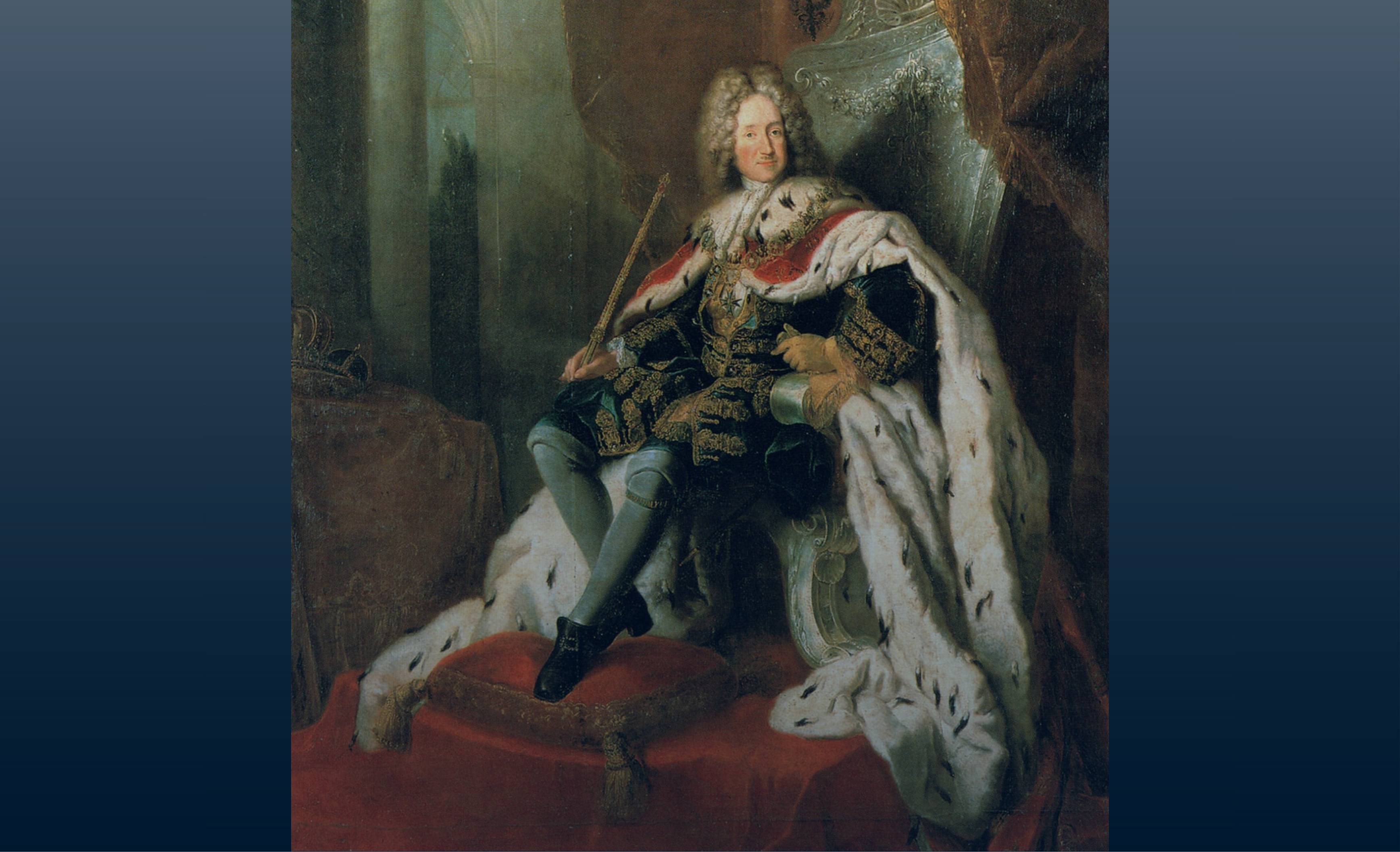
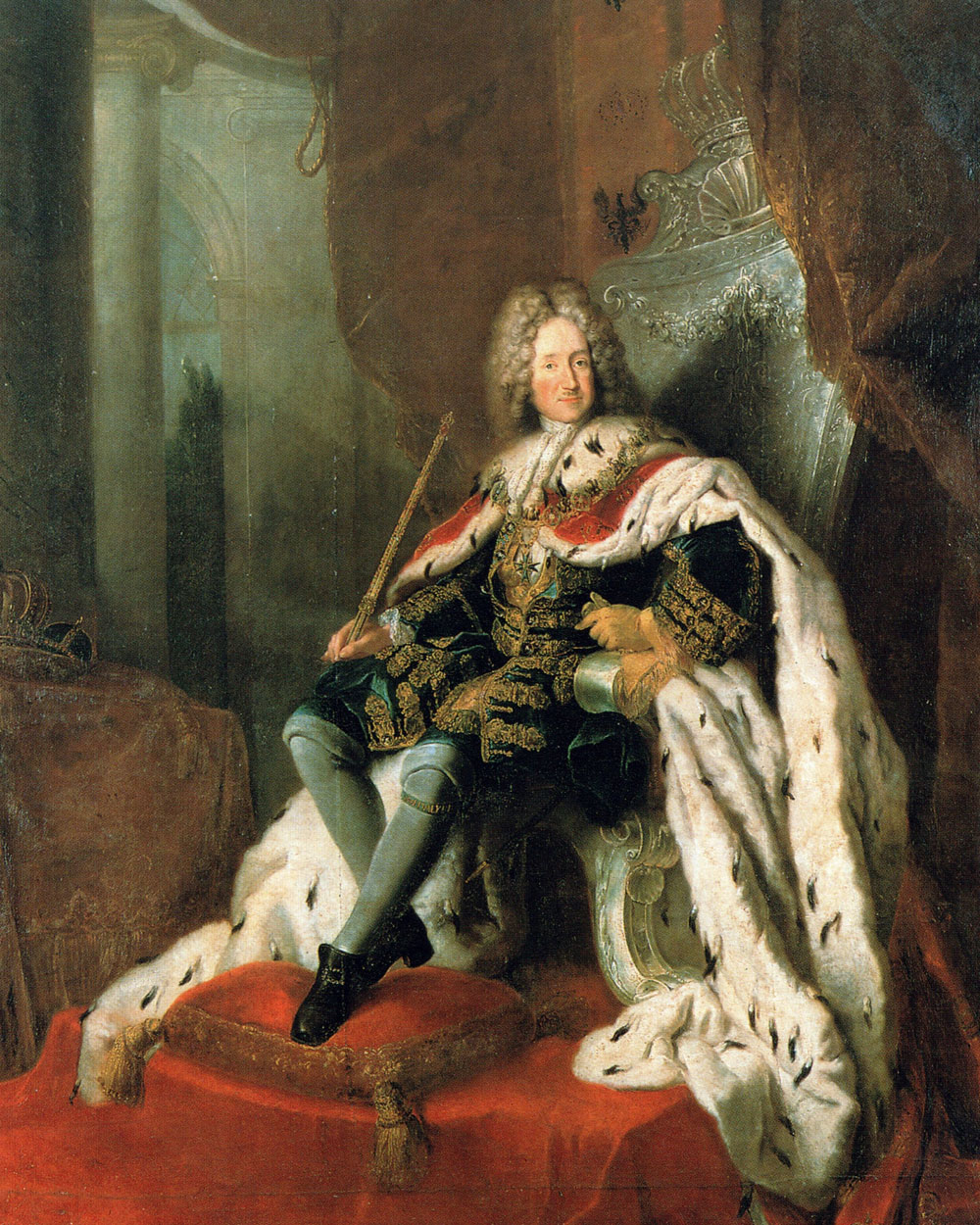
Image Caption
Antoine Pesne: King Frederick I in Prussia on the Silver Throne, painting 1712.
From early childhood, he displayed a pronounced inclination towards pomp and courtly splendour, which manifested itself, among other things, in his founding of the Ordre de la Générosité in 1667 at the age of ten, while still a junior prince — an order from which the Pour le Mérite would emerge in 1740.
In that same year, on 8 June 1667, his mother died of tuberculosis. A year later his father remarried, though Frederick's relationship with his stepmother remained distant throughout.
Militarily, Frederick was nominally appointed cavalry captain in 1670, without however actually exercising a command — a circumstance presumably connected to his physical limitations. In 1673 he became secretly engaged to the twelve-year-old Reformed Princess Elisabeth Henriette of Hesse-Kassel (1661–1683). Between the two, who had known each other since early childhood, there existed a genuine affection. The union is considered comparatively unusual in that it was not primarily motivated by dynastic considerations.
Following the death of his elder brother Karl Emil (born 1655) on 7 December 1674, Frederick became Electoral Prince and gained in political weight as heir to the throne. He accompanied his father in the Northern War (1675–1679) and fell seriously ill during this period. After his recovery, he married Elisabeth Henriette of Hesse-Kassel on 13 August 1679; she died of smallpox in 1683.
As early as 28 November 1684, Frederick remarried — the fifteen-year-old Princess Sophie Charlotte of Brunswick-Lüneburg (1668–1705). This union produced Electoral Prince Frederick William, the future King Frederick William I, on 14 August 1688.
The couple lived primarily at Köpenick Palace, partly to avoid the intrigue-ridden Berlin court, where tensions were stirred above all by the inheritance claims of the sons of his father's second marriage. These conflicts placed a considerable strain on his relationship with the Elector, in particular owing to the latter's publicly known plans to partition the country and override the principle of primogeniture.
In 1686, under pressure from the uncertain succession, Frederick concluded a treaty with Austria without his father's knowledge, which he later declared void. Following further family tensions and a temporary removal from court, he returned to Berlin in 1687 and was admitted to the Privy Council, though mutual mistrust persisted.
After the death of the Great Elector on 9 May 1688, Frederick III assumed government. Despite provisions in the will for a division of the territory, he prevailed by 1692 and preserved the unity of Brandenburg-Prussia. He initially delegated much of the government to his newly appointed first minister Danckelman, his former private tutor.
In foreign policy, Frederick joined the anti-French coalition and took part in the War of the Palatine Succession (1688–1697). At the same time, from around 1696 he pursued the goal of the royal title, in order to enhance the prestige and internal cohesion of his state, though he initially encountered resistance.
In 1697 he had Danckelman stripped of power. Power then shifted under the new first minister, Baron Johann Kasimir Kolbe von Wartenberg (1643–1712), to a narrow circle of advisers, by which the Privy Council lost considerable influence.
It was only the altered military situation following the death of King Charles II of Spain (1661–1700, reigning since 1665) that made the political breakthrough possible: Emperor Leopold I (1640–1705, Emperor since 1658) recognised Frederick as King in Prussia in exchange for financial and military contributions, though the coronation was required to take place outside the Holy Roman Empire.
In December 1700, the Elector set out for Königsberg with a large entourage. There, on the eve of the coronation, he founded the Most Noble Order of the Black Eagle, and on 18 January 1701 crowned himself king — a demonstrative assertion of his sovereignty. The royal title and the new designation of the Brandenburg Elector, who was de facto a king in his sovereign Duchy of Prussia, initially remained highly contested both within the Empire and abroad.
With the coronation, Brandenburg institutions were transformed into royal Prussian ones; in the long term, "Prussia" prevailed as the name of the state. Territorially, Frederick made gains through inheritances and acquisitions. In 1707 he became Prince of Neuchâtel in present-day Switzerland, a status that was also internationally recognised in 1713.
The death of his second wife in 1705 affected him deeply. His third marriage — to the twenty-three-year-old Sophie Louise, a Duchess of Mecklenburg and Princess of Mecklenburg-Schwerin (1685–1735), concluded on 28 November 1708 in Berlin — was politically motivated and proved conflict-ridden, as she was a strict Lutheran who, in her own view, was living in a marriage of sin with the Calvinist king. In domestic policy, Frederick initiated, among other things, an immigration programme to resettle East Prussia following the plague of 1709.
Government was at times dominated by a narrow circle of advisers, the so-called Three-Counts Cabinet, whose corruption was uncovered in 1710. Frederick responded with personnel changes and administrative reforms that tied decision-making more closely to expert scrutiny and contributed to the stabilisation of state finances.
The king's strength noticeably declined after 1712. He had suffered from angina pectoris since his youth; severe coughing and asthma now added to his ailments. Following an incident involving the mentally incapacitated queen, he developed a fever from which he never recovered. He died on 25 February 1713 at the Berlin Palace.
Frederick I long stood in the shadow of his father and his grandson Frederick II, whose critical verdict — that he had been a vain and extravagant ruler — shaped scholarly opinion well into the twentieth century. Older historiography likewise assessed his policies predominantly negatively, frequently applying anachronistic standards. It was only after 1945 that a more nuanced reassessment began, one that placed greater emphasis on his contributions to governmental continuity, the consolidation of administration and governance, and his services to the advancement of the sciences, architecture, and the arts. Together with his wife and Gottfried Wilhelm Leibniz, he founded the Academies of Sciences and Arts in 1696 — both of them significant Berlin institutions.
Bibliography
- Barmeyer, Heide (ed.): Die preußische Rangerhöhung und Königskrönung 1701 in deutscher und europäischer Sicht. Frankfurt am Main 2002.
- Frey, Linda and Marsha: Friedrich I., Preußens erster König. Graz et al. 1984.
- Göse, Frank: Friedrich I. (1657–1713). Ein König in Preußen. Regensburg 2012. Neumann, Hans-Joachim: Friedrich I. Der erste König der Preußen. Berlin 2001.
- Ohff, Heinz: Preußens Könige. Munich 2016, pp. 11–42.
- Schmidt, Werner: Friedrich I. Kurfürst von Brandenburg. König in Preußen. Munich 1996.
- Stephan, Peter: Friedrich I. Die Erfindung Preußens. Eine Biografie. Munich 2025.
- Various pages from de.wikipedia, en.wikipedia, and fr.wikipedia.