

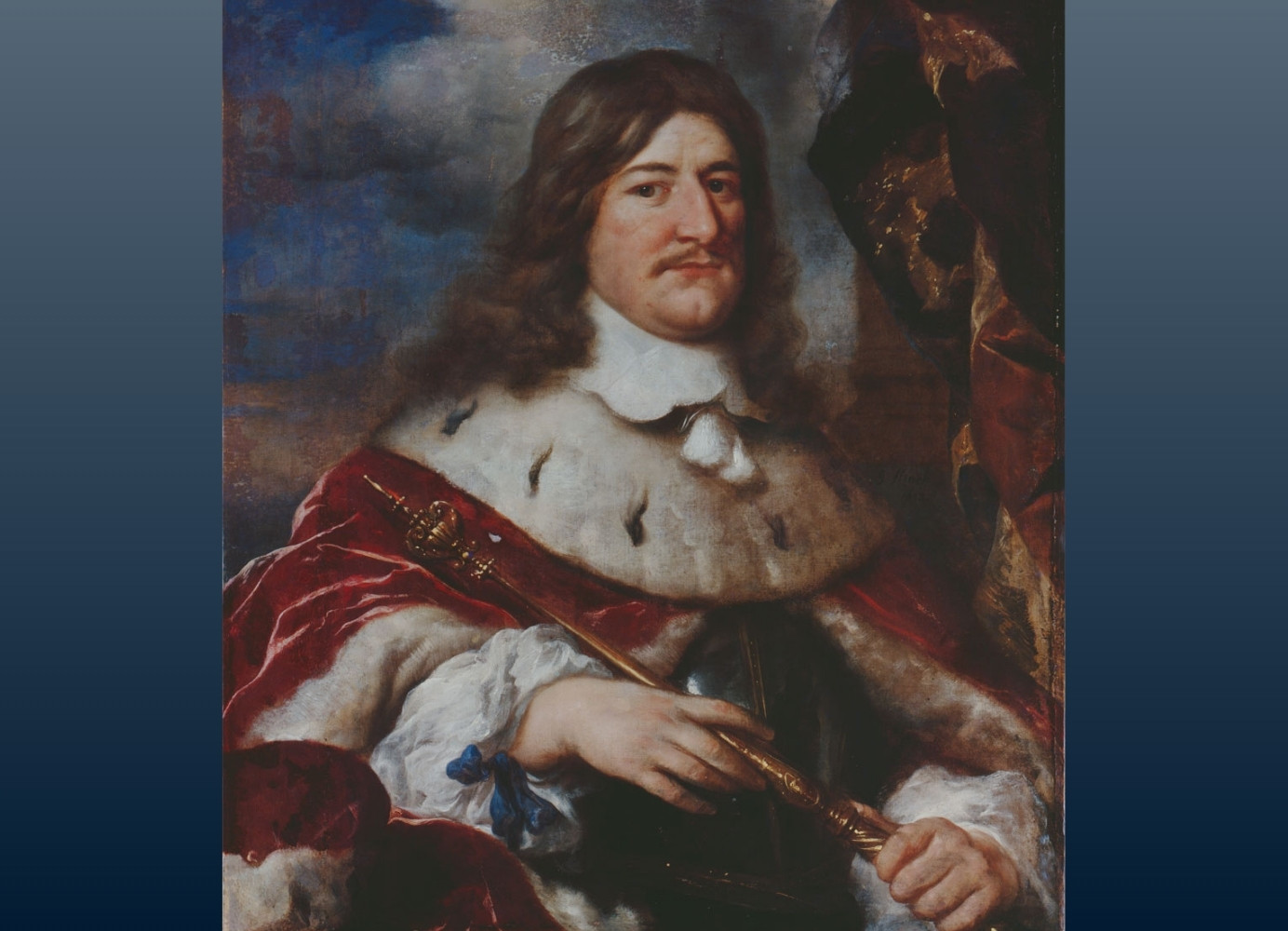
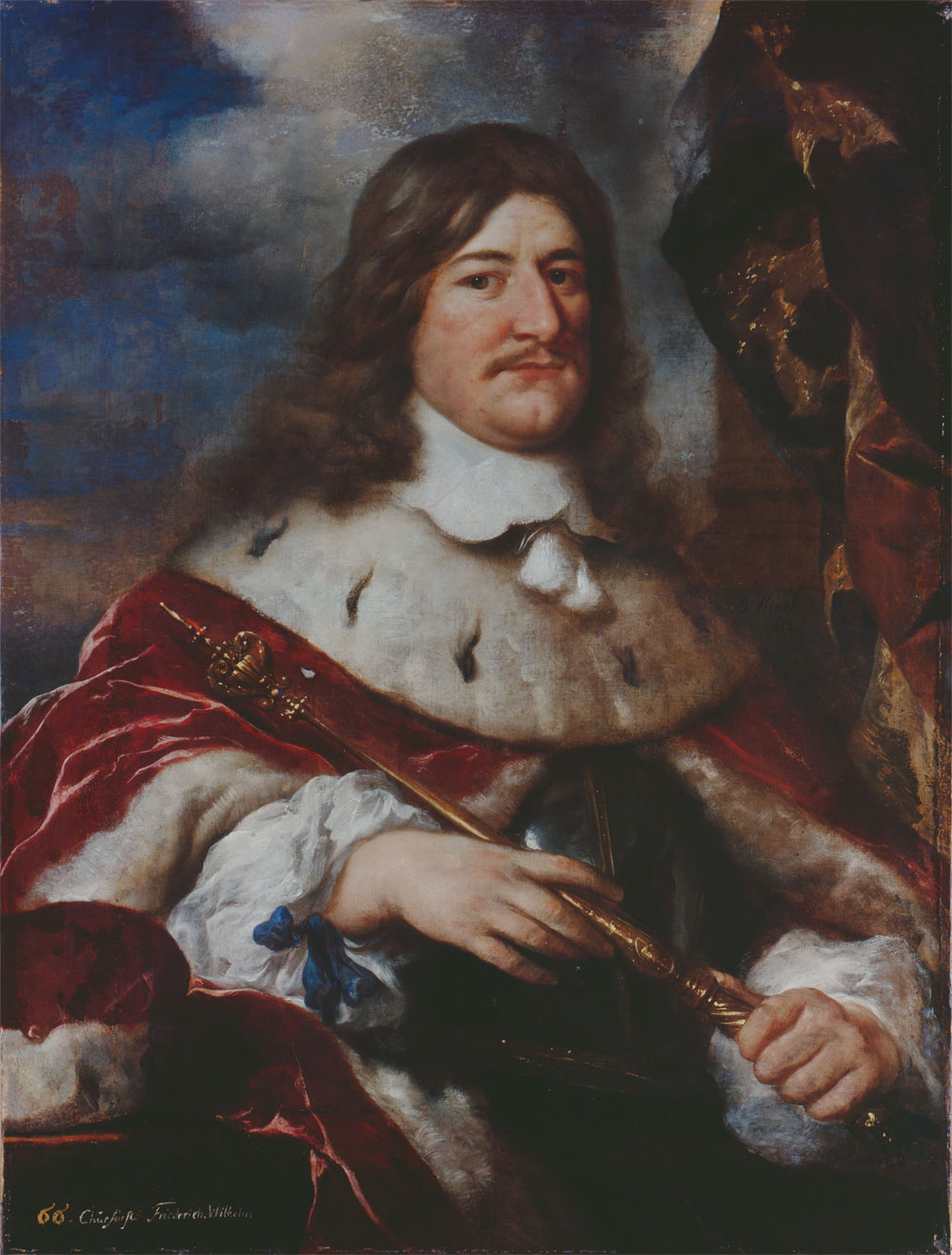
In view of the ravages of war in Brandenburg, he was sent to the Netherlands in 1634 to pursue his studies. There he lived at the court of Stadholder Frederick Henry of Orange (1584–1647, Stadholder of the United Netherlands from 1625), a brother of his grandmother Electress Louise Juliana of the Palatinate, attended lectures in Leiden, and received private tuition. The impressions gained during this approximately four-year stay — in particular the highly developed political and economic life of the country — had a lasting influence on him and served as a model for his later policies. During his extensive travels he also gained insight into shipbuilding.
In 1638 he was recalled to Berlin on his father's orders, where he found a country ravaged by war and effectively under Swedish control.
Following the death of his father on December 1, 1640, Frederick William assumed government at the age of 20 under extremely difficult political conditions, inheriting a widely scattered territory severely devastated by the Thirty Years' War. Large parts of Brandenburg, Cleves, and the County of Mark were under foreign occupation, while the Duchy of Prussia, as a Polish fief, remained an insecure possession. At the same time, the administration and finances were in disarray, and effective power lay in the hands of the influential chief minister Adam, Count of Schwarzenberg (1583–1641).
The palace in Berlin-Cölln was uninhabitable at the time of Frederick William's accession, and in the early years of his reign he resided at the Schwanenburg in Cleves, which bordered the Netherlands and towards which the young Elector also oriented himself in foreign policy. Minister Schwarzenberg was stripped of power and died in 1641 shortly after his arrest. Through an armistice with Sweden and the formal investiture of Prussia, Frederick William regained political room for manoeuvre and returned to Berlin in 1643.
In 1646 he married the nineteen-year-old Louise Henrietta of Orange (1627–1667), eldest daughter of Stadholder Frederick Henry. She brought with her numerous Dutch specialists who promoted economic reconstruction in Brandenburg. In the Peace of Westphalia of 1648, he was compelled to cede Further Pomerania to Sweden and had to content himself with other territories as compensation, which at the same time illustrated the limited power of Brandenburg within the European context.
To consolidate his rule, Frederick William pursued the creation of a standing army, the financing of which was secured in 1653 through tax grants from the estates. In return, he confirmed their privileges — a concession that, for the rural population in particular, was accompanied by a tightening of social burdens.
With the outbreak of the Second Northern War in 1655, the Duchy of Prussia was placed under acute threat by Sweden's invasion of Poland. Frederick William was unable to maintain neutrality and was compelled, by the Treaty of Königsberg on January 16, 1656, to hold Prussia as a fief from Sweden.
After a temporary alliance with Sweden that included shared military successes, King Charles X Gustav (1622–1660, reigning since 1654) recognised Frederick William's sovereignty over Prussia in the Treaty of Labiau on November 20, 1656. As early as 1657, the Elector changed sides again and had full sovereignty confirmed by Poland-Lithuania in the Treaty of Wehlau on September 19, 1657. This was definitively recognised in the Peace of Oliva on May 3, 1660 and formed a decisive precondition for the later rise of Prussia.
Frederick William sought to reconcile the privileges of the estates with the demands of a centralised state, particularly in matters of finance and military organisation. While the estates in the Mark proved comparatively cooperative, considerable resistance arose in Cleves and above all in Prussia, culminating from 1656 in the Königsberg Uprising. It was not until 1663 that the Elector succeeded in asserting his authority. The leading figures of the opposition were subsequently removed from power.
The Berlin Religious Colloquy (1662/63) between Lutheran and Reformed theologians ended without result. With the Tolerance Edict of 1664, Frederick William prohibited confessional polemics and sought to contain religious tensions. A year after the death of his first wife, he married in 1668, as his second wife, Dorothea Sophia, widowed Duchess of Brunswick-Lüneburg, born Princess of Schleswig-Holstein-Sonderburg-Glücksburg (1636–1689), with whom he had several children.
The introduction of indirect taxes made it possible to fund a standing army. At the same time, the Elector promoted the economy, infrastructure, and targeted immigration — including that of Jewish families and later the Huguenots — thereby laying the foundations for an economically dynamic and comparatively tolerant policy.
When the French King Louis XIV (1638–1715, reigning since 1643) attacked the Netherlands in 1672, Frederick William entered the Dutch War in accordance with his alliance obligations, but concluded the separate Peace of Vossem with France on June 16, 1673 in view of the military situation. Following the Imperial declaration of war in 1674, he again joined the struggle against France, but was forced to withdraw on account of the Swedish invasion of Brandenburg.
On June 25, 1675, he won a decisive victory over the Swedes at the Battle of Fehrbellin, which earned him the epithet "the Great Elector." In its aftermath, he was temporarily able to occupy Swedish Pomerania and expel the Swedes from Prussia.
In the Peace of Saint-Germain on June 29, 1679, however, he was compelled to relinquish most of these gains, as he lacked the support of his allies. Disillusioned, he subsequently drew closer to France and, in the secret Treaty of Saint-Germain-en-Laye on October 25, 1679, pledged his support to Louis XIV — above all in the election of the next Holy Roman Emperor.
In 1680/81, Frederick William conducted a privateering campaign against Spanish ships in order to recover outstanding subsidies. Following the revocation of the Edict of Nantes on October 18, 1685, he aligned himself with the Dutch States-General and the Emperor, dispatched an auxiliary force against the Ottomans, and with the Edict of Potsdam on October 27, 1685 actively promoted the settlement of French Huguenot refugees, a measure that generated considerable economic stimulus.
Subsequently — following Dutch models — he pursued a policy directed at maritime trade and colonial acquisition. With the establishment of a Brandenburg navy (1684) and the Brandenburg African Company (BAC), Brandenburg participated in the Atlantic trading system, including the transatlantic slave trade. Given the limited resources available, however, this engagement remained of comparatively short duration and modest effect.
On April 29, 1688, the Great Elector died at the age of 68 at Potsdam Palace. He was laid to rest in the vault beneath the Berlin Cathedral, in the Dominican monastery church, in a magnificent tin sarcophagus designed by court sculptor Michael Döbel.
In foreign policy, Frederick William laid essential foundations for the later rise of Brandenburg-Prussia through the Peace of Westphalia (1648) and the sovereignty over Prussia secured in the Peace of Oliva (1660). In domestic policy, he carried through far-reaching reforms — most notably the creation of a standing army — while his attempts at an independent maritime and colonial policy met with only limited success. As a Calvinist ruler, he pursued a comparatively tolerant religious policy. The reception of large numbers of Huguenots durably promoted the country's economic and cultural development.
Bibliography
- Arndt, Johannes: Der Große Kurfürst, ein Herrscher des Absolutismus? Über die Möglichkeiten und Grenzen monokratischer Herrschaft im 17. Jahrhundert. In: Asch, Ronald G., Duchhardt, Heinz (eds.): Der Absolutismus – ein Mythos? Strukturwandel monarchischer Herrschaft in West- und Mitteleuropa (ca. 1550–1700). Cologne et al. 1996, pp. 249–273.
- Bahl, Peter: Der Hof der Großen Kurfürsten. Studien zur höheren Amtsträgerschaft Brandenburg-Preußens (= Veröffentlichungen aus den Archiven Preussischer Kulturbesitz, Supplement 8). Cologne 2001.
- Bentzien, Hans: Unterm Roten und Schwarzen Adler. Berlin 1992.
- Beuys, Barbara: Der große Kurfürst. Der Mann, der Preußen schuf. Reinbek bei Hamburg 1979, pp. 63 and 76.
- Giersberg, Hans-Joachim, Meckel, Claudia and Bartoschek, Gerd (eds.): Der Große Kurfürst. Sammler, Bauherr, Mäzen. Kurfürst Friedrich Wilhelm 1620–1688. (Exhibition catalogue) Neues Palais in Sanssouci, 10 July – 9 October 1988. Potsdam 1988.
- Gloger, Bruno: Friedrich Wilhelm – Kurfürst von Brandenburg. Biographie. Berlin 1985.
- Hüttl, Ludwig: Friedrich Wilhelm von Brandenburg, der Große Kurfürst 1620–1688. Eine politische Biographie. Munich 1981.
- Luh, Jürgen: Der Große Kurfürst: Friedrich Wilhelm von Brandenburg – Sein Leben neu betrachtet. Munich 2020.
- Neumann, Hans-Joachim: Friedrich Wilhelm der Große Kurfürst. Der Sieger von Fehrbellin. Berlin 1995, p. 38.
- Opgenoorth, Ernst: Friedrich Wilhelm, der Große Kurfürst von Brandenburg. Vol. 1: Eine politische Biographie 1620–1660. Vol. 2: Eine politische Biographie 1660–1680. Göttingen/Zurich 1971/1978.
- Various pages from de.wikipedia, en.wikipedia, fr.wikipedia, pl.wikipedia, and sv.wikipedia.