

George William, Margrave of Brandenburg, was born on November 3, 1595 at the Palace of Berlin-Cölln as the eldest son of Electoral Prince John Sigismund (1572–1619, reigning since 1608) and his wife Princess Anna of Prussia (1576–1625). Between 1608 and 1618, he served first as administrator and later as heir to the Duchy of Prussia.
Very little is known about his childhood and youth. He was initially raised, educated, and confirmed in the Lutheran faith. His mother was regarded as a resolute and highly strong-willed personality who always kept the interests of her duchy in mind. Throughout her life she remained a steadfast adherent and champion of the Lutheran confession in Brandenburg and Prussia. George William's education, which was probably not particularly deep academically, took place in Berlin-Cölln and in Brandenburg.
When George William was 18 years old, his father John Sigismund converted — on Christmas Day 1613, in the Berlin Cathedral — from the Lutheran to the Reformed-Calvinist faith, both for himself and for the Brandenburg House. Contrary to the provisions of the Augsburg Religious and Imperial Peace of September 25, 1555, and in particular the principle later referred to as cuius regio, eius religio (coined in 1612), he permitted his Lutheran subjects to refrain from following him in this change of confession.
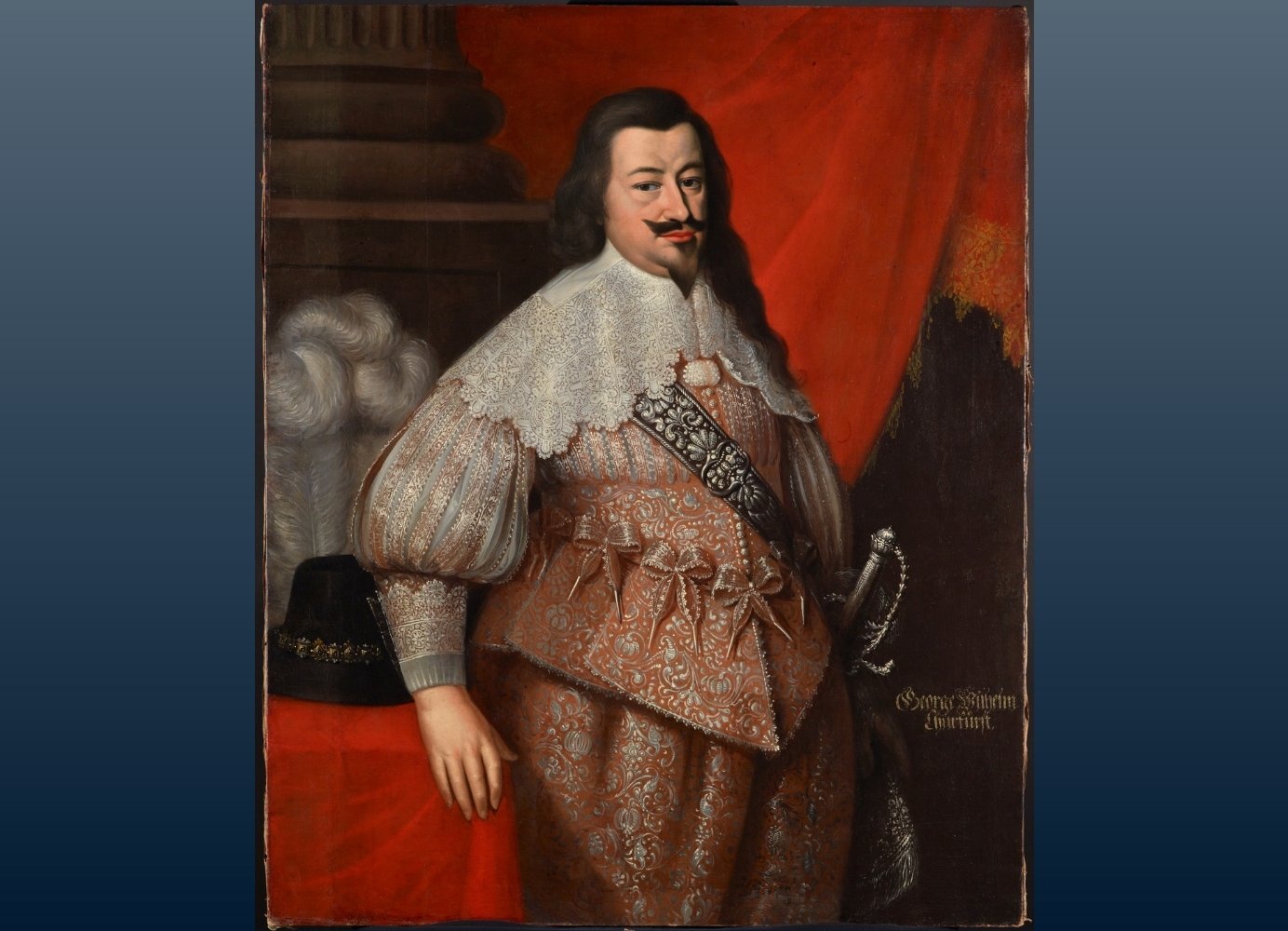
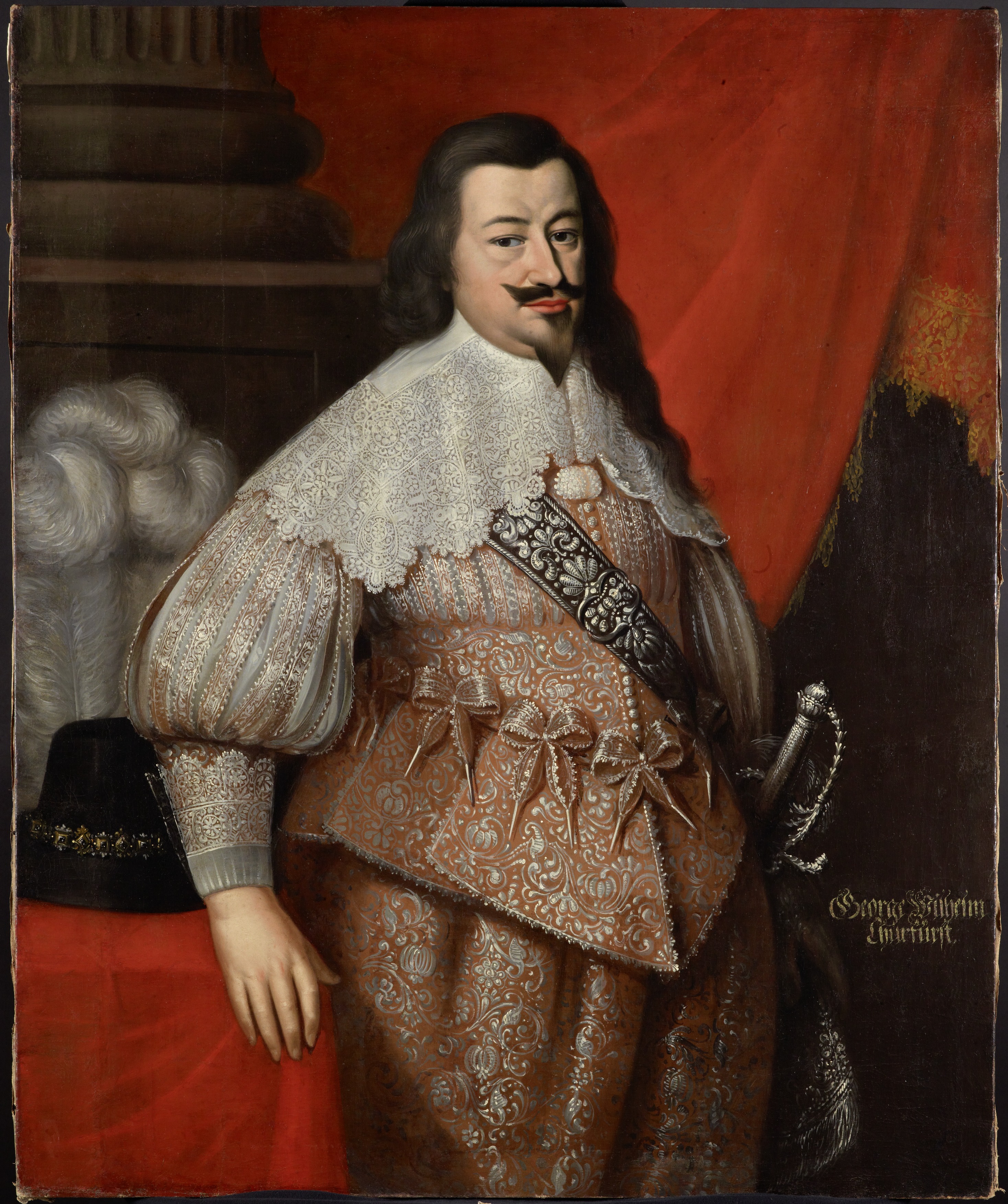
Portrait Unknown artist: Elector George William of Brandenburg, painting c. 1640. Source: Stiftung Hohenzollernscher Kunstbesitz (SPSG).
The considerable resistance this provoked among the Brandenburg clergy meant that the population remained largely Lutheran. At the same time, however, the Elector insisted that the country's elite — particularly senior officials and officers — convert to the Reformed faith, which is why Brandenburg is also described as having practised a form of court Calvinism. As a consequence, all subsequent Brandenburg Electors and later Prussian kings professed the Reformed faith. It was not until 1817 that King Frederick William III ordered the merger of all Lutheran and Reformed congregations in Prussia into what became known as the Evangelical Church in Prussia, later called the Evangelical Church of the Old Prussian Union.
Thereafter, religious life at court was adapted to the new confessional circumstances, particularly in the context of church services and devotions. Liturgy and the understanding of the Eucharist were oriented towards the Calvinist tradition, characterised by a lesser sacramental emphasis, a reticence towards pictorial symbolism, and a pronounced, religiously grounded ethic of duty and achievement.
George William too, as heir to the throne, was required to reorient himself accordingly — to learn the more austere Reformed practice of faith and to receive instruction in the Reformed catechism. A central element of his religious education was regular Bible study, which presumably focused primarily on the Gospels, the Psalms, and the Old Testament books of Kings, and encompassed not only the reading of these texts but also their interpretation and commentary.
On July 24, 1616, the Electoral Prince married Elisabeth Charlotte, Princess of the Palatinate (1597–1660), with whom he had four children, three of whom reached adulthood, including his son Frederick William, the future Great Elector (1620–1688). Elisabeth Charlotte was the younger sister of Elector Frederick V of the Palatinate (1596–1632), later known as the "Winter King."
Following the death of his father on December 23, 1619, George William assumed government as Margrave and Elector of Brandenburg, Arch-Chamberlain of the Holy Roman Empire of the German Nation, Duke in Prussia, Duke of Cleves, and Count of Mark.
An accident in 1620 resulted in a chronic injury to his lower leg, the effects of which spread to both legs after 1631 and permanently impaired his physical capacity, contributing to a reputation for lack of assertiveness.
His central political goal was to secure the territories acquired by his father. At the outset of his reign, during the opening phase of the Thirty Years' War, he pursued a policy of neutrality and loyalty to the Emperor, which was also reflected in his delegation of substantial political responsibility to his chief minister, the Catholic and imperially loyal Adam, Count of Schwarzenberg (1583–1641); he refrained, however, from building an independent military force. This policy encountered considerable difficulties, both among the predominantly Lutheran bourgeoisie and on account of his confessional position and his personal reluctance to make decisive choices.
Through the marriage of his sister Maria Eleonora (1599–1655) to the Lutheran King Gustavus II Adolphus of Sweden (1594–1632, reigning since 1611) on November 25, 1620 in Stockholm, George William found himself in a politically delicate situation. At the same time, Sigismund III Vasa, King of Poland and Grand Duke of Lithuania (1566–1632), his feudal overlord for the Duchy of Prussia, had also sought her hand for his son Władysław IV Vasa (1595–1648, reigning from 1632). From the perspective of Emperor Ferdinand II (1578/1619–1637), George William was thereby entangled in a Protestant network of alliances directed against him.
During the first phase of the Thirty Years' War, Brandenburg was initially largely spared, and George William continued to strive to maintain a policy of neutrality. Given his military weakness and geopolitical situation, however, his territory increasingly became a corridor and supply zone for various armies, suffering considerable burden, plunder, and devastation — particularly during the period of Swedish intervention (1630–1635).
With the advancing Swedish presence, George William was compelled in August 1638 to withdraw with his court to Königsberg in the Duchy of Prussia, which lay outside the Empire. There, both his financial resources and his state of health deteriorated markedly. Bedridden from October 1640 and suffering from severe dropsy, he died on December 1, 1640 at the age of 45 at Königsberg Castle. At the wish of his son and successor Frederick William, he was interred on March 11, 1642 in the princely vault of Königsberg Cathedral.
In historical assessments, George William is widely regarded as a ruler of limited political assertiveness; his policy, which vacillated between imperial loyalty and Swedish ties, is frequently interpreted as a significant factor in the destabilisation of Brandenburg during the Thirty Years' War. On the other hand, this conduct may also be understood as an attempt to keep his territories out of the armed conflicts that were taking shape — an attempt that was ultimately bound to fail in the face of the resolute and power-driven approach of the parties involved.
Bibliography
- Asche, Matthias: Kurfürst Georg Wilhelm von Brandenburg im Dreißigjährigen Krieg. Versuch einer Neubewertung. In: Ders., Kollenberg, Marco, Zeiger, Antje (eds.): Halb Europa in Brandenburg. Der Dreißigjährige Krieg und seine Folgen. Berlin 2020, pp. 32–44.
- Bentzien, Hans: Unterm Roten und Schwarzen Adler. Berlin 1992.
- Beuys, Barbara: Der große Kurfürst. Der Mann, der Preußen schuf. Reinbek bei Hamburg 1979, pp. 63 and 76.
- Hirsch, Theodor: Georg Wilhelm (Kurfürst von Brandenburg). In: Allgemeine Deutsche Biographie (ADB). Vol. 8, Leipzig 1878, pp. 619–629.
- Klein, Thomas: Georg Wilhelm, Kurfürst von Brandenburg. In: Neue Deutsche Biographie (NDB). Vol. 6. Berlin 1964, p. 203.
- Neumann, Hans-Joachim: Friedrich Wilhelm der Große Kurfürst. Der Sieger von Fehrbellin. Berlin 1995, p. 38.
- Pantle, Christian: Der Dreißigjährige Krieg. Als Deutschland in Flammen stand. Berlin 2017, p. 41. Wedgwood, Cicely Veronica: Der 30jährige Krieg. Munich 1999, pp. 139, 169, 193, 245 and 384f.
- Various pages from de.wikipedia, en.wikipedia, fr.wikipedia, pl.wikipedia, and sv.wikipedia.