

Frederick was born on a Sunday, 24 January 1712, at the Berlin Palace as the eldest surviving son of Prussian Crown Prince Frederick William and his wife Sophie Dorothea, a Princess of Hanover.
Together with his elder sister Wilhelmine (1709–1758), the future Margravine of Brandenburg-Bayreuth, with whom he maintained a close relationship of trust throughout his life, he grew up under the care of the Huguenot governess Marthe de Roucoulle (1659–1741), who had already raised his father and left an equally lasting impression on him.
As early as 1713 he was appointed ensign at the age of one; rapid further promotions followed, reaching lieutenant colonel in 1728, reflecting his early integration into the military order.
From the age of six he received a strict, authoritatively shaped Reformed-Protestant education. From 1718 (until 1729) this was directed by Albrecht Konrad, Count Finck von Finckenstein (1660–1735) and until 1727 was substantially shaped by Jacques Égide Duhan de Jandun (1685–1746), with whom he developed a lifelong bond.
Image
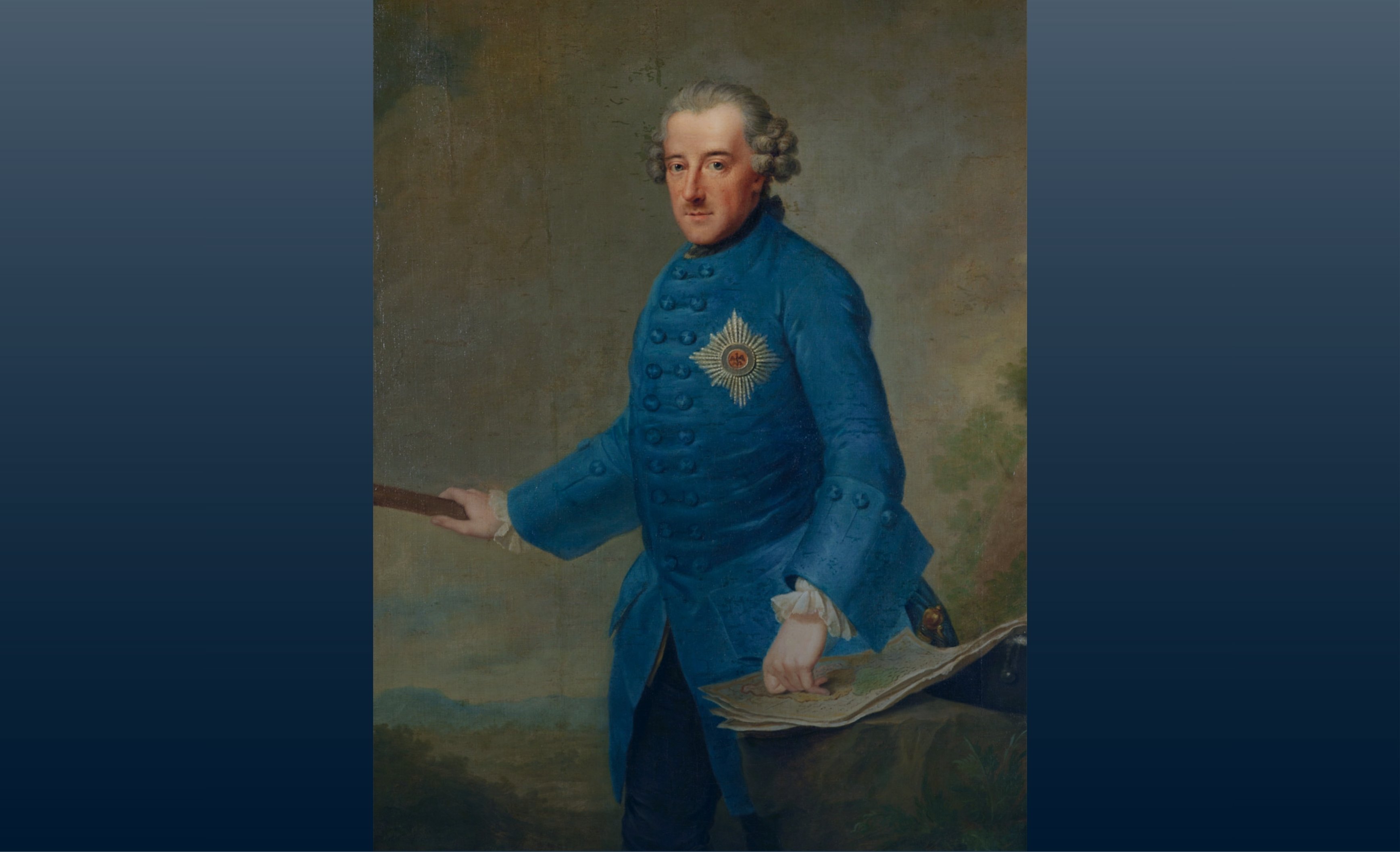
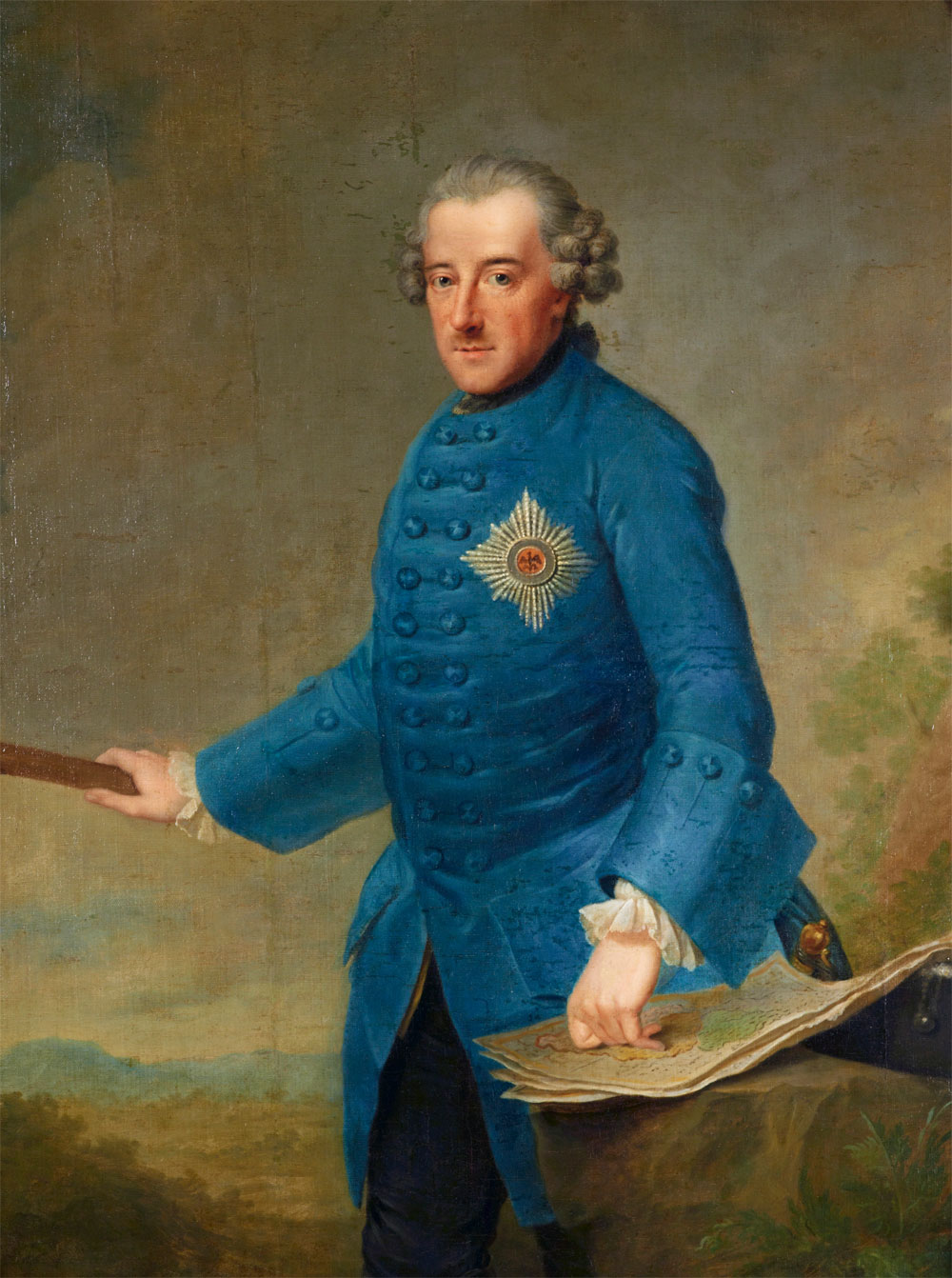
Johann Georg Ziesenis: King Frederick II, painting 1763. Source: Stiftung Hohenzollernscher Kunstbesitz (SPSG)
Against his father's wishes, Frederick received instruction in Latin, literature, and flute playing, which repeatedly provoked violent reactions from the king. The conflict intensified from 1729 through his close relationship with Hans Hermann von Katte (1704–1730). In the context of the king's marriage plans, Frederick planned together with Katte in 1730 to flee to England; they were however apprehended after an escape attempt near Steinfurt, charged with desertion, and imprisoned in the fortress of Küstrin.
As previously noted, both were imprisoned and charged with high treason, contrary to the pleas of the king's advisers and ministers. Only an intervention by Emperor Charles VI brought about the lifting of the death sentence against Frederick — though not against Katte. During his imprisonment Frederick temporarily lost his rank and status. In 1732 an official reconciliation with his father took place: Frederick was rehabilitated, readmitted to the army, and appointed proprietor of the Infantry Regiment von der Goltz, which henceforth bore the name Crown Prince Regiment (IR 16).
At his father's wish, he married in 1733 Princess Elisabeth Christine of Brunswick-Wolfenbüttel-Bevern (1715–1797), a niece of Empress Elisabeth Christine, consort of Emperor Charles VI (1685–1740). The marriage remained childless. From 1740 the couple lived apart. The years until his accession to the throne in 1740 Frederick spent in military service at Neuruppin, the garrison of his regiment, and from 1736 he resided at Rheinsberg Palace on the Grienericksee.
Following the death of his father on 31 May 1740, Frederick ascended the throne as king. With his accession, a cautious reform policy in the spirit of the Enlightenment began. Shortly after assuming government, he sharply curtailed the use of torture and abolished it entirely in 1754 — convinced that it was an unsuitable means of establishing truth. In religious policy he continued the already existing practice of relative tolerance, summed up in the formula that everyone should find salvation in their own way. At the same time, policy towards Jews remained restrictive. Economically he selectively promoted new industries, such as silk production, in order to strengthen Prussia's economic self-sufficiency.
In the public sphere he relaxed censorship for non-political writings and permitted limited freedom of the press, while political content continued to be controlled. At the same time he saw himself as an accessible ruler and sought direct contact with his subjects, endeavouring in particular to curb arbitrary authority. Early encounters with scholars such as Voltaire underline his claim to be an enlightened monarch.
Six months after his accession, Frederick II began the First Silesian War on 16 December 1740. The occasion was the succession crisis following the death of Emperor Charles VI (1685–1740, King of Spain since 1703, Emperor since 1711) and the assumption of government by his daughter Archduchess Maria Theresa (1717–1780) in the Habsburg hereditary lands in accordance with the Pragmatic Sanction of 19 April 1719. Frederick exploited the unclear political situation to invade Silesia and, following military successes, secured possession of the wealthy province in the Peace of Breslau on 11 June 1742. The conflict, however, expanded into the War of the Austrian Succession between 1740 and 1748.
As the military situation began to turn in Austria's favour, Frederick intervened again in 1744 and opened the Second Silesian War. Despite initial setbacks he held his ground and in the Peace of Dresden on 25 December 1745 had possession of Silesia definitively confirmed — which at the same time consolidated his reputation as an opportunistic practitioner of alliance politics.
Alongside these conflicts, Prussia acquired East Frisia in 1744 by inheritance, after its last prince died without heirs.
Following the reversal of alliances engineered by Wenzel Anton von Kaunitz-Rietberg (1711–1794), Frederick II launched the Seven Years' War in 1756 with a pre-emptive strike, in order to forestall the impending attack of a broad coalition. He marched into the wealthy Electorate of Saxony, which subsequently became both a deployment area for the Prussian army and a theatre of operations for its opponents. As a military commander he won significant victories — among others at Rossbach and Leuthen in 1757 — but also suffered severe defeats, such as at Kunersdorf (1759), which brought Prussia to the brink of collapse.
The military and financial situation remained critical until 1761. The decisive turn came only in 1762 with the death of the Russian Empress Elizabeth Petrovna (1709–1762) and the accession of her successor Peter III (1728–1762, reigning 1762). The emperor, a great admirer of the king and of all things Prussian, ended the war, causing the opposing coalition to disintegrate. In the Peace of Hubertusburg on 15 February 1763, the status quo was confirmed; Prussia asserted itself as a European great power. From this time onwards his epithet "the Great" began to appear, becoming a fixed designation after his death. The years of war, filled with physical hardship and the resulting deterioration of his health, as well as the loss of his mother and favourite sister, gave rise to his detached style of government, marked by cynicism and harshness towards those around him.
After 1763, Frederick devoted himself increasingly to domestic reforms. He promoted legal development — including the preparation of the General Legal Code — and actively supported agriculture and internal colonisation, as well as the cultivation of new crops such as the potato. He also had the infrastructure expanded, new settlements established, and founded economic institutions such as the Berlin Porcelain Manufactory. Social reforms, such as the restriction of serfdom, remained however limited to the royal domains. The education system was expanded, though it continued to suffer from structural deficiencies, particularly in teacher training.
In foreign policy, the king oriented himself after the end of the war primarily towards an alliance with Russia, which for more than two decades formed the foundation of his policy. As part of the First Partition of Poland in 1772, Prussia secured further territorial gains and a strategically important land connection. With the annexation of West Prussia, he styled himself from this point forward King of Prussia. In the War of the Bavarian Succession of 1778/79, he prevented a further shift of power in Austria's favour. To safeguard the balance of power within the Empire, he initiated the Protestant-dominated League of Princes in 1785, which lasted until 1791.
The simplicity — indeed negligence — in his outward appearance, which he displayed in public, may be understood as a deliberate form of self-presentation. Like his father before him, who had made the uniform socially acceptable as the constant dress of a monarch throughout Europe, Frederick typically wore the plain service coat of an interim uniform of a colonel of his Life Guard Battalion (IR 15, I), complemented by the embroidered breast star of the Order of the Black Eagle.
As a writer he composed numerous works, predominantly in French, including the Anti-Machiavel (1740), in which he articulated political principles of the Enlightenment while simultaneously justifying power-political action. In historical writings and memoirs he interpreted the development of Prussia from his own perspective. His critical attitude towards contemporary German literature met with considerable opposition.
Culturally, Frederick displayed wide-ranging interests: together with architect friends, artists, philosophers, and art scholars he initiated a distinctive style, the so-called Frederician Rococo. He developed an enormous programme of building throughout his kingdom and initiated major projects such as the remodelling of Potsdam and Charlottenburg Palaces, the Opera House Unter den Linden, Sanssouci Palace, and the New Palace. He assembled extensive art collections. At the same time he was a committed musician, playing the transverse flute, composing, and fostering musical life at court.
He was also closely associated with Freemasonry: admitted as Crown Prince, he supported its spread in Prussia after 1740, without however committing himself permanently to any institutional involvement.
On 17 August 1786, Frederick II died at four o'clock in the morning at Sanssouci Palace in his armchair. Contrary to his own wishes, his nephew and successor Frederick William II (1744–1797) had him interred in a plain metal sarcophagus beside his father in the vault of the Royal Monument at the Garrison Church in Potsdam.
Frederick II is regarded as a central representative of enlightened absolutism and saw himself as the first servant of the state. His reign was characterised domestically by reforms, including the abolition of torture and the expansion of the education system.
The Silesian Wars waged against Austria gave rise to the so-called German Dualism. By the time of the Seven Years' War at the latest, Prussia had established itself as the fifth great power alongside France, Great Britain, Austria, and Russia. Through participation in the First Partition of Poland and the acquisition of West Prussia, Frederick consolidated this position further. Taken as a whole, his policy combined domestic consolidation with a foreign policy oriented towards the balance of power and territorial expansion.
Bibliography
- Bendikowski, Tillmann: Friedrich der Große. Munich 2011. Blanning, Tim: Frederick the Great – King of Prussia – A Biography. Translated from the English by Andreas Nohl. Munich 2018.
- Bled, Jean-Paul: Frédéric le Grand. Paris 2004.
- Bled, Jean-Paul: Friedrich der Große. Translated from the French by Wolfgang Hartung. Düsseldorf 2006.
- Bringmann, Wilhelm: Friedrich der Große. Ein Porträt. Munich 2006.
- Fraser, David: Frederick the Great. London 2000. Frie, Ewald: Friedrich II. Reinbek 2012.
- Hahn, Peter-Michael: Friedrich II. von Preußen. Feldherr, Autokrat und Selbstdarsteller. Stuttgart 2013.
- Heinrich, Gerd: Friedrich II. von Preußen. Leistung und Leben eines großen Königs. Berlin 2009.
- Kunisch, Johannes: Friedrich der Große. Munich 2011.
- Luh, Jürgen: Der Große. Friedrich II. von Preußen. Munich 2011.
- Mittenzwei, Ingrid: Friedrich II. von Preußen. Eine Biographie. East Berlin 1980.
- Schieder, Theodor: Friedrich der Große. Ein Königtum der Widersprüche. Frankfurt am Main 1983.
- Sösemann, Bernd (ed.): Friedrich der Große in Europa – gefeiert und umstritten. Stuttgart 2012.
- Various pages from de.wikipedia, en.wikipedia, fr.wikipedia, and pl.wikipedia.