

Frederick William was born on 14 August 1688 at the Palace of Berlin-Cölln as the second son of Elector Frederick III of Brandenburg. His elder brother Frederick Augustus (1685–1686) had already died before his birth, making Frederick William Electoral Prince of Brandenburg from birth.
Tensions between his parents over his upbringing arose early. Between 1689 and 1692 he grew up at the Hanoverian court of his grandparents Duke Ernest Augustus and Duchess Sophia of Brunswick-Lüneburg, Countess Palatine (1630–1714). There he already displayed an impulsive temperament and a tendency towards conflict, including with his cousin George Augustus, the future King George II of Great Britain and Ireland and Elector of Hanover (1683–1760, reigning since 1727) — a conflict and personal rivalry that both men would sustain for the rest of their lives.
After his return, he was raised from 1692 by the Huguenot Marthe de Montbail, later known as Madame de Roucoulle (1659–1741), through whose influence French became his everyday language. At the same time, he developed an early aversion to the courtly splendour of his parental home, as well as a strong interest in practical matters of state and military affairs.
Image
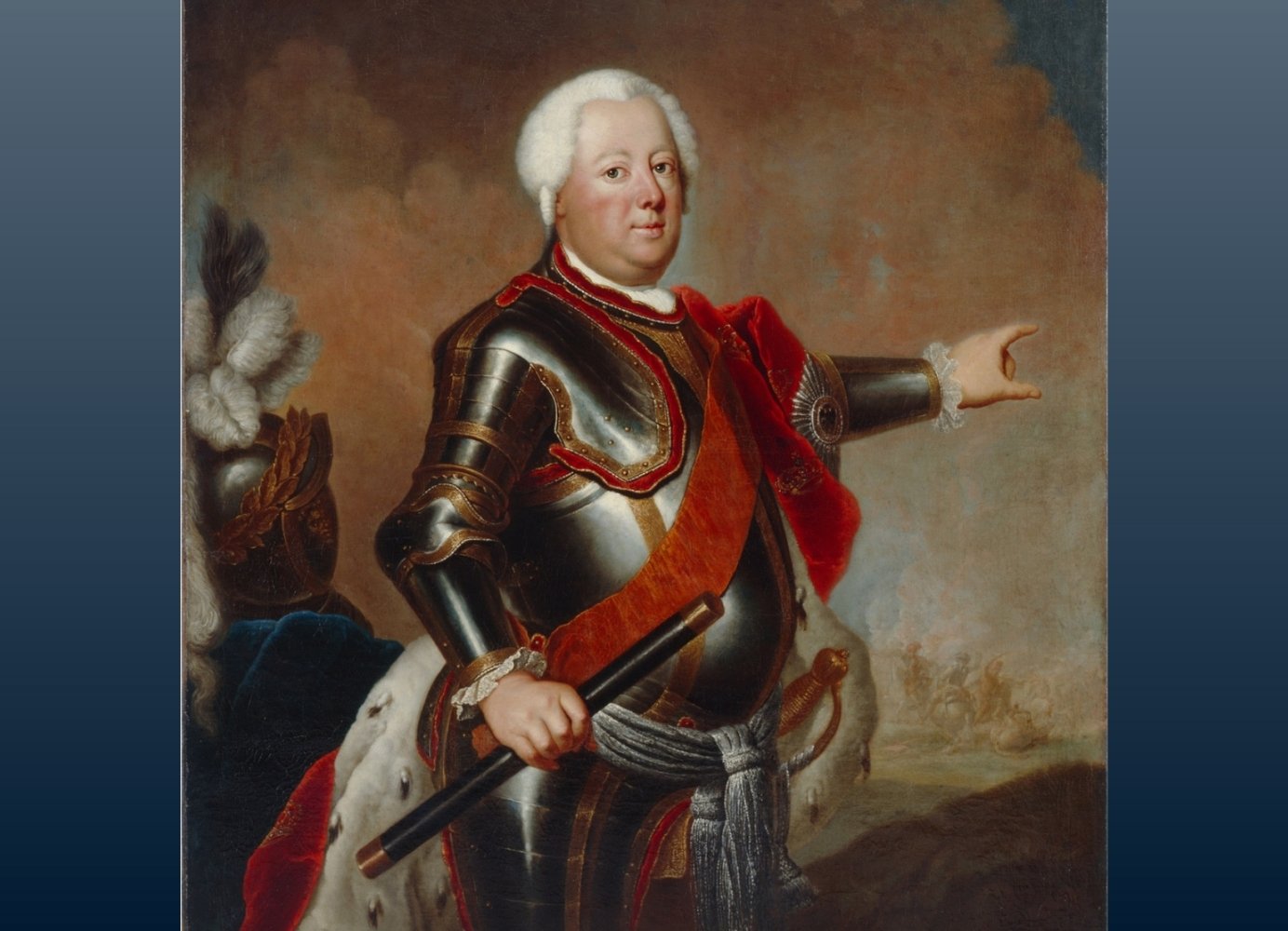
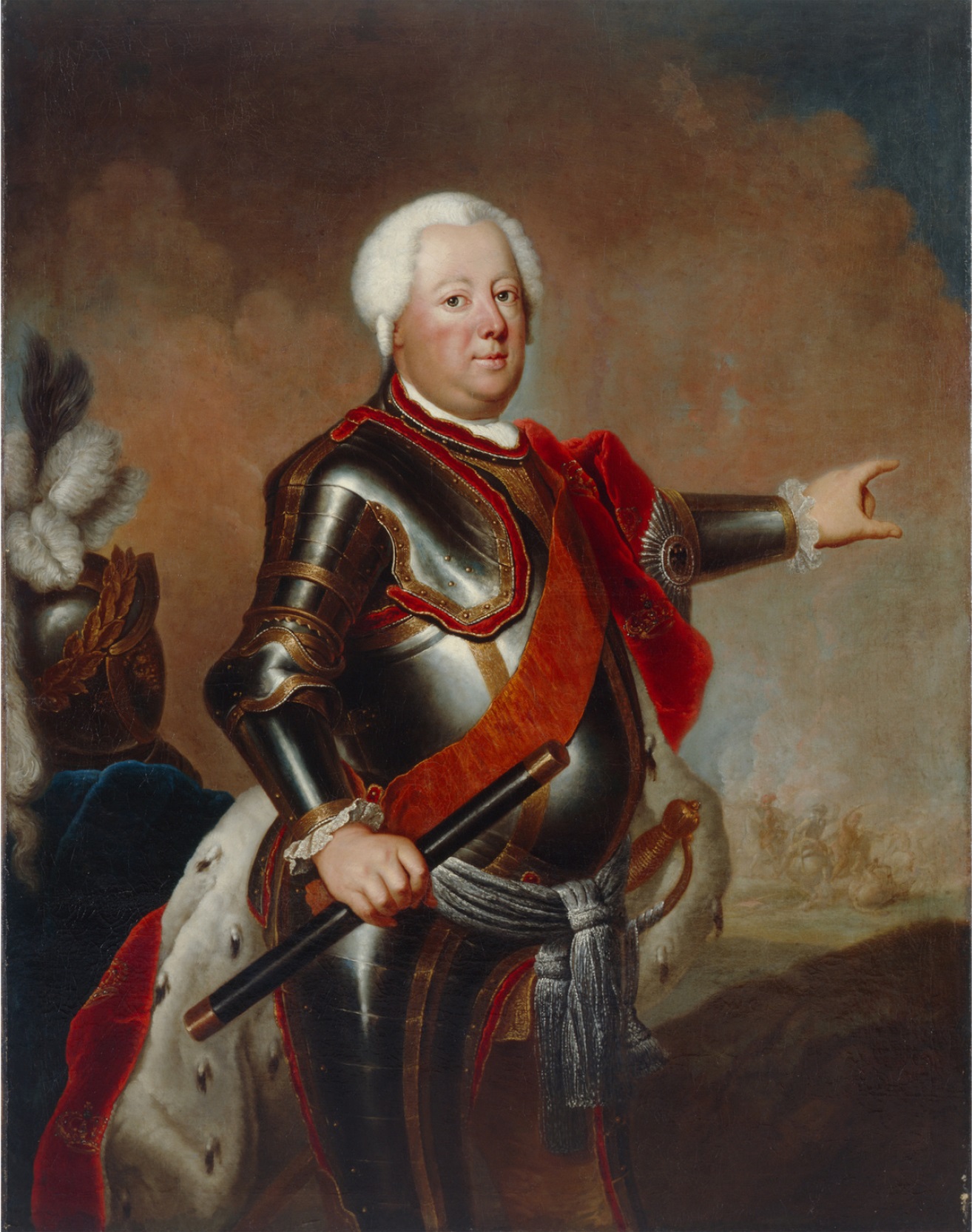
Antoine Pesne (workshop): King Frederick William I in Prussia, painting after 1733.
His education was reorganised from 1695 onwards, combining pietistic and rationalist elements. Despite a broad curriculum, Frederick William showed little inclination towards the sciences, but developed an early practical interest in matters of state and military affairs, along with a pronounced sense of economy.
With the transfer of the estate of Wusterhausen to him in 1698, he received the opportunity for independent administration at the age of only ten, which shaped his economic and administrative abilities. At the same time he turned increasingly to military matters and gained early organisational experience.
Through travels, particularly to the Netherlands, he absorbed the impressions of a bourgeois-Reformed culture. From 1702 onwards he was gradually drawn into government and acquired comprehensive knowledge of administrative and military affairs, while also deepening his critical attitude towards his father's court and policies.
Frederick William I was declared of age in 1704 at the age of 16 and developed the Wusterhausen estate into an economically successful model operation that served him as a model of efficient state administration. The practical experience gained there had a lasting influence on his later understanding of government. Travels to the Netherlands deepened his puritanical-bourgeois orientation and influenced his political and cultural tastes. On 14 June 1706 he married his cousin Princess Sophie Dorothea of Hanover (1687–1757) in Cölln an der Spree, daughter of Elector George Louis of Hanover, who from 1714 was also King of Great Britain and Ireland.
In the War of the Spanish Succession (1701–1714) he gained formative military experience and forged close ties with Prince Leopold I of Anhalt-Dessau, the "Old Dessauer" (1676–1747, reigning since 1693). From 1708 he repeatedly assumed governmental duties in a deputy capacity and intervened actively in politics in 1710, contributing to the exposure of the corruption and mismanagement of the so-called Three-Counts Cabinet. The experience of foreign-policy impotence — particularly in 1711 during the Great Northern War between Russia and Sweden — reinforced his commitment to military self-sufficiency. At the same time, the Halle Pietism of the clergyman August Hermann Francke (1663–1727) temporarily exerted a decisive influence on his thinking.
Following the death of Frederick I on 25 February 1713, he assumed government, renounced a coronation, and initiated a fundamental change of course. Court expenses were drastically reduced, the royal privy purse was secured, and the court establishment was curtailed. Frederick William saw himself as a working monarch, governed personally from his cabinet, and made decisions mostly in the form of brief cabinet orders. The central measures included the reorganisation of finances, the strict reduction of court expenditure, and a focus on an efficient army. Administration and government agencies were streamlined, the General Directory (1722) was established as the central financial and administrative authority, thereby laying the foundation for a centralised bureaucratic state. At the same time, Berlin grew considerably under his rule.
His economic policy followed mercantilist principles and aimed at promoting domestic production and limiting the outflow of capital. Agriculture and infrastructure were developed, while his immigration policy — such as the settlement of 20,000 Salzburg exiles in 1732 — served to secure population levels and the labour supply. Science policy was strongly utilitarian in character: subjects with practical applications were primarily promoted, for instance through early professorships in cameral sciences. Critical scholars such as Christian Wolff (1679–1754) and Johann Jacob Moser (1701–1785) came under political pressure and left the country.
At the same time, Prussia developed into a centre of progressive medicine, in particular through the Charité, which had been founded as early as 1709. With the decree of 28 September 1717, Frederick William I introduced compulsory schooling on the royal domains — a measure that, despite initial difficulties in implementation, contributed in the long term to a raising of educational standards.
In religious policy, the king combined Calvinist convictions with the promotion of Lutheran Pietism, which left its mark on administration, the military, and education. At the same time, he maintained a comparatively tolerant practice towards different confessions, while policy towards Jews remained restrictive. Social welfare measures, such as the founding of the military orphanage in Potsdam, were connected to his religiously informed conception of the state; reforms such as the abolition of serfdom, on the other hand, remained largely ineffectual.
Militarily, Frederick William I left a lasting mark on Prussia: between 1713 and 1740 he doubled troop strength to over 80,000 men and made the state a leading military power in Europe. With the canton system introduced in 1733 and a closed noble officer corps, he created a stable military-social order. Efficiency and discipline stood at the centre, while special phenomena such as the Tall Fellows also reflected personal predilections.
Taken as a whole, Frederick William I created an efficient, tightly organised military establishment that became the central pillar of the Prussian state and prepared its rise to the status of a European great power.
In foreign policy he initially maintained neutrality, but later participated in the Great Northern War and gained, among other things, Stettin in the Peace of Stockholm on 21 January 1720. Overall his policy remained defensive, oriented towards stability and economic rationality; colonial ambitions were abandoned in favour of internal consolidation.
The relationship between Frederick William I and his son Crown Prince Frederick — the future Frederick II (1712–1786, reigning from 1740) — ultimately escalated in 1730 in the context of dynastic marriage plans. The Crown Prince attempted, together with his boyhood friend Hans Hermann von Katte (1704–1730), to flee Prussia, but was apprehended at the military camp near Steinfurt and imprisoned in the fortress of Küstrin. The king rejected the clemency petition from Katte's father and had his son executed. Contrary to Prussian historiographical tradition, Frederick William I did not compel the Crown Prince to witness the execution in person, but merely had him informed of it — which nevertheless caused Frederick an understandable nervous breakdown.
The conflict was rooted in fundamental differences in upbringing and values between a militarily disciplined conception of the state and the artistic and intellectual interests of the Crown Prince. Despite a partial reconciliation later, the relationship remained permanently strained; Frederick was ultimately permitted to withdraw to Rheinsberg Palace, where he was able to pursue independent studies.
With advancing age, Frederick William I — owing to his unhealthy lifestyle and diet — suffered increasingly from attacks of gout and podagra and was compelled to use a wheelchair ever more frequently. On 31 May 1740, the king died at the age of 52 from heart failure. He was interred on 4 June in the vault of the Royal Monument at the Garrison Church in Potsdam. The sarcophagus of black polished limestone had been commissioned by him during his own lifetime.
After his coffin was hidden in 1943 — to protect it from the advancing Red Army — in a salt mine at Bernterode, it was transferred in 1945 first to the Church of St Elizabeth in Marburg, and from there in 1952 to the Protestant Chapel of Christ at Hohenzollern Castle near Hechingen in Baden-Württemberg. On 17 August 1991, his coffin and that of his son were finally transferred to the Kaiser Friedrich Mausoleum near the Friedenskirche in the park of Sanssouci.
Frederick William I combined contradictory qualities in his person: authoritarian militarism and religious rigour alongside pragmatic reason of state and occasional acts of care. His style of government was characterised by discipline, frugality, and a rejection of courtly culture, while education and learning played a subordinate role. Overall, his actions aimed at strengthening the state, its finances, and its army. At the end of his reign, Frederick William I left behind a consolidated, financially stabilised state with a greatly expanded military, with around 85 percent of the state budget devoted to military purposes.
Bibliography
- Baumgart, Peter: Friedrich Wilhelm I. (1713–1740). 2nd, updated and expanded edition. Munich 2009.
- Beck, Friedrich, Schoeps, Julius H. (eds.): Der Soldatenkönig. Friedrich Wilhelm I. in seiner Zeit. Potsdam 2003.
- Göse, Frank: Friedrich Wilhelm I. Die vielen Gesichter des Soldatenkönigs. Darmstadt 2020.
- Kathe, Heinz: Der Soldatenkönig. Friedrich Wilhelm I. 1688–1740. König in Preußen. Cologne 1981. Ohff, Heinz: Preußens Könige. Ein Leben zwischen Hoffnung und Revolution. Munich / Berlin / Zurich 2016, pp. 43–84.
- Venohr, Wolfgang: Friedrich Wilhelm I. Preußens Soldatenkönig. 2nd, revised new edition. Munich 2001.
- Various pages from de.wikipedia, en.wikipedia, and fr.wikipedia.