

It is remarkable to what degree the personality profiles of two individuals of almost the same age — raised under the guidance of the same educators and within comparable circumstances — diverged in their development on account of differing dispositions. While Crown Prince Frederick William (IV) developed into an aesthetically cultivated, pleasure-loving Romantic for whom military matters were remote, his brother William (I), two years his junior, had already developed from an early age a keen interest in everything soldierly and military. These interests remained of central importance throughout his life (cf. Wolfram Siemann).
At the same time, it must be noted that shared experiences also produced comparable formative influences. As in the case of Frederick William, the comparatively rich source material available for Emperor William I permits a nuanced reconstruction of the future emperor's character development.
Wilhelm Friedrich Ludwig, Prince of Prussia, was born on 22 March 1797 at the Crown Prince's Palace in Berlin as the second son of the Prussian Crown Prince couple. In his early years (c. 1797 to 1798/99), he lived alternately between the Crown Prince's Palace, Charlottenburg Palace, and the Potsdam residences. The family cultivated a domestic, almost bourgeois lifestyle that was little governed by courtly convention. Early upbringing took place in the immediate environment of the parents, under the care of nursemaids; during this phase — as with his elder brother Frederick William — a very close bond with their mother, Queen Louise, developed. More than his elder brother, he venerated his mother throughout his life.
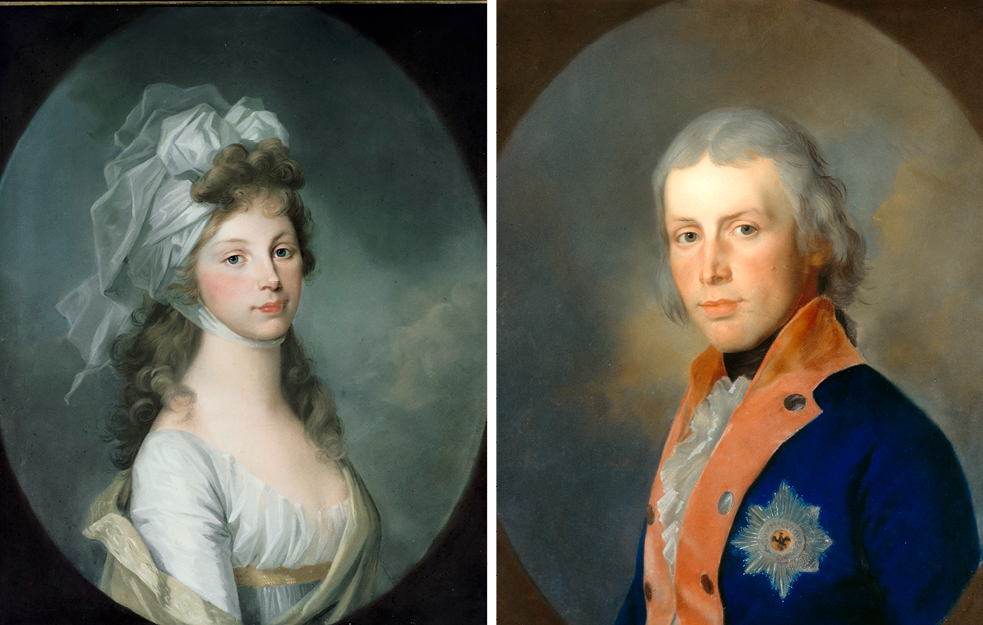
Image caption f.l.t.r.
Henriette Félicité Tassaert after Johann Friedrich August Tischbein: Crown Princess Louise of Prussia, pastel 1796.
Henriette Félicité Tassaert after Johann Friedrich August Tischbein: Crown Prince Frederick William of Prussia, pastel 1796.
Around 1798/99, formally separate court households were established for Prince William and his elder brother, though in practice they were run as a single household. William was taught by the same teachers as his elder brother, but unlike him did not share his quick grasp of things. William, on the other hand, excelled in all physical exercises.
The war against France, the destruction of the Prussian army at Jena in October 1806, and the subsequent flight to Prussia — which ended only near the Russian border at Memel — left a deep, indeed traumatic impression on the boy.
In Memel, the Crown Prince and Prince William formed a lifelong friendship with Friedrich Wilhelm August Argelander (1799–1875), who would later become a distinguished astronomer.
After the return from East Prussia in 1809, the two princes received a new tutor: the theologian and philosopher Jean Pierre Frédéric Ancillon, who was appointed their governor and chief court marshal. While the religious education took hold in the case of Frederick William, it met with little resonance in Prince William.
Since his father envisaged a military career for Prince William, he was appointed ensign on 22 March 1807, his tenth birthday. In his mother's assessment, the frequently ailing prince was initially not equal to the demands of military service.
The death of his mother, the popular Queen Louise, on 19 July 1810, was a traumatic experience for the sensitive boy. His aunt, Princess Marianne of Prussia (1785–1846), became his most important female figure of reference after his mother's death.
Following the catastrophic outcome of Napoleon's Russian campaign in 1812, Prussia — which since the Peace of Tilsit of 7 July 1807 and the alliance and subsidy treaty of 24 February 1812 had been bound to France — began gradually to detach itself from this alliance. At the beginning of 1813 a Russo-Prussian coalition was formed, which Great Britain and Austria soon joined.
In the winter of 1813/14, Frederick William III acceded to the wish of his nearly seventeen-year-old son to be allowed to take the field as well. William participated in the fighting from a relative distance, in order to gain military experience. On 27 February 1814 he took part together with his father in the Battle of Bar-sur-Aube in Champagne, during which both came under French rifle fire but remained unharmed.
For his supposed bravery, William received the Russian Order of St. George, Fourth Class, on 5 March 1814, and the Prussian Iron Cross, Second Class, on 10 March 1814. He himself, however, regarded these distinctions as owed more to his rank than to personal merit. On 30 October 1814 he was finally promoted to second lieutenant.
These experiences left lasting impressions on Prince William. Both the Prussian defeat of 1806/07 and his participation in the Wars of Liberation played a decisive role. For William, being a soldier meant above all loyalty to God, king, and fatherland. Already as a sixteen-year-old he displayed a pronounced sense of responsibility, a serious understanding of his duty as an officer, and a high degree of personal discipline. Service appeared to him as a moral obligation rather than an opportunity for self-presentation. Contemporary accounts emphasise his modesty in quarters, his endurance on marches, and his readiness to accept the conditions of field life without reservation.
During the campaign of 1814, his calm conduct was noted — without arrogance or panic. He did not seek an exposed heroic role, but displayed steadfastness and self-control — qualities that distinguished him from more impulsive officers and were to shape his entire life.
Unlike other princes, he accepted the military hierarchy unreservedly and respected experienced generals. His interest lay in learning, not in exerting influence. His close attachment to the traditional order and a scepticism towards far-reaching reform ideas were apparent from an early stage. This attitude was rooted both in his early encounters with French soldiers shaped by the revolution and in his impressions of Russia, which he visited in 1826 shortly after the Decembrist uprising.
Already in his youth he embodied the type of the old Prussian line officer with a pronounced monarchical sense of responsibility. Closely linked to his military formation was William's religiosity. As an old Prussian Protestant of duty, he understood religion less as an expression of individual inwardness than as the foundation of the fear of God, responsibility, and state-oriented morality. In the Calvinist tradition, he was also shaped by the concept of predestination, which he interpreted as God's eternal decree and as an expression of divine providence; accordingly, he was convinced that God actively intervenes in the course of history.
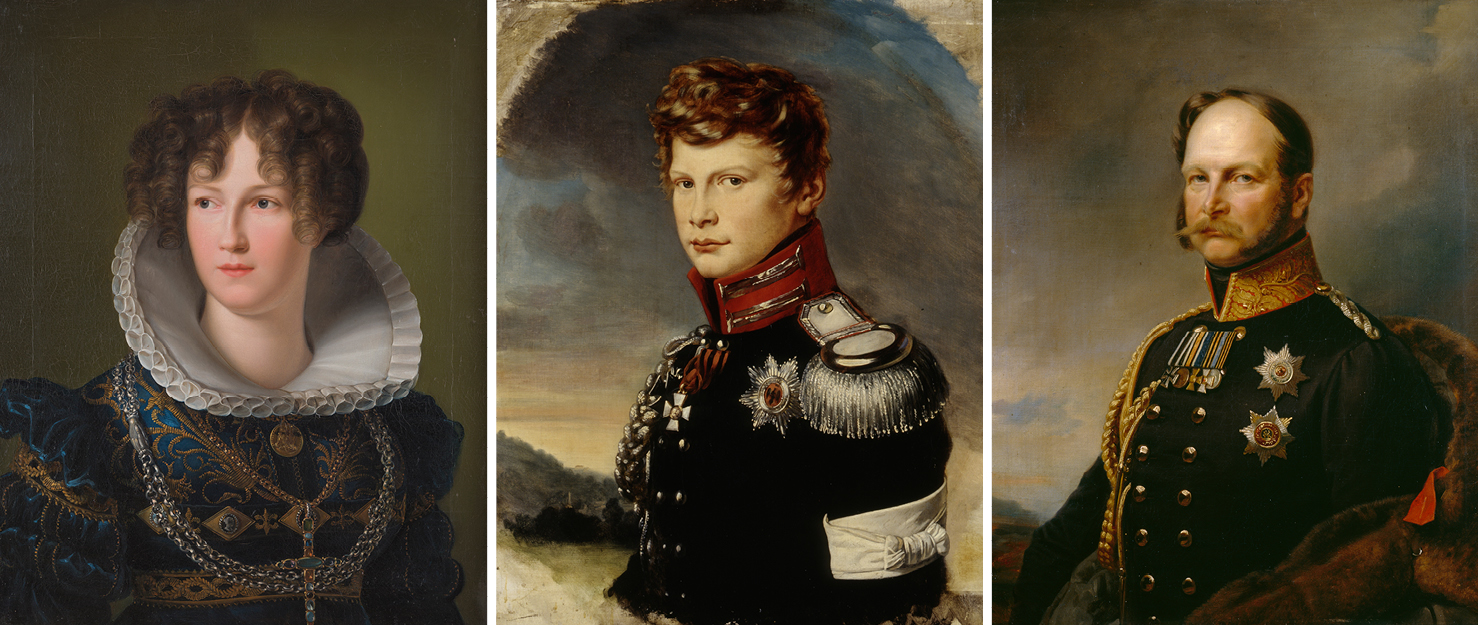
Image captions f.l.t.r.
Wilhelm von Schadow: Princess Marianne of Prussia in old German dress, painting 1812.
Carl von Steuben: Prince William of Prussia wearing the Allied armband, painting 1814.
Franz Krüger: William I as Prince of Prussia, painting 1858.
William was neither a mystic nor a theological thinker and certainly not a church reformer. He was fundamentally in agreement with and loyal to the merger of the Lutheran and Reformed churches into the Evangelical Church in Prussia, initiated by Frederick William III in 1817. He understood this step as an act of state church governance rather than theological reform, which he supported as a loyal subject. He was also broadly receptive to later changes in the church, court, liturgical, and communion order, though in his personal piety he remained committed to his Calvinist formation.
In matters of church politics, William rarely argued in theological terms. In the context of the so-called Kulturkampf, he expressed himself more cautiously than Reich Chancellor Otto von Bismarck. His positions were predominantly shaped by constitutional and state-law considerations. He interpreted the universalist claim of Pope Pius IX (1792–1878) primarily as a political challenge to state authority. In this connection he formulated the credo "that he recognised no power above himself other than God. He was king of Prussia by the grace of God, and the Pope may reign in spiritual matters, but in Prussia I reign." At the same time he expressed concern that too close a bond with Rome might undermine the state loyalty of his subjects: "I will never tolerate subjects being estranged from the state in their conscience."
After the assassination attempts of 1878, he moderated his attitude towards the Catholic Church, declaring that he wanted no religious war. This changed position contributed indirectly to the later rapprochement with Pope Leo XIII (1810–1903).
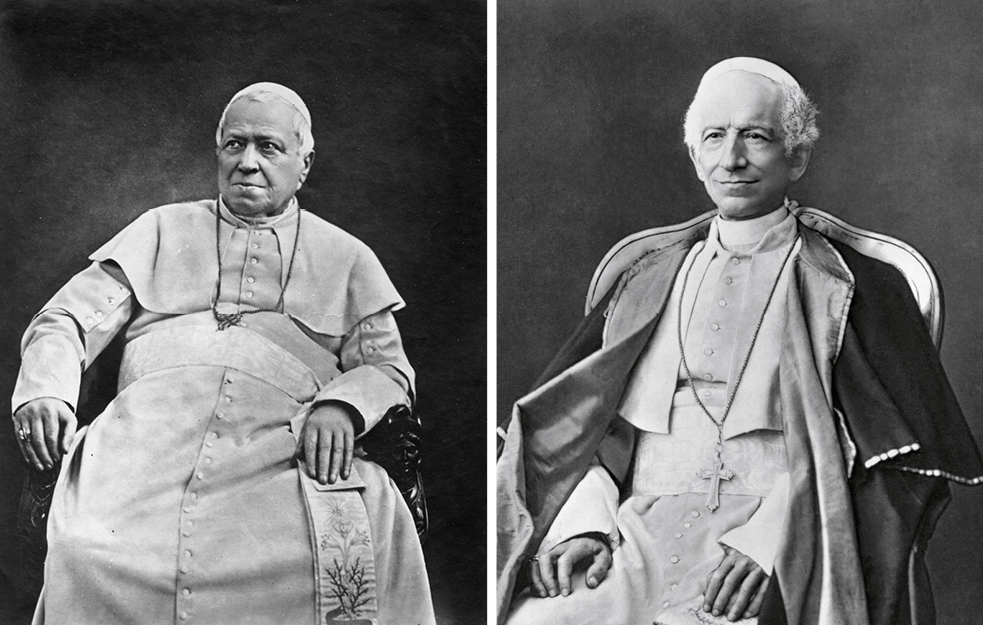
Image captions f.l.t.r.
Adolphe Braun: Pope Pius IX, photograph 1875.
Adolphe Braun: Pope Leo XIII, photograph 1878.
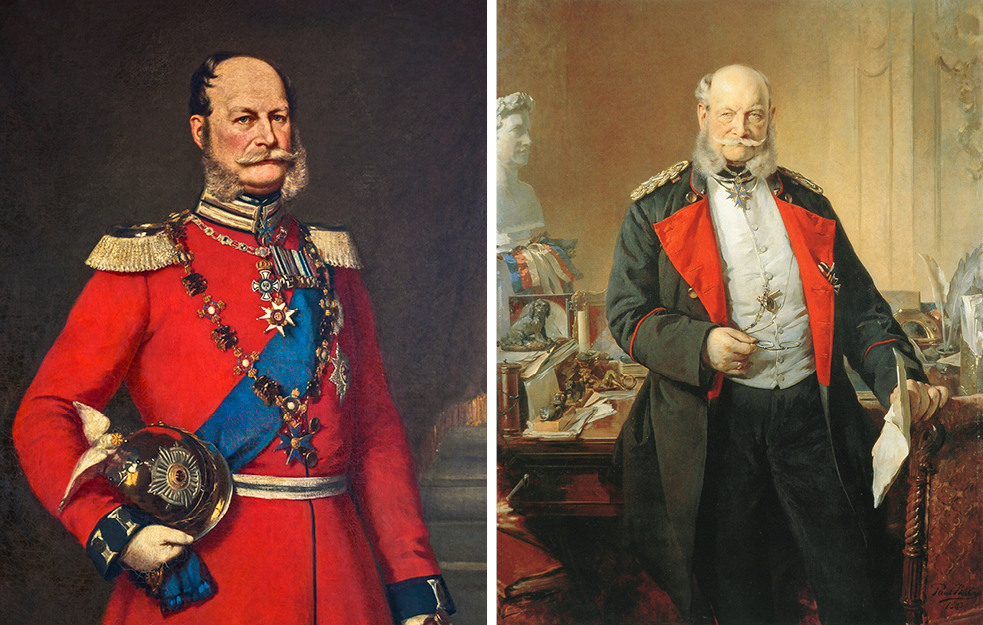
William's personal piety noticeably influenced his entire lifestyle, particularly his daily routine and dietary habits. Contemporary descriptions characterise him as moderate, although he appreciated fine cuisine and preferred French cooks at his court. He was known as a great admirer of women and was regarded as a gentleman of the nineteenth century, presiding over a court that was not extravagant but of extraordinary elegance.
His sense of duty was reflected in a strictly regulated daily routine. He would generally rise around 6.30 a.m., take a simple breakfast, and then devote several hours to military correspondence and the study of files, which he annotated in his own hand — with remarks such as "Agreed," "Briefing requested," "With God's help," "God willing," "God protect Prussia," or "With God for King and Fatherland." Audiences followed, generally conducted standing.
Dinner customarily took place at 1.00 p.m. according to the rules of court ceremonial, with a fixed seating arrangement. The emperor ate sparingly. During meals he spoke little and avoided lengthy political discussions. The afternoon was frequently devoted to walks or rides, before audiences and file study resumed. Around 7.00 p.m. he attended social gatherings or received guests in a smaller circle. He particularly enjoyed marches and military music and showed little interest in opera. He generally retired around 10.00 p.m. On the whole, he attached considerably greater importance to the regularity of his daily routine than to representative social splendour. He maintained this pronounced discipline into advanced age. Even beyond his eighty-fifth year, he devoted himself intensively to file work every day.
Image captions f.l.t.r.
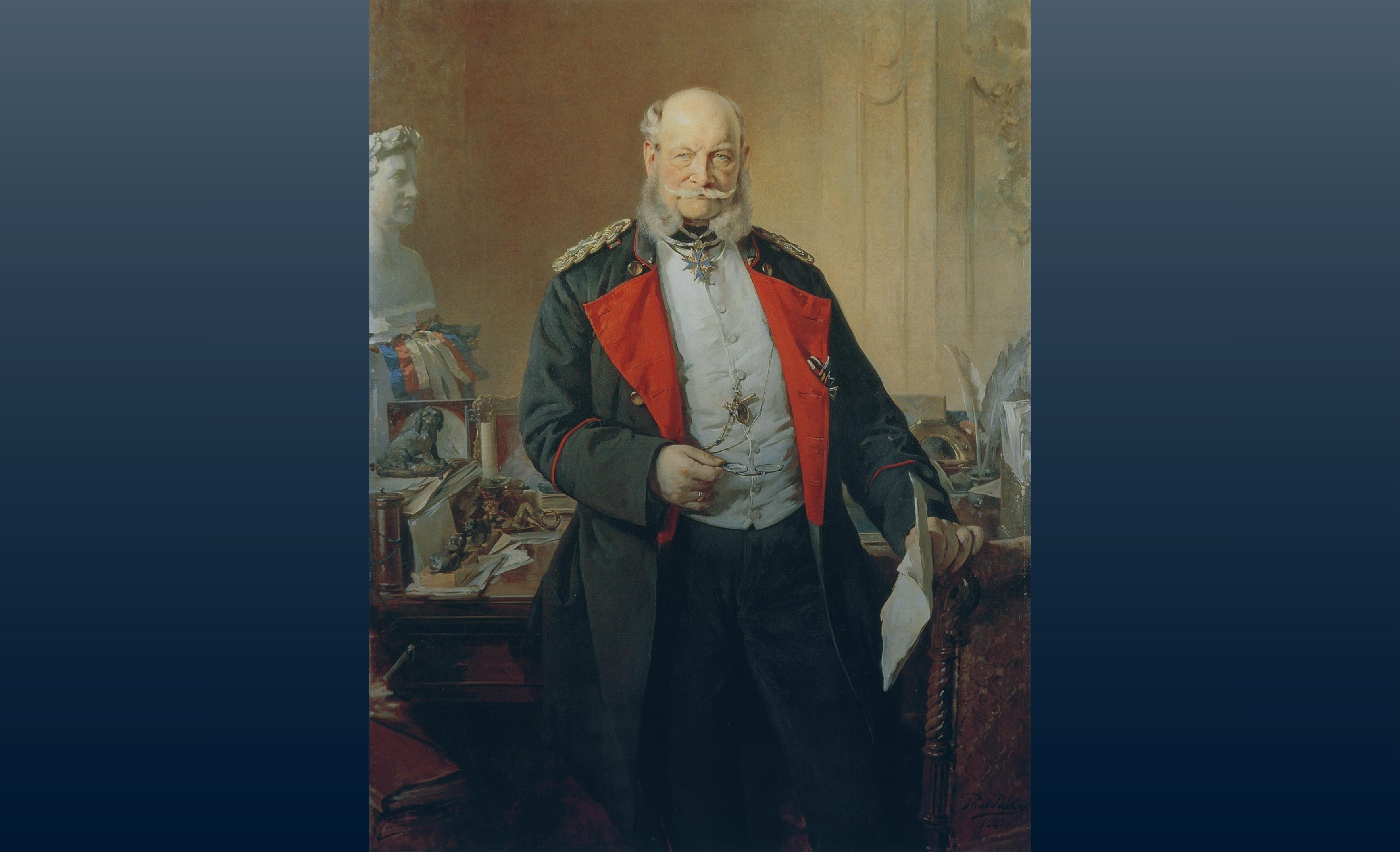
Unknown artist after Franz Xaver Winterhalter: King William I in the full dress uniform of the Garde du Corps Regiment, painting c. 1861.
Paul Bülow: William I in his study, painting 1883.
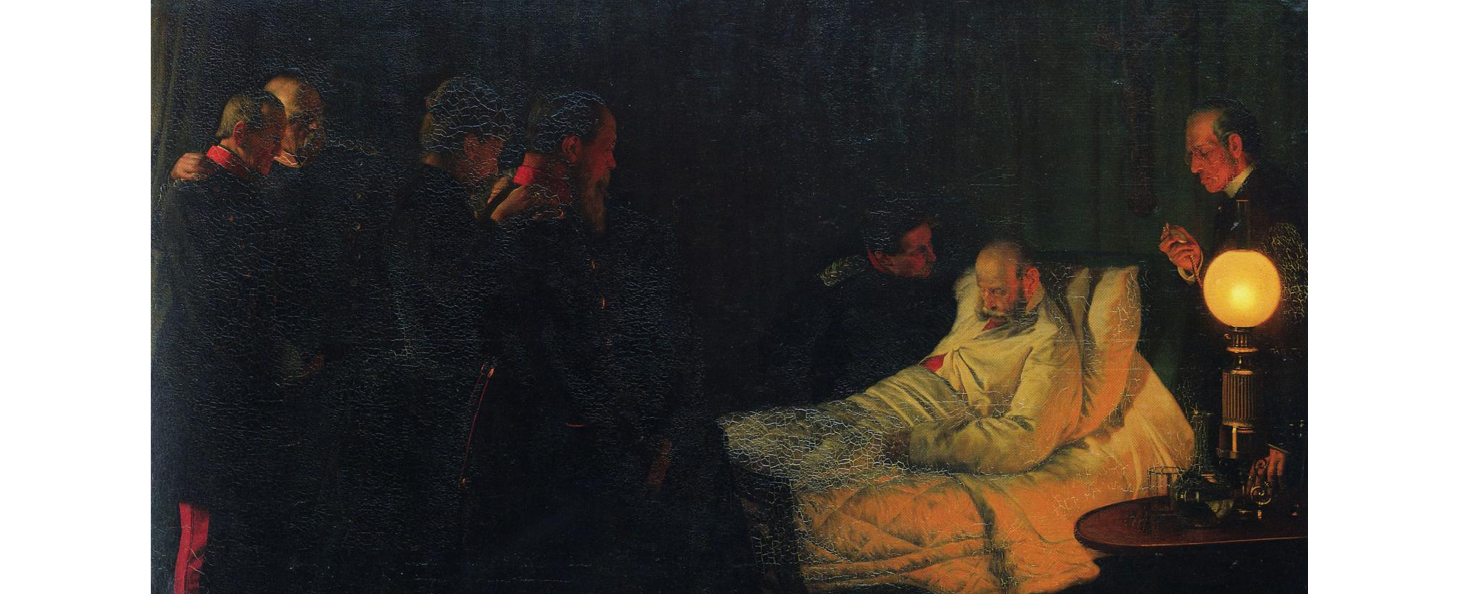
Shortly before William's death on 9 March 1888, the final encounter between him and Bismarck took place in his bedroom at the Old Palace Unter den Linden in Berlin. In the course of this encounter the emperor is said to have told Bismarck: "It was not always easy to be emperor under you." This remark was first reported by the Reichstag deputy Ludwig Bamberger (1823–1899) in 1899 — more than ten years after William's death. To quote Giordano Bruno (1548–1600): "Se non è vero, è ben trovato!" — "Even if it is not true, it is well invented." William I remained throughout his life a Calvinist-formed, devout soldier — firmly rooted in the divine right of kings and convinced that divine providence and human history were inseparably bound together.
Image caption
Anton von Werner: Emperor William I on his deathbed, 9 March 1888, painting 1898.
Bibliography
- Bismarck, Otto von: Gedanken und Erinnerungen. Essen 1990.
- Fischer, Robert-Tarek: Wilhelm I. Vom preußischen König zum ersten Deutschen Kaiser. Cologne 2020.
- Herre, Franz: Kaiser Wilhelm I. Der letzte Preuße. Cologne 1980.
- Markert, Jan: Der verkannte Monarch. Wilhelm I. und die Herausforderungen wissenschaftlicher Biographik. In: Forschungen zur Brandenburgischen und Preußischen Geschichte. New Series 31 (2021), pp. 231–244.
- Markert, Jan: Ein System von Bismarcks Gnaden? Kaiser Wilhelm I. und seine Umgebung – Plädoyer für eine Neubewertung monarchischer Herrschaft in Preußen und Deutschland vor 1888. In: Pyta, Wolfram, and Voigt, Rüdiger (eds.): Zugang zum Machthaber (Staatsverständnisse 171). Baden-Baden 2022, pp. 127–156.
- Markert, Jan: Wilhelm I.: Vom "Kartätschenprinzen" zum Reichsgründer. Berlin 2024. (Schneider, Louis:) Erdient und Verdient! – Die Orden, militärischen Ehrenzeichen und Kriegs-Denkmünzen Seiner Majestät des Deutschen Kaisers und Königs von Preußen Wilhelm I. Berlin 1875.
- Schulze-Wegener, Guntram: Wilhelm I. Deutscher Kaiser, König von Preußen, Nationaler Mythos. Hamburg and Bonn 2015.
- Siemann, Wolfram: Gesellschaft im Aufbruch. Deutschland 1849–1871. Frankfurt am Main 1990.
- Walter, Dierk: Der Berufssoldat auf dem Thron. Wilhelm I. (1797–1888). In: Walter, Dierk, Förster, Stig, and Pöhlmann, Markus (eds.): Kriegsherren der Weltgeschichte. 22 historische Porträts. Munich 2006, pp. 217–233.
- Weber, Rita: Wilhelm I. Nicht zum König geboren. Nicht zum König erzogen. In: Weinland, Martina (ed.): Im Dienste Preußens. Wer erzog Prinzen zu Königen? Berlin 2001.
- Various pages from de.wikipedia, en.wikipedia, and fr.wikipedia.