

Friedrich Wilhelm Viktor Albert, Prince of Prussia, was born on 27 January 1859 at the Crown Prince's Palace in Berlin as the eldest son of the future Emperor Frederick III and his wife Princess Victoria of Great Britain and Ireland.
The complicated breech birth of the prince necessitated the intervention of Professor Dr Eduard Arnold Martin (1809–1875) as well as emergency measures involving chloroform. As a consequence, a paralysis of the left arm and a torticollis developed. The causes were already the subject of controversy among contemporaries.
Initially Wilhelm received instruction in the Evangelical-Union faith and was taught reading and writing, French, history and geography, music, and drawing. From 1866 until Wilhelm's coming of age in 1877, his upbringing was largely taken over by the Reformed educationalist Dr Georg Ernst Hinzpeter (1827–1907), who applied a strictly authoritarian concept that was, however, widely regarded as unsuccessful and left a lasting mark on the heir apparent's personality. Hinzpeter provided instruction in religion, German, French, English, and Latin, in history, mathematics, and physics, and in political science and constitutional theory. From 1874 Wilhelm attended the Fridericianum (today the Friedrichsgymnasium) in Kassel, where he passed his Abitur on 20 January 1877.
Image caption
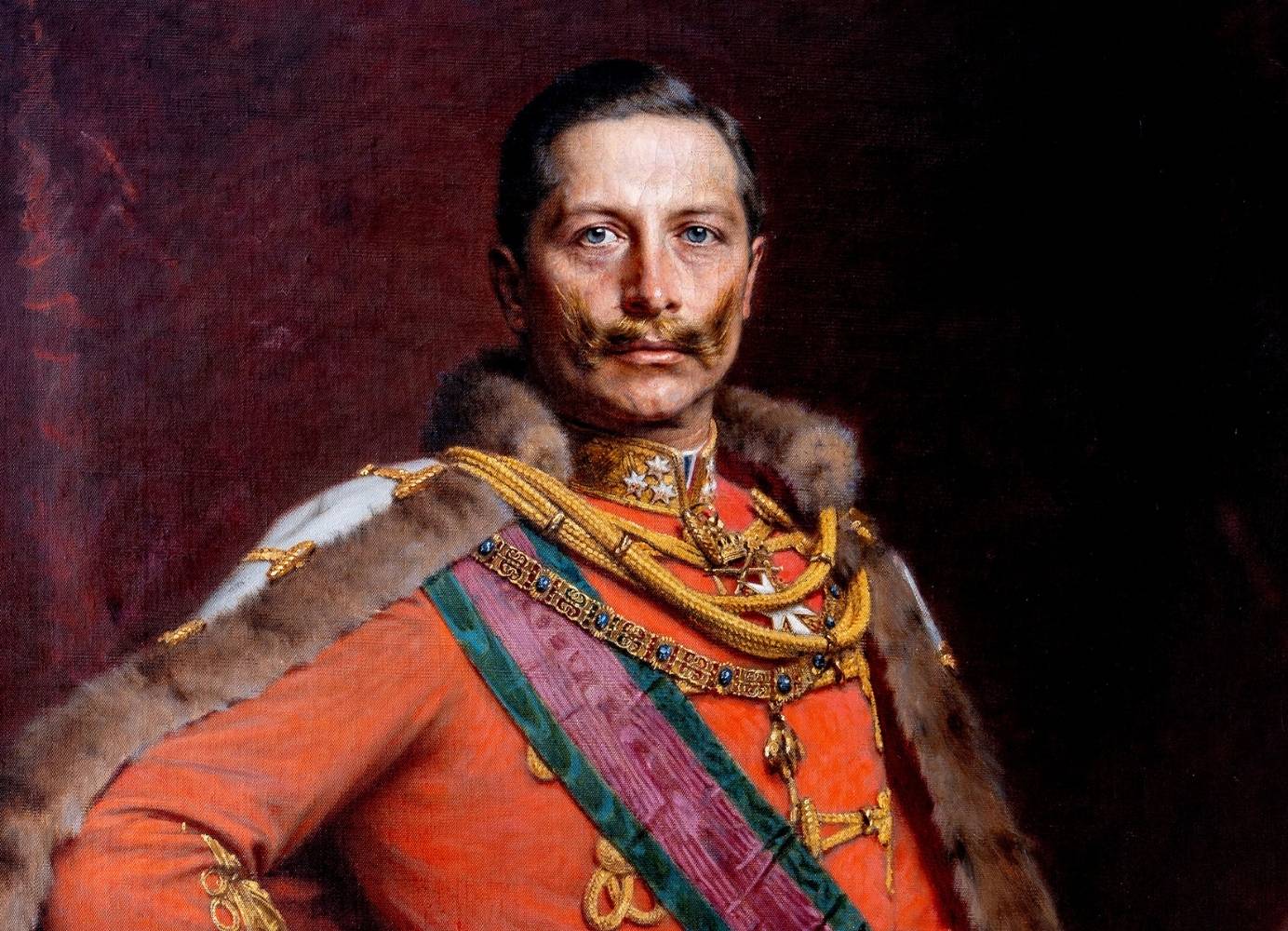
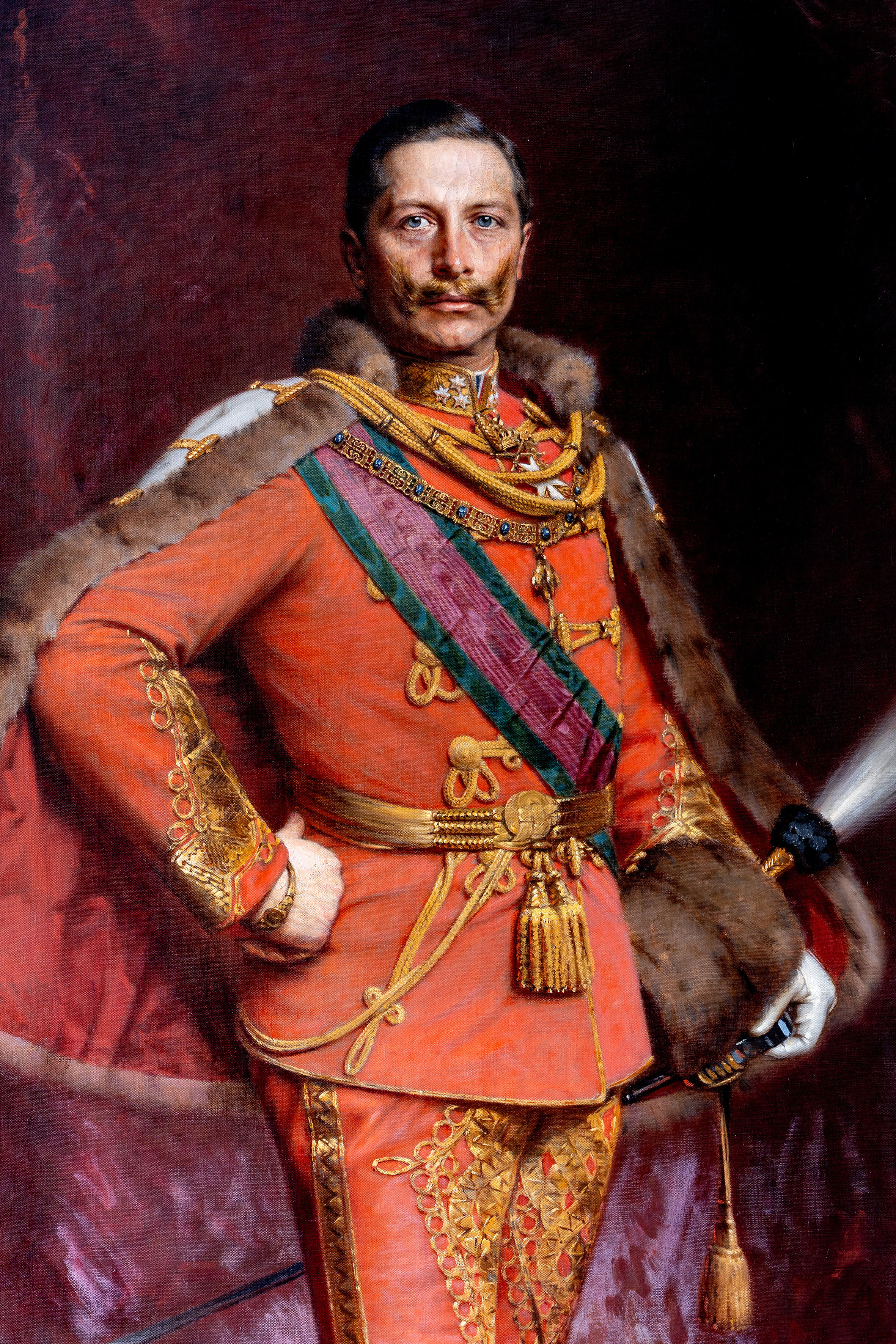
Arthur von Ferraris: Emperor William II in the full dress uniform of the Royal Hungarian Generals, painting 1898.
Under various officers, Prince William received extensive instruction in both theoretical and practical military subjects. On 27 January 1877, his eighteenth birthday, he was appointed second lieutenant in the 1st Foot Guard Regiment, where on 9 February he began his effective military service in the 6th Company under Captain Ernst Karl Gustav von Petersdorff (1841–1903).
On 27 April 1881 he married in Berlin Princess Auguste Viktoria of Schleswig-Holstein-Sonderburg-Augustenburg (1858–1921), to whom he had been engaged since 1880. With her he had six surviving sons — Crown Prince Wilhelm (1882–1951) and the Princes Eitel Friedrich (1883–1942), Adalbert (1884–1948), August Wilhelm (1887–1949), Oskar (1888–1958), and Joachim (1890–1920) — as well as the daughter Princess Viktoria Luise (1892–1980), who became from 1913 the last Duchess of Brunswick.
Until 1888 the prince was assigned to various Guard units, most recently as commander of a brigade; his rapid military career was supplemented by repeated periods of leave for administrative training, but remained fragmentary given the political circumstances. The governmental structure continued to be decisively shaped by the Prussian Minister President and Reich Chancellor Prince Otto von Bismarck (1815–1898), who held central political control and sought to assert his influence under the new emperor as well.
Following the death of his father Emperor Frederick III on 15 June 1888, William II ascended the German-Prussian throne at the age of only 29.
His thirty-year reign was characterised by the ambition to establish the German Empire as a great power. This was accompanied by military rearmament, expansive colonial policy, and an increasingly confrontational foreign policy — particularly towards the British Empire — with misjudgements and incoherent decisions contributing to international isolation. At the same time, a demonstrative military orientation led to the deep social entrenchment of militaristic norms, in which rank and military service constituted central criteria for social advancement.
Economic and technological progress encouraged a pronounced faith in progress. In social policy, William II built on Bismarck's reforms without, however, bringing about structural changes or democratisation; monarchical decision-making power remained dominant. His personal rule proved inconsistent and heavily dependent on shifting influences.
In domestic politics, structural deficiencies of the political system and conflicts between the parties prevented stable governmental conditions. Social policy initiatives remained only marginally effective and could neither achieve the political integration of the working class nor halt the rise of Social Democracy. Overall, William's reign appears characterised by surges of modernisation alongside political backwardness, institutional weakness, and misdirected foreign policy.
During the July Crisis of 1914, William II acted contradictorily: while he made efforts at de-escalation through personal diplomacy, he simultaneously promoted escalation by effectively backing Austro-Hungarian policy. This approach accelerated the intensification of the crisis and contributed substantially to the outbreak of war. Strategic misjudgements — particularly regarding Russia and Pan-Slavism — reinforced the dynamic.
With the outbreak of war, decision-making power shifted rapidly to the military leadership; political control was abandoned in favour of operational logic. William's public statements served primarily to mobilise and propagandistically unify public opinion — the so-called Burgfrieden — while his actual capacity for influence diminished. By 1916 at the latest, he was largely marginalised by the Supreme Army Command under Field Marshal Paul (von Beneckendorff und) von Hindenburg (1847–1934) and Quartermaster General Erich Ludendorff (1865–1937); the governmental system took on the characteristics of a military dictatorship. Key decisions — such as the resumption of unrestricted submarine warfare, to which he had in fact been openly opposed — he took in accordance with the military's wishes, with far-reaching consequences including the entry of the United States of America into the war on 6 April 1917.
William's expansive and at times unrealistic war aims — extensive annexations, satellite states in Eastern Europe, and major colonial gains — remained largely without political consequence, since his actual capacity for control was limited. Overall, the war period is characterised by a progressive loss of power on the part of the emperor, accompanied by a radicalisation of objectives and the structural dominance of military decision-making bodies.
Following the military collapse of 1918, the Supreme Army Command initiated the transition to armistice negotiations and parliamentarisation. Under the influence of American President Woodrow Wilson (1856–1924), William II's abdication became a central precondition for a peace settlement. At the same time, the domestic political situation radicalised: revolutionary unrest, the Kiel mutiny, and pressure from the majority parties made the continuation of the monarchy impossible.
In this situation the emperor effectively lost all capacity for action. Military options — such as action against the revolution — foundered on the lack of loyalty among the troops, while alternative scenarios remained politically unrealistic. On 9 November 1918, his abdication was proclaimed unilaterally by Reich Chancellor Prince Max of Baden, the last heir to the Baden throne (1867–1929, Reich Chancellor 1918), in parallel with the proclamation of the Republic. William thereupon withdrew into Dutch exile on 10 November 1918.
The formal abdication took place on 28 November 1918 at Amerongen Castle near Utrecht and sealed the end of the monarchy. This phase marks in its entirety the complete collapse of imperial rule, brought about by military defeat, political delegitimisation, and revolutionary pressure.
The Netherlands refused in 1920 to extradite William II to the Allies as demanded. From 1920 he lived at Huis Doorn near Utrecht, which he had purchased, where he was treated de facto as an internee. Here his thinking radicalised, particularly through antisemitic and conspiracy-ideological interpretations of his downfall. During the Second World War he remained passive and responded opportunistically to German successes. His years of exile were overall marked by political irrelevance, ideological rigidity, and illusory aspirations to restoration. With the occupation of the Netherlands by the German Wehrmacht in May 1940, the Huis Doorn estate was cordoned off by the Secret Field Police; William II remained there as an internee — now of the Germans.
On 4 June 1941, William II died at Huis Doorn at the age of 82 at 12.30 p.m., from a pulmonary embolism. He was initially interred in the smallest of circles — family and a few former officers — in a chapel near the Doorn gatehouse, and was later transferred to the mausoleum he had planned, erected in the park of Huis Doorn, where he rests to this day.
William II grew up under emotionally burdensome conditions and with a physical disability, which presumably fostered insecurity, susceptibility to offence, and compensatory self-presentation; psychiatric diagnoses remain contested. His personality was characterised by impulsivity, a need for recognition, and limited empathy. He frequently intervened directly in politics, preferred military milieus, and showed little consistency in personnel matters. A talent for public self-presentation made him a media monarch, but also led to political missteps. An urge for self-dramatisation and a lack of consistency in judgement characterise his conduct overall.
Bibliography
- Clark, Christopher: Wilhelm II. Die Herrschaft des letzten deutschen Kaisers. Translated from the English by Norbert Juraschitz and Thomas Pfeiffer. Munich 2008.
- König, Wolfgang: Wilhelm II. und die Moderne. Der Kaiser und die technisch-industrielle Welt. Paderborn et al. 2007.
- Krockow, Christian, Count von: Kaiser Wilhelm II. und seine Zeit. Berlin 1999.
- Röhl, John C. G.: Wilhelm II. Vol. 1: Die Jugend des Kaisers, 1859–1888. 2nd edition, Munich 2001. Vol. 2: Der Aufbau der Persönlichen Monarchie, 1888–1900. Munich 2001. Vol. 3: Der Weg in den Abgrund, 1900–1941. Munich 2008.
- Röhl, John C. G.: Wilhelm II. Munich 2013.
- Schönberger, Paul and Schimmel, Stefan: Kaisertage – Die unveröffentlichten Aufzeichnungen (1914 bis 1918) der Kammerdiener und Adjutanten Wilhelms II. Constance 2018.
- Various pages from de.wikipedia, en.wikipedia, and fr.wikipedia.