


On numerous occasions, Künker has had the privilege of preparing and offering its clients significant and interesting collections of Saxon coins for its auctions. Thus, on March 19, 2026, in our Auction No. 441, collectors were able to acquire coins minted in Gotha from the small but exquisite collection of Dr. Wolfgang Kümpfel for their own collections. On the night before the auction, our Scientific Consultant, Professor Johannes Nollé, gave a well-attended lecture that shed light on the history of the Saxons from antiquity to modern times, outlining the migration of the Saxon name from the mouth of the Elbe to England, Lower Saxony, and Westphalia, as well as to Saxony-Anhalt and the present-day federal states of Saxony and Thuringia.
The speaker focused in particular on the numerous partitions of the estate that increasingly fragmented the Duchy of Saxony. This applies especially to the Ernestine line, which emerged from the 1485 partition of the duchy in Leipzig; unlike the Albertines, the Ernestines did not establish primogeniture, under which the firstborn son inherited the undivided territory. Since the Ernestines, as staunch supporters of the Reformation, dared to oppose the Catholic Emperor Charles V at the Battle of Mühlberg in 1547, they lost the Saxon electoral title to the Albertine dynasty. Furthermore, the Ernestines were confined to Thuringia and the adjacent Franconian possessions of the Saxons. In the period that followed, through consistent divisions of the inheritance, they transformed Thuringia into a region dotted with small Saxon states. Constant territorial changes ensued, as several lines died out and their territories fell to other Saxon ducal houses. It is an ironic twist of history that one of these small states, the House of Saxe-Coburg and Gotha, despite its small size and insignificance, was able to rise to become one of the most important princely houses in Europe in the first half of the 19th century, as its members married into the most distinguished ruling houses of Europe or became regents.
Queen Victoria of England, whose mother was a princess of Saxe-Coburg-Saalfeld, married her cousin Prince Albert of Saxe-Coburg and Gotha in 1840. Saxe once again played an important role in England. The marriage of Victoria and Albert had been arranged by Leopold I, who was also a prince of Saxe-Coburg and Gotha and had ascended the Belgian throne in 1830.
For anyone who would like to relive the lecture or view it for the first time, a recording is available here. The lecture was held in German.
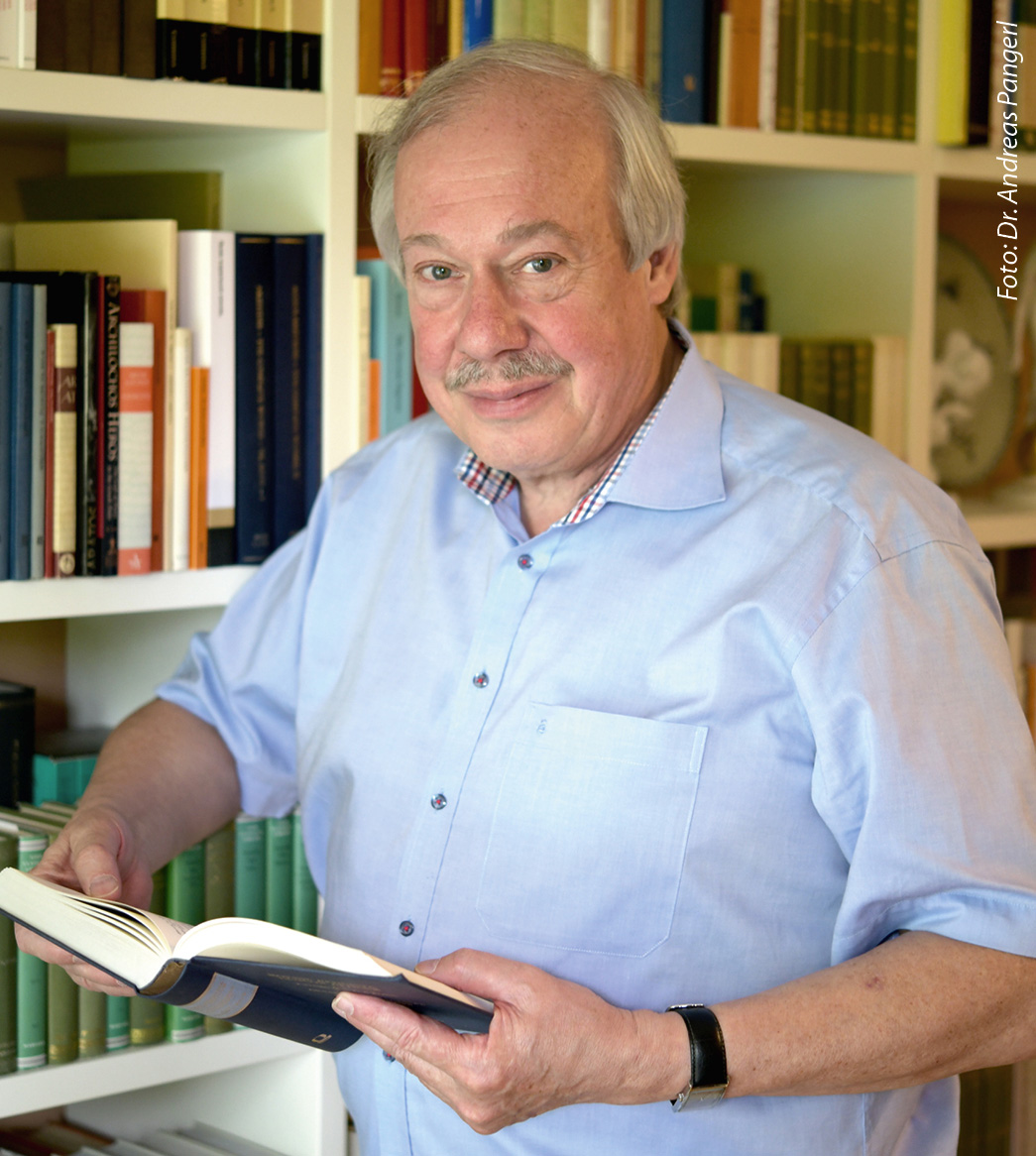
Professor Dr Johannes Nollé
was born in Aachen in 1953. Having finished high school he studied history, German language and literature, paedagogics and politics at Aachen University, classical philology, ancient history and archaeology at Cologne University. He earned his doctorate at Cologne University in 1981. After his habilitation at Bremen University and habilitation recognition at the Ludwig Maximilians-University in Munich he was appointed associate professor in 1998. From 1985 to 2014 he was a research scholar of German Archaeological Institute at the Commission for Ancient History and Epigraphy in Munich. He has been a scientific consultant for our company since 1st of July, 2019.