

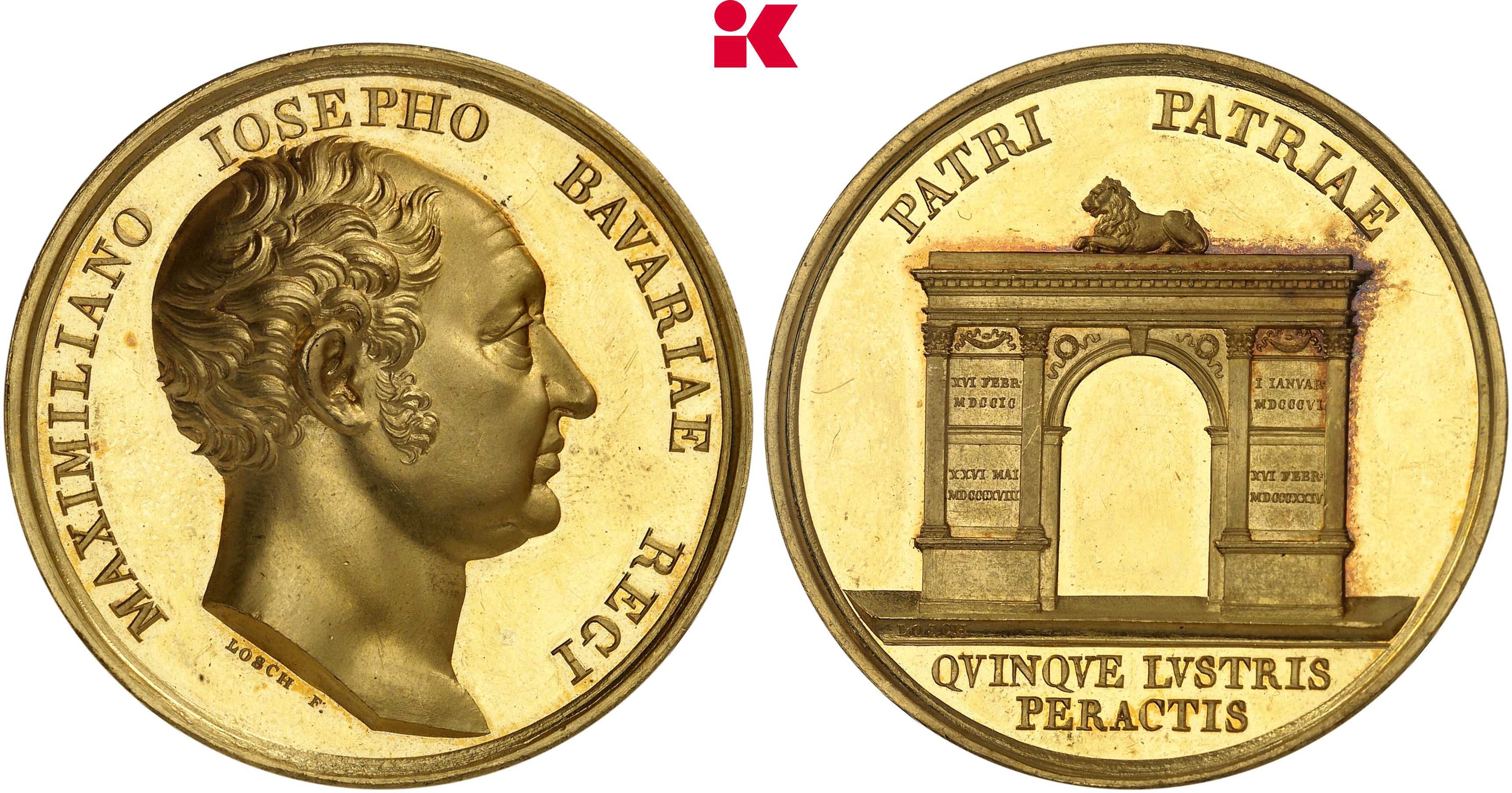
The medal commemorating the 25th jubilee of his reign designates Maximilian I Joseph on the reverse as Father of the Fatherland (pater patriae); on the triumphal arch, crowned by the Bavarian lion, four dates are inscribed.
16 February 1799 – Assumption of Rule
On 16 February 1799, the Bavarian Elector Charles Theodore (1742/1777–1799) died without heirs. Maximilian Joseph, as Duke of Zweibrücken, was his closest relative. Nevertheless, it was worth acting swiftly — and this was possible for him, since Charles Theodore's widow, Maria Leopoldina of Austria-Este, had notified him without delay. He was thus able to assume his inheritance without difficulty and became Elector of Bavaria as Maximilian IV Joseph. In his early years of rule, he steered the country forcibly into the modern era with the help of his minister Montgelas — through secularisation, tax reform, army reform, and the introduction of military conscription.
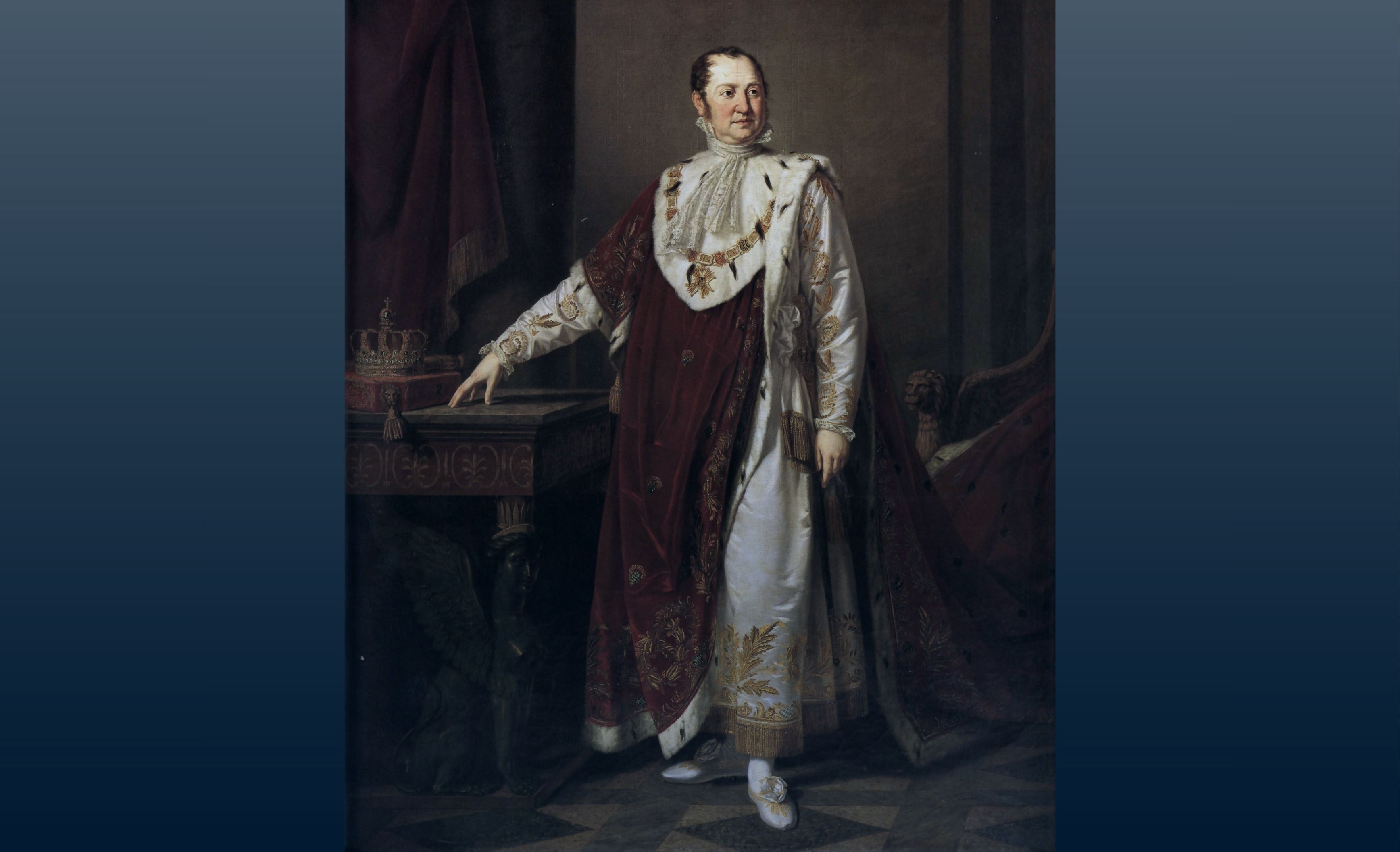
Image caption: Moritz Kellerhoven: King Maximilian I Joseph of Bavaria, painting 1806.
1 January 1806 – King of Bavaria
In his youth he had already served in the French army, and so he did not shy away from an alliance with France in 1805. This initially brought him several advantages of a territorial nature — Ansbach, Tyrol, Vorarlberg — as well as elevation in rank to King of Bavaria. As king he took the name Maximilian I Joseph. The tide turned in the Russian campaign, when of the 38,000 Bavarians who had set out, barely 2,297 soldiers returned. When the Allies threatened Bavarian territory, Max I switched to the Allied camp ten days before the Battle of the Nations at Leipzig in 1813 and abandoned the alliance with Austria and France. He had thus changed sides just in time to be adequately compensated at the Congress of Vienna for the loss of Tyrol and Vorarlberg.
26 May 1818 – Constitution
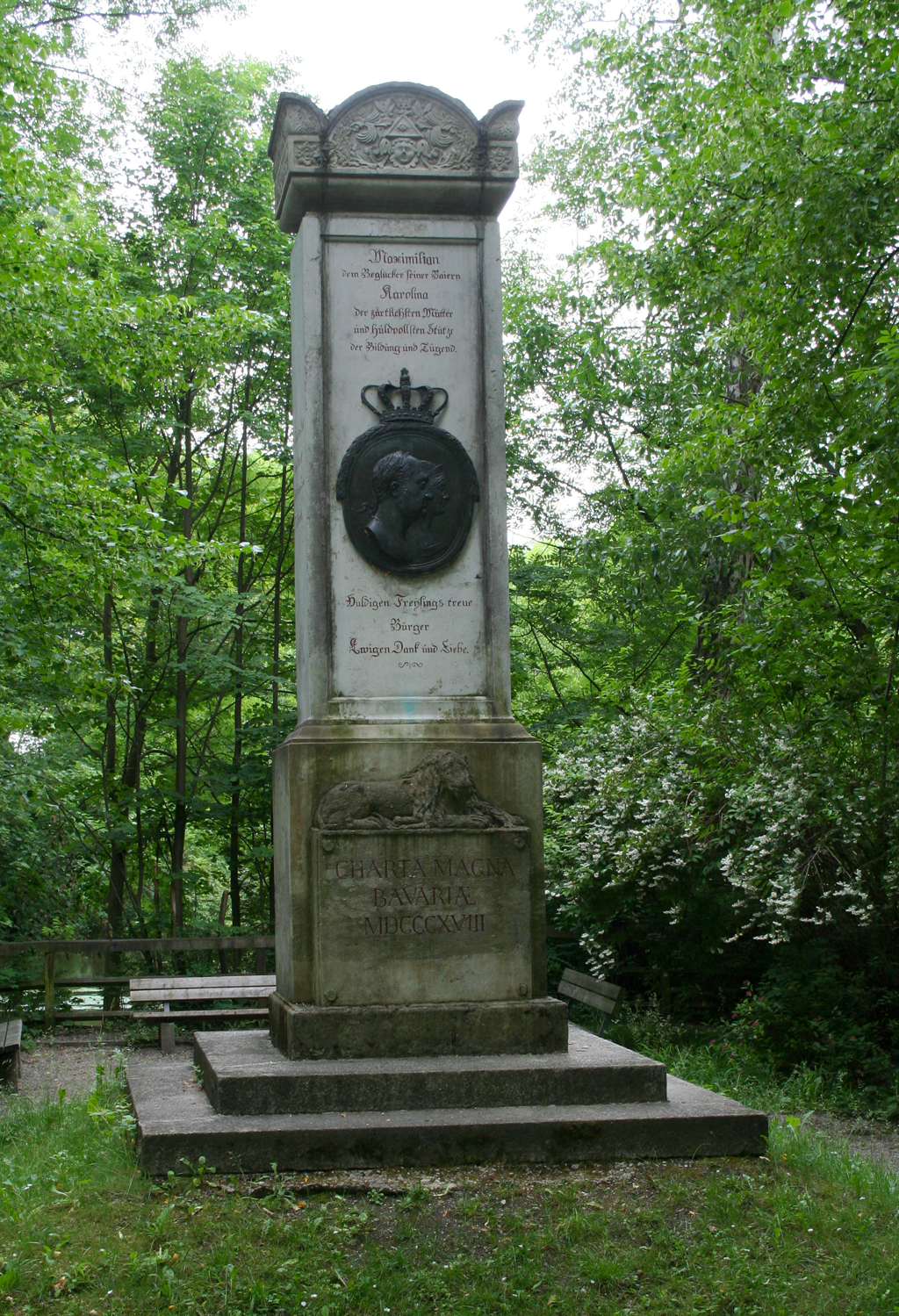
As the first of the five kings in Germany and the eighth state of the German Confederation to do so, Maximilian I issued a written constitution. This built upon the first constitution of 1808, drawn up when the kingdom sought to unite its new territories into a cohesive whole — at that time Bavaria had been able to pre-empt a constitution imposed by France. In 1818, it was now the threat of a federal constitution by the Austrian Chancellor Metternich that accelerated the work. The Bavarian constitution contained a progressive catalogue of fundamental rights and divided the assembly of estates into two chambers, whose consent would henceforth be mandatory for the passage of laws. Bavaria thereby became a constitutional monarchy.
Image caption: Ingrid Glatt: The Königsstein near Freising, photograph 2007.
16 February 1824 – 25th Jubilee of Rule
Even though at the beginning of his reign he had forced modernity upon Bavaria through his reforms, the king — who liked to present himself as close to the common people, walking through Munich mostly on foot and with few attendants, conversing freely with his subjects — was regarded at his 25th jubilee of rule as "the good father Max," as the reverse legend of the medal expresses it in Latin. A number of monuments were erected in his honour, among them the Königsstein near Freising, which commemorates both the jubilee of his reign and the constitution.