

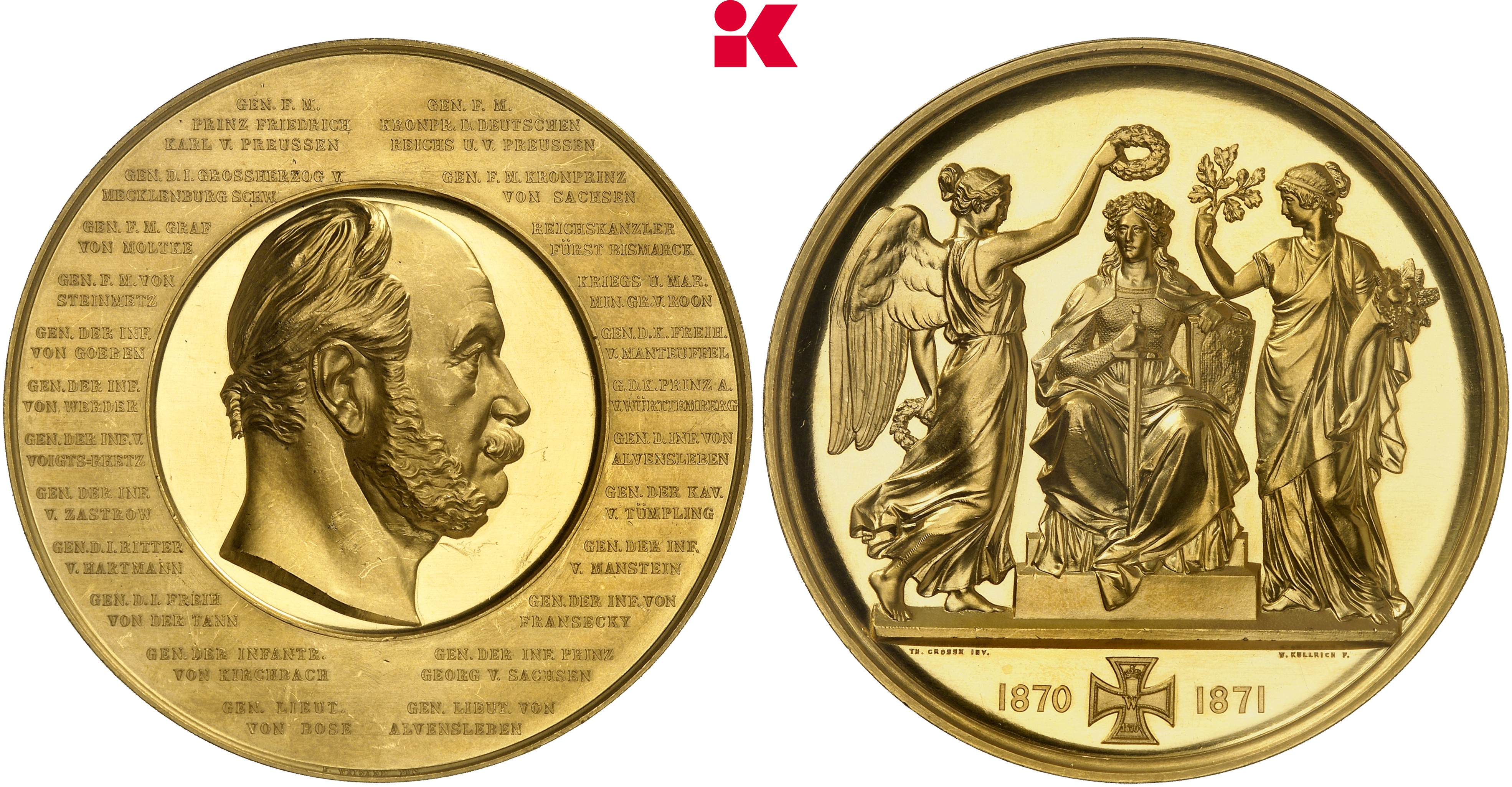
William I commissioned 25 examples of the "Generals' Medal" at 120 ducats each, in order to present them to those who, in his eyes, had made possible the victory over France and thereby the unification of Germany. The "Generals' Medal" is thus a central document of German history. And yet this medal is only a tiny component — a small contemporary witness — of an elaborately staged spectacle.
The Berlin Victory Parade on 16 June 1871
At its centre stood the victorious army, to which the German civilian population paid tribute for its victory. In many towns and villages, 16 June 1871 was a day of celebration — even if the central victory parade was naturally reserved for the new capital, Berlin.
The date had been carefully chosen: exactly five years earlier, the Prussian army had marched into Saxony, Hanover, and Hesse. This had escalated the conflict between Prussia and Austria over supremacy in the German Confederation. In just five years, the political duo of Bismarck and William I had succeeded in forging a powerful empire from many small states. A united Germany had brought the overpowering France to its knees militarily. For many, this victory marked the end of a trauma that had begun with the occupation of Germany by Napoleon. This aspect was emphasised in many details of the triumphal procession.
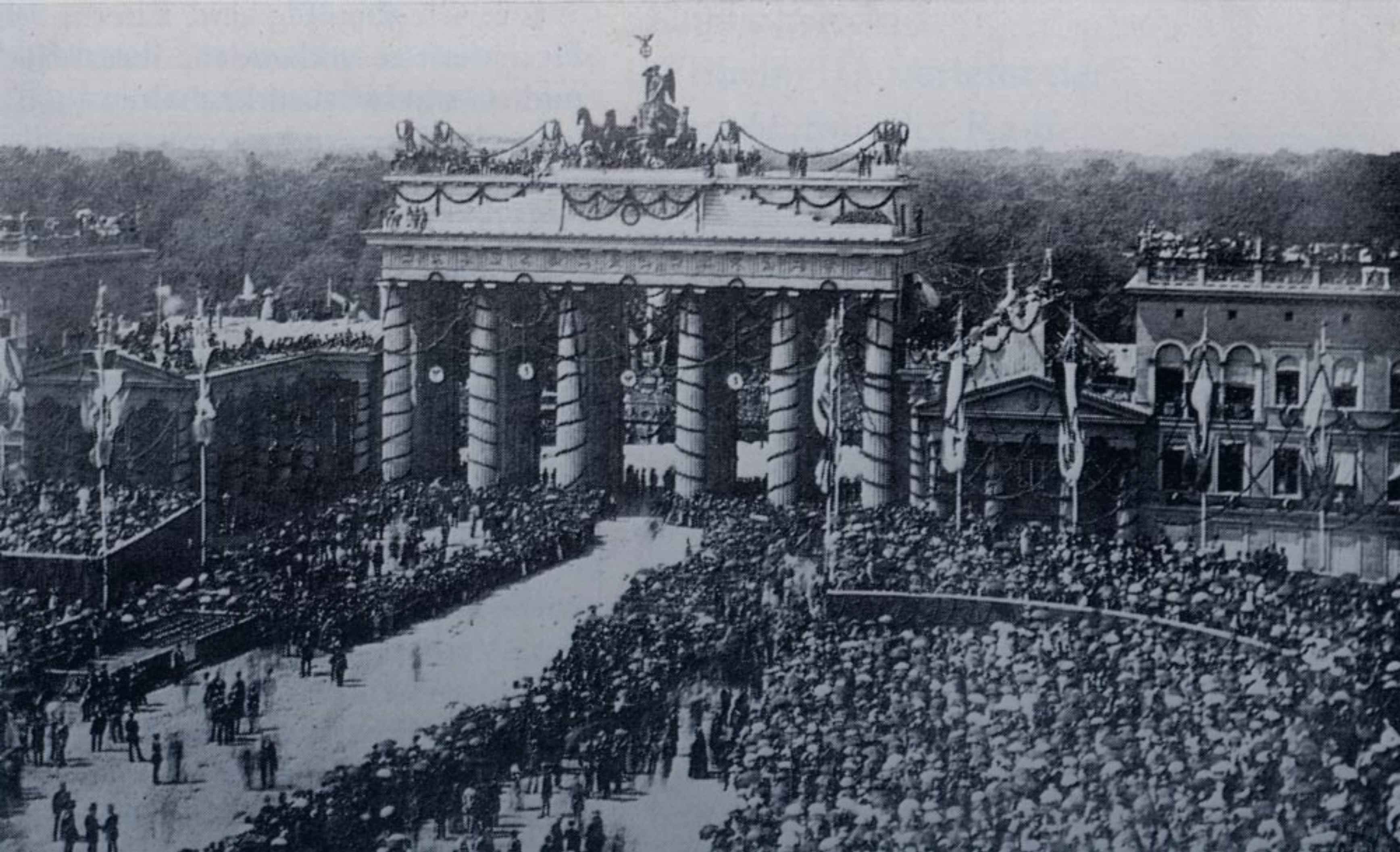
And so 40,000 soldiers, representing the entire army, marched in a triumphal procession through Berlin — from the Hallesches Tor through the Brandenburg Gate, past the royal palace, to the Lustgarten. The central ceremony took place on the Pariser Platz, which bore its name in commemoration of the capture of Paris during the Wars of Liberation in 1814.
Every individual soldier who participated in the victory parade received a gift. The ordinary soldiers received one thaler, the non-commissioned officers two, and the people of Berlin collectively ensured an abundant supply of food.
Image caption: Unknown photographer: The Brandenburg Gate decorated for the occasion, ready for the triumphal procession of the returning troops after the Franco-Prussian War, photograph 1871.
The Generals at the Head of the Troops
At their head rode "Papa Wrangel," Prussian Field Marshal and veteran of the Wars of Liberation. The venerable gentleman was already 87 years of age at the time of the triumphal procession and was no longer part of the active generalship, and therefore received no medal.
He was followed by the officers of the War Ministry and the General Staff, the members of the medical service, the adjutants, and the military governors.
Only now came, mounted on horseback and acclaimed by the entire population, the commanding generals listed on the Generals' Medal. They rode in a precisely determined order, which is reflected in the listing of their names and offices on the medal.
Simply put: the higher the rank, the higher the person's name appears on the medal. In the procession itself the order was reversed, in accordance with military ceremonial: the most senior military figures rode last in the column.
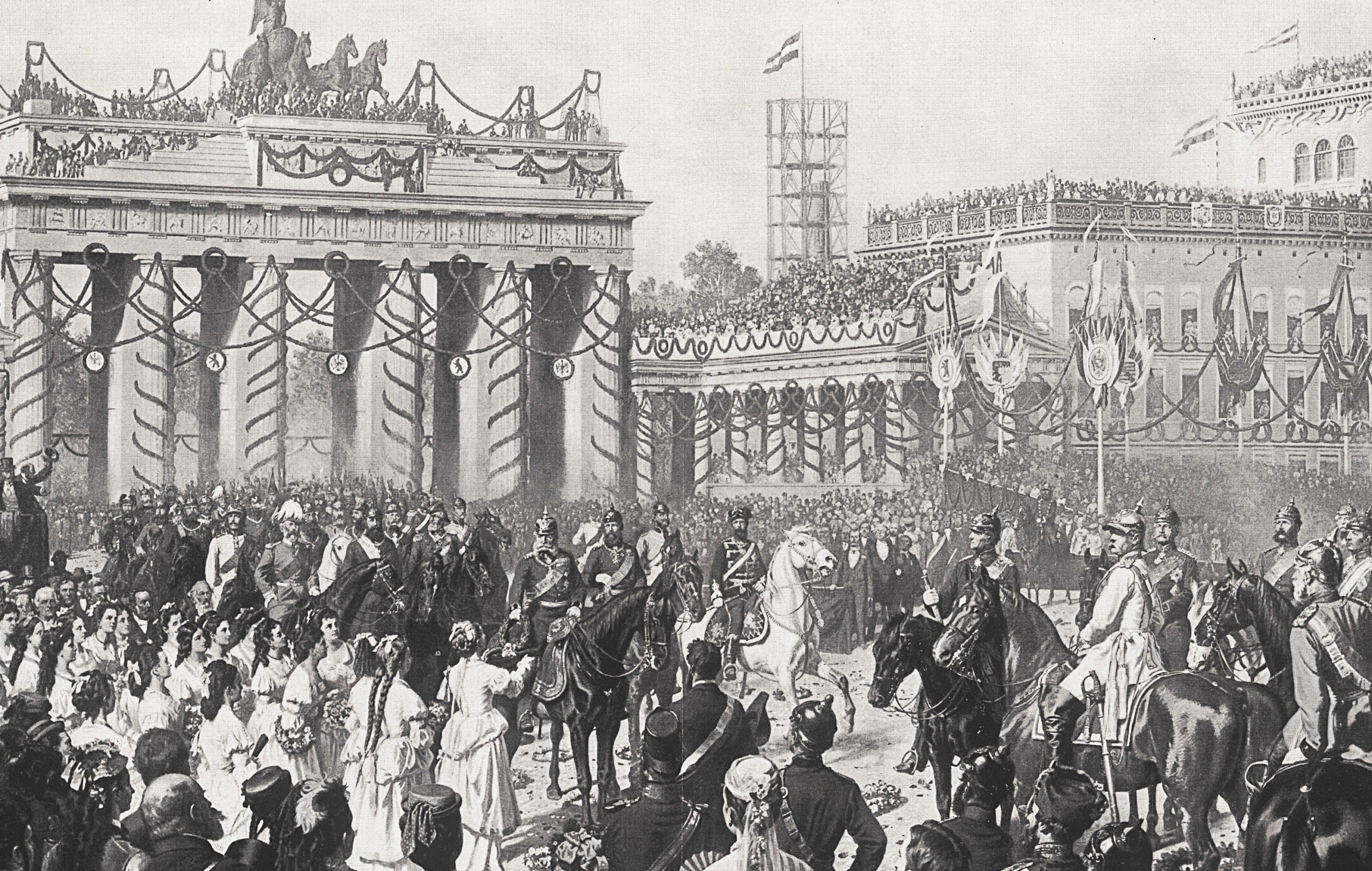
Riding ahead was the group of commanding generals in the following order
- General of Infantry Prince George of Saxony
- General of Infantry von Alvensleben
- General of Infantry von Voigts-Rhetz
- General of Cavalry von Tümpling
- General of Infantry von Zastrow
- General of Infantry von Manstein
- General of Infantry von Hartmann
- General of Infantry Baron von der Tann
- General of Infantry von Fransecky
- General of Infantry von Kirchbach
- General of Infantry von Werder
- Lieutenant General von Bose
- Lieutenant General von Alvensleben
- Frederick Francis, Grand Duke of Mecklenburg-Schwerin
- Albert, Crown Prince of Saxony
- Field Marshal von Steinmetz
- General of Cavalry Baron von Manteuffel
An Honour in the Form of a Medal
While ordinary soldiers and non-commissioned officers received their thalers pressed into their hands, William I presented the commanding generals with a numismatic treasure in the form of an exclusive gold medal weighing 120 ducats, of which he had only 25 examples made: 24 for the politicians and military figures centrally involved in the victory, and one for the supreme commander-in-chief Emperor William I himself. It is precisely this example — belonging to the supreme commander — that is being auctioned here.
The New Germany: Bourgeois and Militarily Strong
The design of the reverse was created by the Dresden sculptor and history painter Franz Theodor Grosse. It is worth examining his Germania more closely. Like many other allegorical figures of the period, she bears weapons — including a sword and a shield, which is cleverly turned so that the viewer may decide for themselves whether to recognise on it the Hohenzollern eagle or the double-headed imperial eagle. Remarkable is the chain mail beneath the imperial purple mantle in which the artist has clothed the personification of Germany. Even the peacefully enthroned Germania remains vigilant and prepared for defence.
Germania is crowned not with the victor's laurel, but with oak leaves, which appear several times in the reverse design. Thus the winged Victoria brings Germania wreaths of oak leaves — not, as might be expected, of laurel; and Fortuna extends to Germania an oak branch rather than the customary olive branch.
One might of course point to the oak as the quintessentially German tree, but that would be too superficial a reading. Viewers of the time, thoroughly versed in classical literature and Roman history, would have been immediately reminded of Emperor Augustus. The Senate had awarded him the golden civic crown to thank him for bringing the civil wars to an end. Through this imagery, the viewer automatically associated the idea that Germania too would bring all civil wars between the German states to an end.
The Iron Cross, which with its two dates refers to the Franco-Prussian War, recedes entirely into the background visually.
Contemporary Interpretation and Historical Reality
We know today what consequences the Franco-Prussian War was to have. Its contemporaries, of course, did not. The times then permitted an optimistic view of the future. And so one of them described the six-metre-high Germania that had been erected directly in front of the Berlin Palace: "United Germany, restored within its ancient borders, having become conscious of its strength in unity, is the prize of battle with which Providence has blessed the efforts and sacrifices of princes and peoples in the service of the common beloved fatherland."